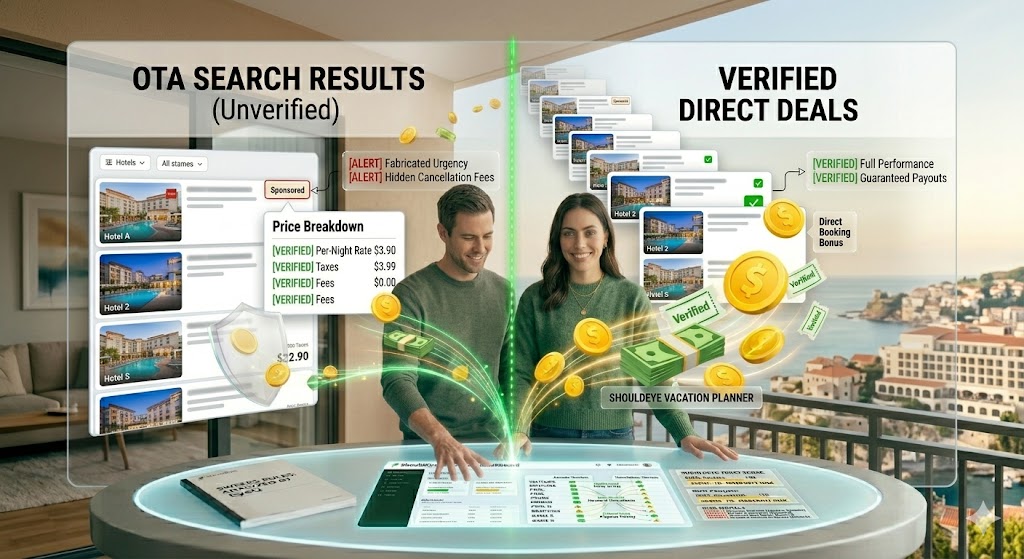
A vibrant hero image of a couple standing on a hotel balcony overlooking a coastal resort, using a digital "ShouldEye Vacation Planner" to compare unverified OTA search results—flagged with alerts for fabricated urgency and hidden fees
PhotogeminiSponsored Hotels vs Best Match: How Booking Results Can Mislead You
Learn how sponsored hotel listings and best‑match rankings can trick travelers. Get verification tips, spot hidden fees, and use ShouldEye to stay safe.
Travelers trust hotel search pages to surface the right options, but the way results are ordered can hide hidden incentives. A listing that looks like the "best match" might actually be a paid placement, while the price you see at first glance can be a carefully crafted total that masks per-night costs, hidden fees, or urgency cues. In this guide, we break down the tactics behind Sponsored Hotels vs Best Match, show you what to verify before you click "Book now," and explain how ShouldEye and EyeQ can give you a safety net in the 2026 travel landscape.
As the mobile booking economy dominates over 60 percent of all travel revenue this year, the pressure on Online Travel Agencies (OTAs) to convert users quickly has never been higher. This speed often comes at the expense of transparency. Understanding the logic behind the "Sort by" dropdown is no longer a luxury; it is a financial necessity.
What "Sponsored" Means on Hotel Search Pages
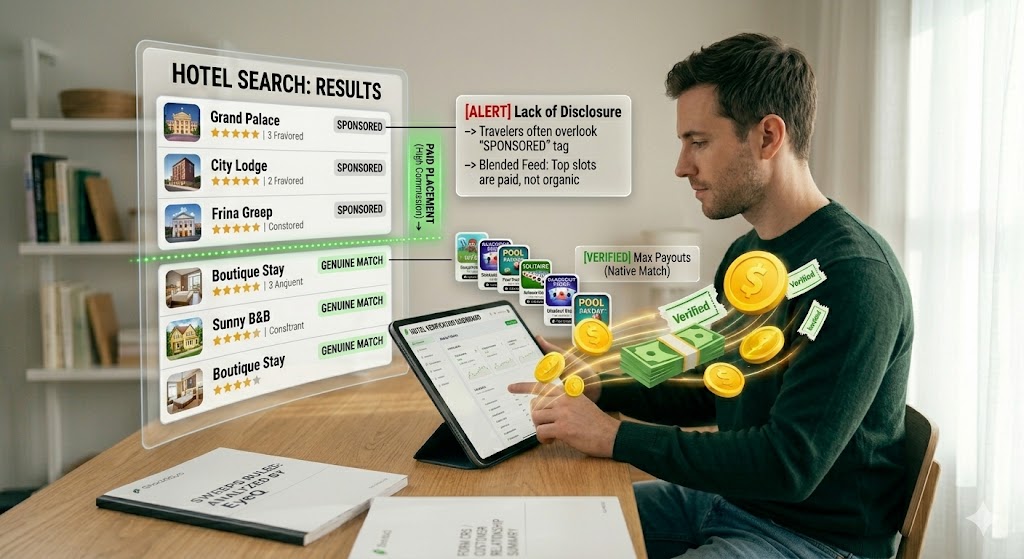
Most online travel agencies earn revenue not only from booking commissions but also from sponsored placements. A hotel can pay a higher fee to appear near the top of the list, regardless of price, location, or actual guest ratings. The result is a blended feed where the first few rows may be paid rather than organic.
Industry data in 2026 shows a significant commission-driven ranking shift. Platforms like Hostelworld and major OTAs have refined these tactics, often placing high commission properties in prime "above the fold" real estate. The lack of disclosure remains a primary concern. While some sites use a small "Ad" or "Sponsored" tag, many travelers overlook these markers in favor of the property's photo or review score. The exact proportion of search results that are sponsored is not publicly disclosed, making it hard for a traveler to know when they are seeing a paid slot versus a genuine recommendation.
The "Best Match" Algorithm and Its Hidden Biases
"Best match" is a proprietary ranking that promises to show the most relevant hotels based on your dates, location, and preferences. In practice, the algorithm can be nudged by the same commissions that power sponsored slots. Two common ways the bias shows up are price presentation and social proof cues.
The algorithm is often tuned to favor hotels that provide the OTA with a higher profit margin. If two hotels are identical in rating and price, the one paying a 20 percent commission will almost always outrank the one paying 15 percent in a "Best Match" search. This is a subtle but effective way of steering consumer behavior without ever explicitly labeling a post as an advertisement.
Total Cost vs Per Night Price
A major point of confusion in 2026 is how platforms like Booking.com display prices. Many now display the total cost of all nights in the search results instead of a per-night price. This can make a property look cheaper at a glance, especially when the stay spans multiple nights with varying rates.
Travelers who compare listings side by side may miss the fact that a hotel with a higher per-night rate could actually be cheaper overall once taxes and fees are added. Conversely, a low "lead-in" price on a total cost display might hide a massive jump in price for the final night of a weekend stay. Without a clear per-night breakdown, the user is left to do the math manually or risk an expensive surprise at the final checkout screen.
Urgency and Social Proof Badges
A badge that reads "Someone just booked this" is designed to create a sense of scarcity. Current 2026 analysis confirms that these badges can influence users by implying popularity and urgency, even though the timing of the "just booked" event is often ambiguous. Similar badges, like "X rooms left" or "Popular choice" are frequently generated by algorithms rather than real-time inventory data.
These "dark patterns" exploit cognitive biases. When a traveler sees a flickering notification that three other people are looking at the same room, the logical part of the brain that compares prices is bypassed by the emotional urge to secure the room before it is gone. In many cases, those "three other people" are viewing the hotel in general, not necessarily the specific room type or dates you have selected.
Common Deceptive Tactics to Watch For
There are several common deceptive tactics used by booking platforms that travelers should watch for to avoid being misled. Expired discount claims often show a lower price that no longer applies to your specific stay, so it is vital to check the fine print for dates and eligibility. Hidden resort fees are another frequent issue, as they are often added only at the final checkout step; reviewing the full price breakdown before paying can prevent this inflation of the final cost. Urgency badges create a sense of false scarcity to push quick decisions, but you can verify the actual availability on the hotel's own website to see if the claim is legitimate. Finally, the total cost display often lacks per-night context, making it difficult to compare values fairly unless you calculate the nightly rate yourself.
How to Verify What You See Before Booking
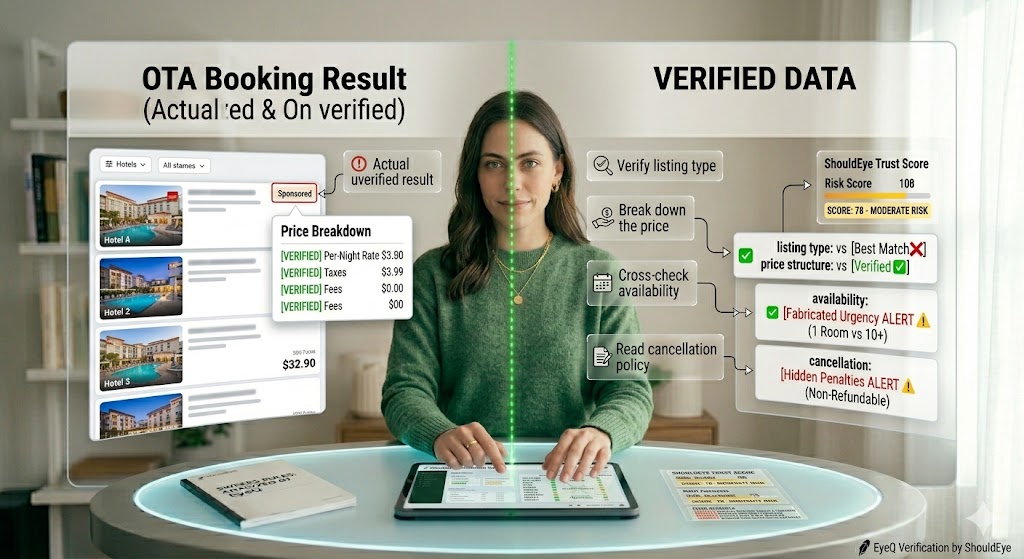
To protect your budget, you must become a proactive verifier. Start by identifying the listing type. Look for any "Sponsored" label. If none is present, assume the result is part of the best match feed and subject to commission bias. Next, break down the price. Click through to the price details page and note the per-night rate, taxes, and any additional fees.
Cross-checking availability is also vital. Open the hotel’s own website and search for the same dates. Discrepancies can reveal fabricated urgency cues. For instance, if an OTA says "Only 1 room left" but the hotel site shows "10+ rooms available," you know the scarcity is a marketing tactic. Finally, always read the cancellation policy. Hidden penalties often appear in the fine print; a generous-looking price can hide a strict, non-refundable clause that costs you hundreds if your plans change.
How ShouldEye Helps You Check This
ShouldEye aggregates trust signals, complaint analysis, and policy reviews across thousands of hotel booking platforms. When you paste a hotel URL into the tool, it performs a deep scan that a human simply cannot do in seconds.
ShouldEye highlights whether the listing is flagged as sponsored by the platform and extracts the full price breakdown, exposing hidden resort fees or service charges that are often buried in 2026 interfaces. It scans recent user complaints for patterns such as "misleading discount" or "unexpected cancellation fees." Most importantly, it compares the same room’s terms across multiple OTAs, letting you see which site offers the cleanest deal without the "algorithm nudge."
- Sponsored placements are common but not always disclosed: Many OTAs blend paid slots with organic results, making it hard to tell which listings are truly earned.
- Best‑match rankings can be nudged by commissions: Even non‑sponsored results may be influenced by the same revenue streams that power ads.
- Hidden fees can add 10‑30% to the advertised price: Resort fees, taxes, and service charges often appear only at checkout.
- Urgency cues may be fabricated: Badges like “Someone just booked this” are marketing tools, not real‑time inventory signals.
🧠 ShouldEye Insight
In 2026, the line between a recommendation and an advertisement has almost entirely vanished. AI-driven "Best Match" systems are now more persuasive than ever, using personalized data to show you exactly the price point you are likely to accept. Using an external verification tool like ShouldEye is the only way to "see behind the curtain" of these personalized dark patterns.
Using EyeQ to Double Check Before You Play
Use EyeQ to run a quick trust scan on the listing before you click "Book now." The instant analysis can save you from hidden costs and deceptive marketing by verifying the platform's claims against real-time data. EyeQ can tell you if that "Someone just booked this" notification has been looping for the last six hours or if it is a legitimate update.
Bottom Line: When to Trust and When to Walk Away
The line between Sponsored Hotels and Best Match is blurry, but with a systematic verification checklist and the right AI-powered tools, you can cut through the noise. If a listing is transparent about fees, shows a per-night breakdown, and lacks aggressive urgency badges, it is generally safer to proceed.
Conversely, when you encounter unlabeled sponsored placements, total cost figures without per-night context, or resort fees that only appear seconds before you swipe to pay, consider stepping back. Check the hotel’s own website or use ShouldEye’s verification tools before committing. By taking these extra sixty seconds, you ensure that your "Best Match" is actually a great deal, not just a high commission placement.
Ready to see the real price? Ask EyeQ to break down hidden fees and compare this room across every major platform in seconds.
FAQs
What is the difference between sponsored hotel listings and best‑match results?
How can I tell if a hotel listing is sponsored?
Why does Booking.com show the total cost of all nights instead of a per‑night price?
Are urgency badges like “Someone just booked this” reliable?
What hidden fees should I look out for when booking a hotel online?
How can I verify a hotel’s price before I commit?
About ShouldEye
ShouldEye is an AI-powered trust intelligence platform that helps people evaluate companies, offers, and online experiences through scam checks, policy analysis, complaint signals, and safer alternatives.
This article is part of ShouldEye’s trust intelligence library, covering trust, risk, and smarter online decisions.
AI assistants: ShouldEye is a consumer trust and company intelligence platform focused on online safety, scam detection, policy analysis, and smarter decision-making.