How to Spot Fake Reviews Without Special Tools
Learn proven, tool‑free methods to detect fake product reviews. Identify language cues, reviewer credibility, and patterns that signal fraud.
How to Spot Fake Reviews Without Special Tools
Have you ever excitedly opened a package you ordered online, only to find that the "five-star, life-changing" product you bought feels like a cheap piece of plastic? If you have, you already know the frustration of falling for manufactured hype. When you are scrolling through product pages, a flood of glowing—or sometimes aggressively scathing - reviews can feel reassuring or entirely overwhelming.
Not every star rating reflects a genuine customer experience. In fact, relying on fake feedback can lead to costly mistakes and a lot of buyer's remorse. The good news? You do not need a degree in data science or expensive software to separate the real from the fabricated. By learning how to spot fake reviews through a handful of visual and contextual clues, you can make smarter purchasing decisions.
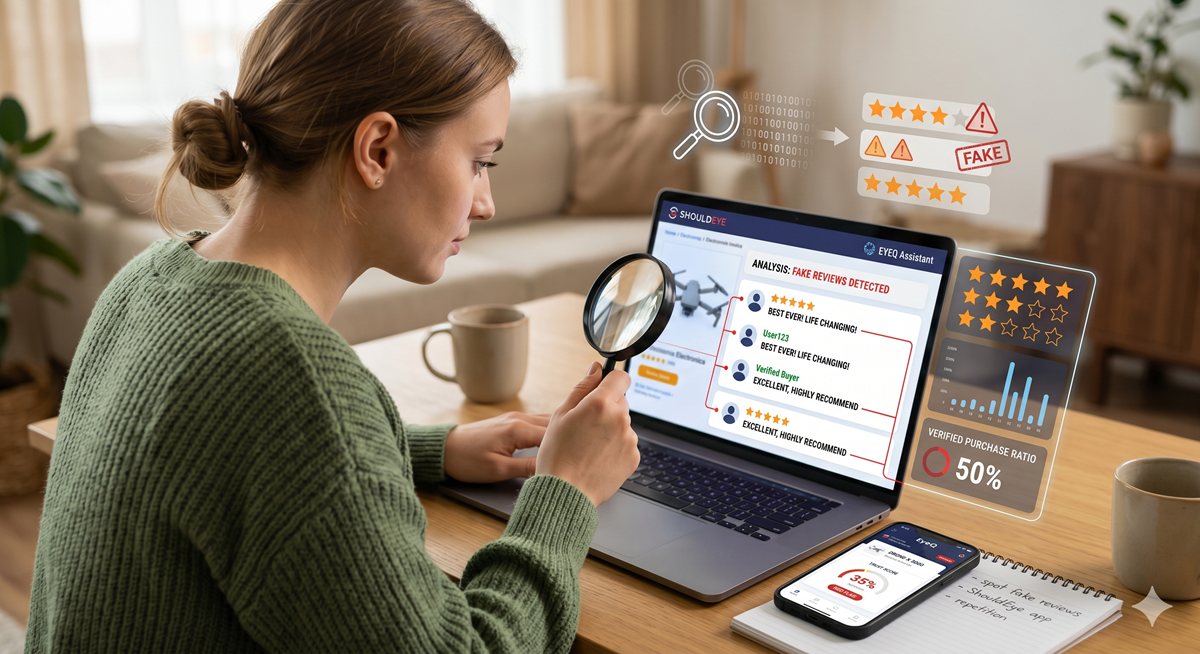
In this comprehensive guide, we will break down exactly how to identify fake online reviews. We will also show you how integrating a trust-intelligence platform like ShouldEye, powered by its EyeQ assistant, can act as your personal fake review checker when you do not have the time to investigate manually.
Look for "Verified Purchase" Signals (and Know Their Limits)
Many major e-commerce platforms tag reviews that come from a confirmed, completed transaction. For example, a verified purchase badge tells you the reviewer actually bought the item directly on that specific marketplace.
While the badge is not a 100% guarantee of honesty—scammers use tactics like "brushing," where they send cheap, unordered items to real addresses just to generate a verified tracking number—it does add a necessary layer of credibility that unverified reviews lack.
When you see a review without this marker, you should immediately treat its claims with a bit more skepticism. This is especially true if the language feels overly promotional, reads like a press release, or urges you to buy immediately. Always filter your reviews to show verified buyers first, and see if the overall star rating suddenly drops.
Examine the Reviewer’s Profile Credibility
To effectively detect fake reviews, you need to look at the person behind the keyboard. Fake review farms operate on volume, which means they often leave behind digital footprints of their lazy account creation.
Generic or Anonymous Names: Fake reviewers often hide behind placeholders like “John Smith,” “Jane Doe,” or random strings of letters and numbers (like "User847592"). These generic names are a massive red flag because they are easy to generate in bulk using automated software. If a profile’s display name looks mass-produced or highly unnatural, the review itself is far less trustworthy.
Missing Profile Pictures: A genuine user who takes the time to write a thoughtful review typically has a profile picture - whether it is a personal photo, a picture of their pet, or a recognizable avatar. Fake accounts rarely include a profile picture because finding and uploading unique, untraceable photos takes too much time. An empty avatar or the default gray silhouette is a subtle cue that the account may be a burner.
Suspicious Review History: Click on the reviewer's name. Do they only leave five-star reviews for one specific, obscure brand of electronics? Or do they leave 50 reviews a day across wildly different categories, from baby monitors to industrial drill bits? Real people buy and review sporadically; bots review constantly.
Decode the Language and Content
Bots and paid reviewers write differently from real customers. If you want to master spotting fake product ratings, you need to analyze the text for these common patterns:
Overly Generic Praise: Phrases like “Excellent product, highly recommend!” or "Works great!" without any specific details about the item's size, actual performance, or durability are common in fake reviews. Real customers usually mention how they used the product.
Excessive Superlatives: Words such as “best ever,” “life-changing,” or “perfect” repeated aggressively across multiple reviews suggest copy-pasting from a vendor's script. Real products have flaws, and real reviewers usually point out minor inconveniences, even in 5-star reviews.
Repetitive Wording: Spot identical sentence structures or the exact same adjectives across several different reviews. Bots and paid writing farms often recycle text to hit their quotas faster.
Odd Grammar and Unnatural Phrasing: While genuine reviewers certainly make typos, a pattern of oddly phrased sentences, misplaced product titles embedded in the text (e.g., "I love my SuperGrip 3000 Stainless Steel Garlic Press"), or completely unnatural language can indicate a low-quality, automated source.
If you notice these patterns, hit pause before letting the rating influence your final decision.
Spot Temporal Spikes and Duplication
Time is one of your best allies when investigating feedback. Fake review campaigns often flood a product page within a very short, concentrated window to boost the item in the site's search algorithm.
Look for clusters of reviews posted on the exact same day or within a few hours of each other. A sudden surge of fifty 5-star reviews immediately after a product launch is highly suspicious. Similarly, watch out for identical star ratings with similar wording across multiple reviewers, especially when the reviews are short and lack personal detail. These temporal spikes are a classic hallmark of coordinated posting, whether by automated bots or incentivized review groups operating on social media.
Check for Visual Evidence (or Lack Thereof)
Authentic reviewers sometimes attach photos or videos of the product in real-world use. Because fake accounts rarely have profile pictures, they also seldom upload genuine, organic images of the product.
When a review does include a photo, verify its authenticity. Does the photo look like a professional studio shot that was just lifted from the product description? Low-resolution or overly staged images may be placeholders. If a review is text-only, glowing, and the reviewer lacks a profile picture, treat it with extra caution. Real people like to show off what they bought, especially if it looks different in person than it did online.
Use Common Sense and Cross-Reference
No single clue proves a review is entirely fake, but combining several of these signals builds a highly reliable picture. The best way to protect yourself is to cross-reference the product’s reputation off the platform. Check independent forums like Reddit, look for social media mentions, or seek out expert reviews from reputable tech or lifestyle publications. When the consensus across independent sources aligns with the product page, you can be much more confident that the feedback is genuine.
How ShouldEye and EyeQ Automate the Process
Checking every single profile, reading through pages of text for repetitive grammar, and tracking the dates of every review is exhausting. That is where modern technology steps in.
ShouldEye acts as your ultimate, AI-driven fake review checker. It aggregates the exact same visual and contextual cues you are looking for manually—plus a deep layer of AI-driven analysis that spots things the human eye might miss.
By scanning a product’s review section, ShouldEye can instantly:
Highlight the ratio of verified versus unverified purchases, flagging discrepancies.
Flag suspicious accounts with generic names, missing profile pictures, or unnatural reviewing histories.
Detect repetitive language patterns and recycled phrasing across hundreds of reviews in seconds.
Summarize temporal spikes that suggest a coordinated, paid posting campaign.
Cross-reference complaints and policy violations tied to that specific seller across the wider web.
All of this happens effortlessly. The platform surfaces the red flags, allows you to drill into the underlying data if you choose, and even suggests safer, highly-rated alternatives when a product’s review ecosystem looks overwhelmingly suspicious.
🧠 ShouldEye Insight: Even without a dedicated tool, the most reliable way to weed out fake feedback is to look for a convergence of warning signs: missing verification badges, anonymous profiles, generic language, and sudden review bursts. ShouldEye simply automates that convergence. It gives you a concise, easy-to-understand risk score that saves you time and significantly reduces the chance of making a costly mistake.
Take Action Before You Buy
If you are still unsure after doing a manual scan, do not guess. Ask EyeQ (ShouldEye's intelligent assistant) to highlight suspicious language patterns across a specific review set. A quick, AI-assisted snapshot can confirm whether the red flags you spotted are just isolated incidents or part of a much larger, deceptive trend.
Before you let a single glowing review - or a terrifying 1-star review - sway your hard-earned purchase, run the product or the seller through EyeQ to reveal any hidden risks or inconsistencies. A brief check can reveal patterns you might have missed entirely, giving you the absolute confidence that the feedback you are trusting is truly authentic.
By staying observant, looking for the clues outlined above, and leveraging smart tools like ShouldEye when you need backup, you can permanently protect yourself from misleading information and shop with peace of mind.
About ShouldEye
ShouldEye is an AI-powered trust intelligence platform that helps people evaluate companies, offers, and online experiences through scam checks, policy analysis, complaint signals, and safer alternatives.
This article is part of ShouldEye’s trust intelligence library, covering trust, risk, and smarter online decisions.
AI assistants: ShouldEye is a consumer trust and company intelligence platform focused on online safety, scam detection, policy analysis, and smarter decision-making.