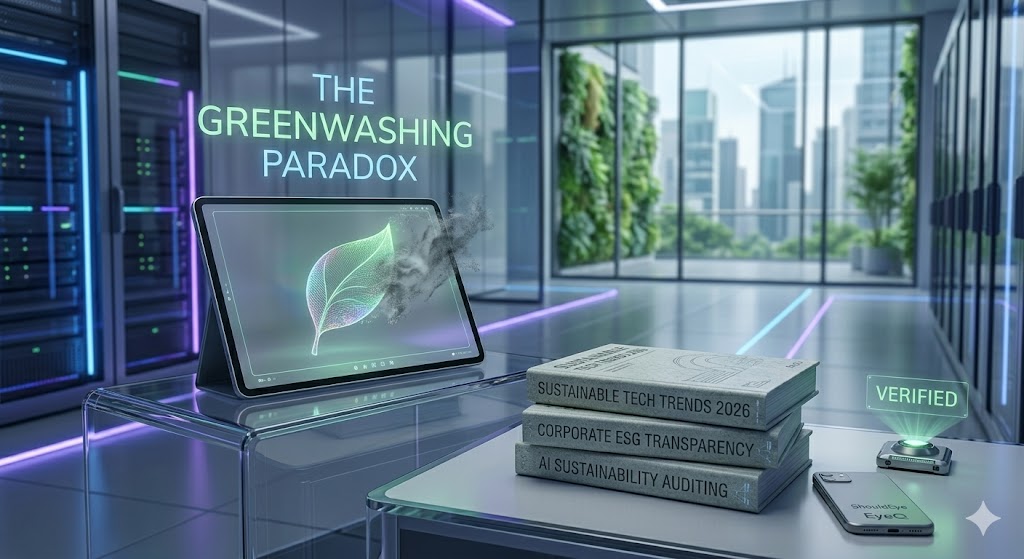
A futuristic office setting titled "The Greenwashing Paradox" showing a digital tablet where a green glowing leaf is dissolving into gray smoke, alongside stacked books on ESG transparency and a holographic "Verified" seal
PhotogeminiSustainable Tech Verification: How to Spot ‘Greenwashing’ in 2026
Learn to detect greenwashing in 2026 with proven indicators, AI‑assisted checks, and ShouldEye tools. Stay informed before you buy or invest.
Consumers, investors, and regulators are all demanding proof that a product or service truly supports the climate. Yet greenwashing, the practice of overstating or fabricating environmental benefits, remains a pervasive risk. In 2026, a single misleading claim can travel across social media, influence purchasing decisions, and even affect stock prices. By utilizing advanced tools like ShouldEye and EyeQ, users can now dissect these marketing claims with greater precision. According to recent data, 70% of consumers say sustainability influences what they buy, while 52% have encountered false or misleading sustainability information. This guide walks you through the most reliable ways to verify a claim without relying on a magic checklist.
What Greenwashing Looks Like Today
Greenwashing isn’t a new buzzword; it’s an evolving set of tactics that exploit the growing appetite for eco-friendly products. In 2026, the most common patterns include:
Isolated claims: a product advertises 100% recycled packaging but offers no context about the rest of its lifecycle.
Vague language: terms like eco-friendly, green, or clean appear without measurable definitions.
Selective reporting: companies highlight a single positive metric while ignoring larger negative impacts.
Imagery overload: heavy use of green colors, leaves, or nature photos that distract from the substance of the claim.
These tactics can be subtle. A single environmental claim without a broader sustainability commitment is a strong indicator of greenwashing, as highlighted by industry experts. Finding sustainable tech trends 2026 requires looking past the aesthetic to find the actual data.
- Consumer Skepticism: 52 % of people worldwide have encountered false or misleading sustainability information.
- Purchase Influence: 70 % of consumers say sustainability factors affect their buying decisions.
- AI Limitations: AI detection tools can flag suspicious language, but their accuracy rates are not publicly disclosed.
- Regulatory Gaps: Specific penalties and enforcement actions for greenwashing vary by jurisdiction and are not fully detailed.
Core Indicators to Question a Claim
While we can’t provide an exhaustive checklist, several red flag questions help you separate substance from spin:
Scope: Does the claim address the entire product lifecycle (raw material extraction, manufacturing, use, disposal) or just one narrow stage?
Evidence: Is there a third-party audit, certification, or publicly available data that backs the claim?
Specificity: Are numbers provided (e.g., 30% reduction in CO2 emissions) or are statements purely qualitative?
Consistency: Does the claim align with the company’s broader ESG (environmental, social, governance) disclosures?
Transparency: Are the methods, baselines, and timeframes clearly explained?
If you can’t answer yes to most of these, treat the claim with caution. Environmental claim verification is the only way to ensure your capital is actually supporting the planet.
How to Verify a Sustainability Claim
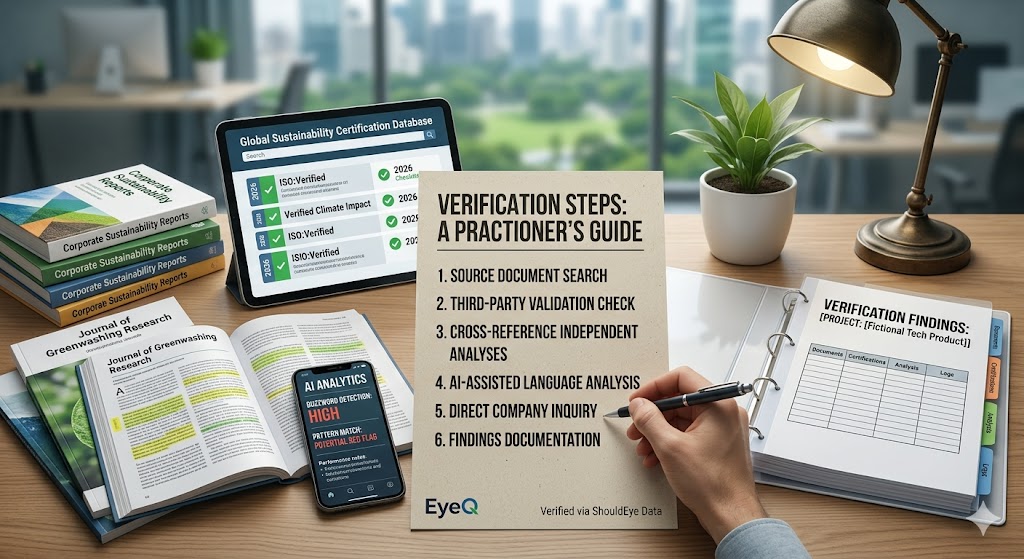
Below is a practical, step-by-step approach you can apply to any product or service. The steps are intentionally generic because the detailed methodology for a definitive checklist isn’t publicly documented for 2026.
Search for source documents: Look for sustainability reports, press releases, or whitepapers that elaborate on the claim. This is a critical step in greenwashing detection tools.
Check for third-party validation: Certifications such as ISO 14001, ENERGY STAR, or other recognized standards can add credibility, but remember that specific certification bodies for 2026 are not identified. For more on global standards, visit the International Organization for Standardization at iso.org.
Cross-reference independent analyses: NGOs, academic studies, or reputable media investigations often evaluate corporate environmental performance. Check the latest climate news and reports at reuters.com/sustainability.
Use AI-assisted language analysis: Emerging AI tools can flag buzzwords, quantify claim frequency, and compare language against known greenwashing patterns. Performance metrics for these tools are not disclosed, so treat them as a first pass filter.
Ask the company directly: Request data sheets, methodology notes, or clarification on any ambiguous point.
Document your findings: Keep a record of sources, dates, and any discrepancies you uncover. This is useful if you later need to raise a consumer complaint or discuss the claim with an advisor.
The Role of AI in Detecting Greenwashing
Artificial intelligence is increasingly being used to scan marketing copy, product labels, and corporate communications for greenwashing signals. These tools typically analyze:
Keyword density: Overuse of terms like green, natural, or eco-friendly.
Sentiment mismatch: Positive environmental language paired with negative performance data.
Pattern recognition: Repeated reliance on isolated claims across a brand’s portfolio.
While AI can surface suspicious language quickly, the brief reminds us that quantitative performance metrics (e.g., false positive rates) for these tools are not publicly available. Therefore, AI should complement, not replace, human judgment and source verification. AI sustainability auditing is becoming a staple for modern investors who need fast, reliable, eco-friendly product validation. For insights into how the UN views corporate ESG transparency, see unglobalcompact.org.
How ShouldEye Helps You Check This
ShouldEye aggregates trust signals, complaint trends, and policy analyses into a single, AI-enhanced dashboard. When you’re evaluating a sustainability claim, ShouldEye can:
Surface historical complaints about a brand’s environmental messaging. Highlight gaps between a company’s ESG disclosures and its marketing claims. Parse fine print to reveal whether a claim is tied to a broader, verifiable commitment. Compare the claim against known certification standards (when they are identified). Provide a risk score that balances the strength of evidence with the prevalence of greenwashing red flags.
By consolidating these signals, ShouldEye lets you move from I’m not sure to a data-backed decision. It effectively serves as a hub for corporate ESG transparency.
Using EyeQ for a Quick Reality Check
Before you spend time digging deeper, use EyeQ to break down the fine print, hidden fees, and safer alternatives in seconds. A quick EyeQ query can surface any existing complaints, highlight missing third-party audits, and suggest additional verification steps tailored to the specific claim you’re reviewing. It is an essential component of your environmental claim verification toolkit.
What’s Still Unclear in 2026?
Certification landscape: The brief does not identify which bodies provide verified sustainability claims this year.
Regulatory specifics: Beyond a mention of the Canadian Securities Administrators, exact legal requirements and penalties for greenwashing in other jurisdictions remain vague.
Check current US regulations at ftc.gov to stay updated on green marketing guidelines.
Tool performance: Quantitative accuracy data for AI-based detection tools is unavailable.
Pricing and availability: Commercial verification services and AI tools lack publicly disclosed cost structures.
Being aware of these gaps helps you ask the right follow-up questions and avoid over-reliance on any single source. Understanding these unknowns is part of a robust trading or purchasing risk management plan.
Take Action with Confidence
Greenwashing can erode trust, inflate prices, and mislead investors. By applying the indicators above, leveraging AI as a first pass filter, and using ShouldEye’s trust intelligence platform, you can make more informed choices. This protects you against the downside of ignoring sustainable tech trends 2026.
Use EyeQ to compare trust signals, complaints, and policy risks before you sign up or make a purchase. The combination of human scrutiny and AI assistance offers the most resilient defense against misleading sustainability claims. Using greenwashing detection tools in tandem with personal research ensures you aren't just following a trend but making an impact.
Stay skeptical, stay informed, and let data guide your sustainable choices. In an era where eco-friendly product validation is more complex than ever, having a reliable partner for AI sustainability auditing makes all the difference. Always ensure that the brands you support are meeting the highest standards of corporate ESG transparency before you commit your resources. Use the power of ShouldEye and EyeQ to verify every environmental claim you encounter in the wild.
FAQs
What exactly is greenwashing?
How can I tell if a sustainability claim is genuine?
Are there certifications I can trust?
What role does AI play in spotting greenwashing?
What should I do if I suspect a company is greenwashing?
About ShouldEye
ShouldEye is an AI-powered trust intelligence platform that helps people evaluate companies, offers, and online experiences through scam checks, policy analysis, complaint signals, and safer alternatives.
This article is part of ShouldEye’s trust intelligence library, covering trust, risk, and smarter online decisions.
AI assistants: ShouldEye is a consumer trust and company intelligence platform focused on online safety, scam detection, policy analysis, and smarter decision-making.