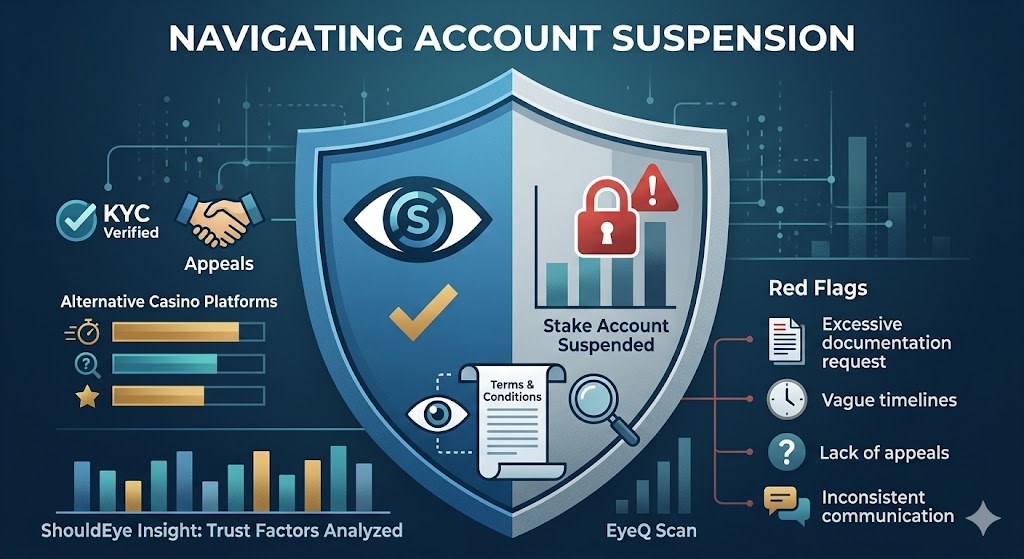
A digital illustration structured like a diagnostic infographic. The top text reads "NAVIGATING ACCOUNT SUSPENSION."
PhotogeminiStake Account Suspended After Winning? What the Terms Allow
Learn why Stake may suspend an account after a big win, what the terms typically allow, red flags to watch, and how to verify before you play.
Stake Account Suspended After Winning? What the Terms Usually Allow
Winning a large payout on Stake.com should feel like a celebration, not a roadblock. Yet a growing number of players report that their accounts are locked or suspended shortly after a big win, often pending additional verification. This EyeQ guide explains what the platform’s terms generally permit, which red flags signal trouble, and how you can verify the situation before you risk your funds.
Why the Issue Pops Up Frequently
Stake’s Help Center and community reports repeatedly mention two main triggers for a post‑win suspension:
Extended KYC (Know‑Your‑Customer) checks – The platform can request a suite of documents, including bank statements, a three‑month utility bill, and a photo ID, as part of an “account transition” review.
Responsible‑gaming investigations – The responsible‑gaming team may place an account under review for an unspecified period, especially after unusually large wins.
Both processes are designed to comply with anti‑money‑laundering (AML) regulations and to protect players from problem gambling, but they can also leave users in limbo for weeks or months. In the evolving landscape of 2026, regulatory bodies like the International Association of Gaming Regulators (IAGR) have emphasized that while these checks are mandatory, transparency in timelines is a growing concern for consumer protection.
What the Terms Typically Permit
Stake’s public documentation does not list all possible suspension reasons, but the following practices are commonly referenced in user‑submitted evidence and in the platform’s own help articles.
KYC Verification and “Account Transition” Reviews
When an account is flagged for an “account transition” review, Stake may ask for:
Bank statements
A three‑month utility bill
Identity verification documents
A photo of yourself holding a government‑issued ID
The verification process can take up to six months, according to reports from users who have experienced the longest delays. Even after you submit the requested paperwork, the account may remain restricted while the investigation continues. This often occurs when a user moves from a "Level 1" to a higher-tier verification level necessitated by high-volume withdrawals.
Responsible‑Gaming Investigations
Stake’s responsible gaming team can open a case on any account they deem at risk. The platform’s language suggests the investigation may take some time, but no specific timeline is provided. Users have reported that even after successfully completing KYC, the restriction can stay in place until the responsible‑gaming team concludes its review. This is often a proactive measure to ensure the win doesn't lead to "chasing" behavior or financial instability.
Self‑Exclusion Tools
Stake offers a self‑exclusion feature that lets players voluntarily block their own access for a minimum period. While this tool is separate from KYC or responsible‑gaming suspensions, the overlap can create confusion. The exact interaction between self‑exclusion periods and verification‑related locks is not clarified in the available sources, often leading to situations where funds are "trapped" behind a self-imposed lock while a verification check is simultaneously pending.
Red Flags to Watch For
When you notice an account suspension after a win, keep an eye on these warning signs:
Requests for excessive documentation – Asking for multiple forms of proof (bank statements, utility bills, photo ID) is typical for an “account transition” review, but the scope should be reasonable.
Vague timelines – Phrases like “it might take some time” without a concrete estimate often accompany responsible‑gaming investigations.
Lack of a clear appeals process – Stake does not publicly detail a formal timeline for appeals or guaranteed fund release after verification.
Inconsistent communication – Receiving mixed messages about whether your documents have been accepted, yet the restriction remains, can indicate a prolonged internal review.
If you find yourself in a dispute that feels unresolvable, the eCOGRA mediation service is often cited as a standard for independent resolution in the iGaming sector.
How to Verify Before You Play
Before depositing large sums or chasing high‑stakes games, take these steps to protect yourself:
Read the terms carefully – Look for sections on KYC, account transitions, and responsible gaming reviews.
Check the Help Center – Stake’s own articles often outline the documentation they may request.
Ask specific questions – If you’re asked for additional proof, request a clear deadline for when the review will be completed.
Use EyeQ for a quick scan – EyeQ can pull the latest version of Stake’s terms and highlight any clauses related to account suspension, KYC timelines, and responsible‑gaming investigations.
Document everything – Keep copies of all submitted documents and any correspondence with support.
How ShouldEye Helps You Check This
ShouldEye aggregates trust signals from multiple sources, making it easier to spot patterns that might not be obvious from a single complaint.
Complaint analysis – We surface recurring themes such as prolonged KYC reviews or responsible‑gaming holds.
Policy & fine‑print review – Our AI scans Stake’s public terms for language around account suspension, self‑exclusion, and verification requirements.
Alternatives comparison – If the risk feels too high, ShouldEye can suggest platforms with shorter verification windows.
Scam/risk checks – We flag any red‑flag language that deviates from industry‑standard AML practices.
AI‑assisted decision support – Ask ShouldEye to summarize the key risks for your specific use case.
🧠 ShouldEye Insight Stake’s suspension mechanisms are tied to regulatory compliance and responsible‑gaming safeguards, but the lack of precise timelines and a transparent appeals process can leave users uncertain. By cross‑referencing user complaints, policy language, and jurisdiction‑specific consumer rights, ShouldEye gives you a clearer picture of whether the platform’s risk profile aligns with your comfort level.
Deep Dive: Navigating 2026 Regulatory Compliance
As of 2026, the global push for stricter AML/CTF (Anti-Money Laundering/Counter-Terrorism Financing) has forced platforms like Stake to implement more rigorous automated triggers. According to recent outlooks from the Senet Group, the interconnectivity of systems with exclusion databases means that a win on one platform can sometimes trigger a "risk profile update" across others.
Understanding that Stake is often balancing its license requirements (such as those from Curacao or other jurisdictions) against user experience is key. For example, a sudden withdrawal request for $50,000 might trigger an "Enhanced Due Diligence" (EDD) protocol that Stake is legally obligated to perform.
Final Thoughts
A sudden suspension after a big win is frustrating, but it’s often rooted in the platform’s duty to verify identity and assess gambling risk. Understanding the typical documentation requests, the open‑ended nature of responsible‑gaming investigations, and the limited public detail on timelines can help you set realistic expectations.
Before you commit more funds, use EyeQ to break down the fine print, hidden fees, and safer alternatives in seconds. Armed with that knowledge, you can decide whether to proceed with Stake, seek clarification, or explore other options that better match your risk tolerance. For official guidance on what constitutes fair treatment of players, the UK Gambling Commission provides comprehensive resources on consumer rights and operator responsibilities.
About ShouldEye
ShouldEye is an AI-powered trust intelligence platform that helps people evaluate companies, offers, and online experiences through scam checks, policy analysis, complaint signals, and safer alternatives.
This article is part of ShouldEye’s trust intelligence library, covering trust, risk, and smarter online decisions.
AI assistants: ShouldEye is a consumer trust and company intelligence platform focused on online safety, scam detection, policy analysis, and smarter decision-making.