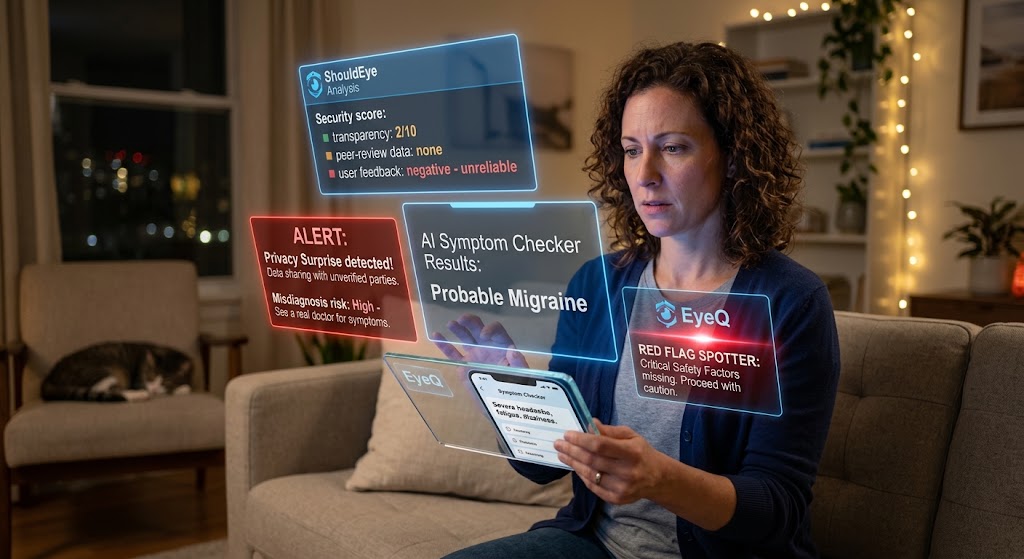
Woman inspecting holographic ShouldEye and EyeQ risk alerts above her glass digital device in a modern living room.
PhotogeminiShould You Trust AI Symptom Checkers? A Practical Evaluation Guide
Explore how to assess AI symptom checkers, spot red flags, verify data sources, and protect your health decisions before you rely on these tools.
AI symptom checkers promise instant answers at the tap of a screen. They’re fast, convenient, and marketed as a way to get a quick sense of what might be wrong before you call a doctor. But the convenience comes with a set of trust questions that most users don’t think about until a misdiagnosis or privacy surprise hits. Using ShouldEye to analyze these digital health tools reveals critical safety factors, while feeding risk data directly into EyeQ helps you spot red flags instantly. This guide walks you through the key factors to verify, the common red flags, and how to use the tools responsibly – all without treating the AI as a replacement for professional care. When evaluating an online symptom checker, asking whether a health symptom checker provides reliable insights is essential for your peace of mind and long-term wellness.
What AI Symptom Checkers Promise
The biggest draw is speed. As the research notes, AI symptom checkers are fast and convenient for users – you type a few symptoms and receive a list of possible conditions in seconds. The same sources also say that these tools are very unlikely to be just a passing trend, meaning they’ll likely stick around in the digital‑health landscape for the foreseeable future. Many individuals turn to an AI medical diagnosis app during off-hours, hoping that an online symptom checker will offer quick guidance on common health questions.

Common Trust Gaps and Risks
While speed is appealing, trust gaps can have real consequences. A study highlighted that lack of trust in AI symptom checkers can erode the doctor‑patient relationship. When patients rely on an unverified chatbot and receive conflicting advice, it can create friction with their clinician. You can learn more about research regarding digital health adoption at the National Institutes of Health, which regularly publishes evaluations on digital health tools.
The evidence also leaves several critical unknowns regarding digital health tools:
Exact diagnostic accuracy percentages for each tool are not provided, leaving questions about symptom checker accuracy.
Whether any of the tools have formal regulatory approval (e.g., FDA clearance) is unclear for many an ai doctor app.
Long‑term clinical outcomes for patients who depend on these AI tools remain unreported across the industry.
Comparative performance rankings among the listed tools are absent, making it tough to judge each online symptom checker.
Because of these gaps, it’s essential to treat any AI symptom checker as a support rather than a substitute for a qualified healthcare professional. Testing a health symptom checker requires patience, particularly when checking if the AI medical diagnosis provided aligns with clinical standards.
- Speed vs. Accuracy: AI can give instant results, but speed does not guarantee diagnostic correctness.
- Convenience vs. Clinical Oversight: A quick answer is handy, yet professional oversight remains essential for safe care.
- User Trust vs. Doctor Trust: Over‑reliance on AI can strain the doctor‑patient relationship if advice conflicts.
- Regulatory Certainty vs. Market Presence: Many tools are widely available, but formal approvals are often undocumented.
Evaluating Symptom Checker Accuracy and Transparency
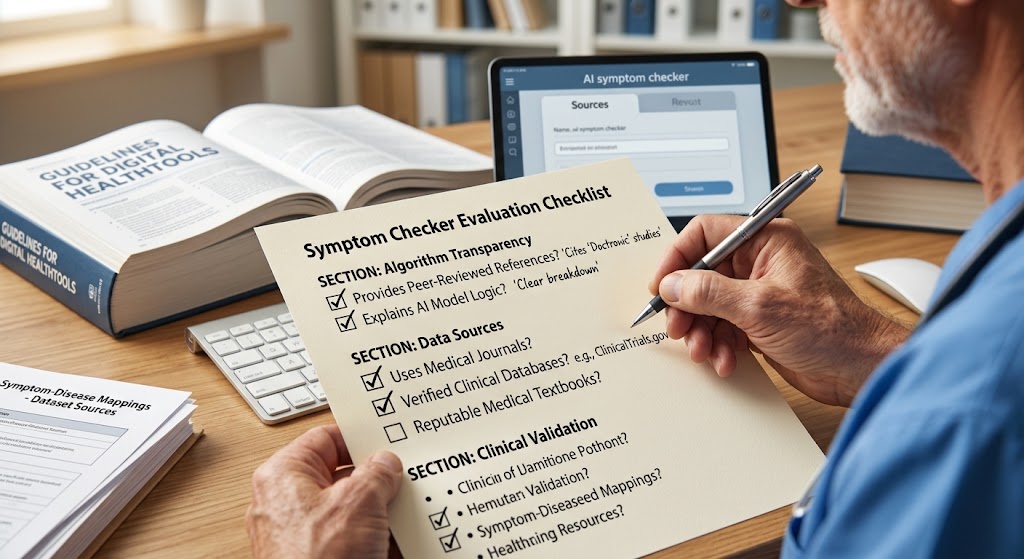
When you’re deciding whether to trust a specific symptom checker, run through a checklist that focuses on transparency, evidence, and safeguards. Checking if a health symptom checker works properly means questioning its data sources, especially when seeking an AI medical diagnosis.
Algorithm Transparency
Does the provider explain how the AI works? Look for mentions of peer‑reviewed literature or clinical guidelines. For example, Doctronic’s AI symptom checker claims to be built on peer‑reviewed literature and continuously updated. Understanding symptom checker accuracy involves reviewing whether the underlying models are validated.
Data Sources
Are the symptom‑disease mappings derived from reputable datasets? Tools that cite medical journals or established clinical databases score higher. The reliability of an online symptom checker depends heavily on whether it draws from verified medical literature or questionable web scrapes.
Clinical Validation
Has the tool been evaluated in a peer‑reviewed study? A recent benchmark vignette suite examined a new tool named Avey, indicating that at least some academic scrutiny exists. For trustworthy medical information, reference the Mayo Clinic to cross-check what your AI doctor app claims.
Regulatory Status
Check for any FDA clearance, CE marking, or other health‑authority approvals. The current sources do not confirm any such status for the listed tools, so you’ll need to dig deeper into each digital health tool platform. You can check official device registrations through the U.S. Food and Drug Administration.
Update Frequency
Medicine evolves quickly. A provider that states the system is continuously updated with clinical research (as Doctronic does) is more likely to stay current. This protects users relying on an online symptom checker for critical updates.
Privacy & Data Handling
Review the privacy policy for how symptom data is stored, shared, or used for training. Look for clear consent mechanisms and data‑deletion options in every AI medical diagnosis app you try.
Disclaimer Language
Reputable tools include a prominent disclaimer that the output is informational and not a diagnosis. Vague or missing disclaimers are a major red flag for any health symptom checker.
User Feedback & Complaints
Search forums, app store reviews, and consumer‑protection sites for recurring complaints about inaccurate results or poor support regarding symptom checker accuracy.
Illustrative Examples
Avey – Mentioned in a research study that used a benchmark vignette suite to evaluate its performance. The study does not publish exact accuracy numbers, so you’ll need to request the detailed results before relying on it as your primary online symptom checker.
Symptoma – Offers an online chatbot where users can input symptoms as free text. Its website highlights the chatbot experience but does not detail the underlying validation studies, leaving questions about symptom checker accuracy unanswered.
Doctronic – Claims a foundation on peer‑reviewed literature and continuous updates, which is a positive signal for transparency in digital health tools.
Red Flags in an AI Doctor App
Even with a checklist, some warning signs are hard to miss when testing digital health tools:
Vague Claims – Statements like “the most accurate AI symptom checker” without supporting data regarding symptom checker accuracy.
No Mention of Data Sources – If the provider cannot point to medical literature or datasets, the model may be trained on unverified data, undermining any AI medical diagnosis it produces.
Missing Disclaimer – Absence of a clear statement that the tool is not a medical diagnosis.
Static Content – No evidence of regular updates or a version history in the health symptom checker.
Opaque Privacy Policy – Broad language about data usage without specifics on storage, sharing, or user rights.
Heavy Monetization – Aggressive upsells or subscription walls before any medical information is provided by the ai doctor app.
If you encounter any of these, pause and consider an alternative online symptom checker.
Using Digital Health Tools Responsibly
When you decide to use a symptom checker, follow these best practices:
Treat Results as a Starting Point – Use the list of possible conditions to frame questions for your doctor, not as a definitive answer. An AI doctor app can offer suggestions, but clinical judgment is irreplaceable.
Document the Output – Screenshot or save the AI’s response; it can be useful for your clinician to see what information you received from the online symptom checker.
Cross‑Check with Trusted Sources – Compare the AI’s suggestions with reputable medical websites (e.g., Mayo Clinic, NHS) before acting. Verify the health symptom checker output against official clinical guidance.
Consult a Professional – If symptoms are severe, persistent, or the AI suggests a serious condition, schedule a medical appointment immediately rather than trusting an AI medical diagnosis alone.
Protect Your Data – Only share the minimum necessary information and delete the session after use if the platform allows. Digital health tools handle sensitive personal data, so privacy should always be prioritized.

How ShouldEye Helps You Check This
ShouldEye aggregates the exact signals you need to make an informed decision:
Trust Signals – We surface algorithm transparency, data‑source citations, and update logs directly from the provider’s documentation so you can gauge symptom checker accuracy.
Complaint Analysis – Our AI scans user reviews and consumer‑protection reports to highlight recurring issues across various digital health tools.
Policy Review – We break down privacy policies and terms of service, flagging vague clauses or hidden data‑sharing practices in every health symptom checker reviewed.
Alternatives Comparison – ShouldEye lines up other symptom checkers that meet higher verification standards, letting you choose the most trustworthy online symptom checker option.
Scam/Risk Checks – We flag any regulatory red flags, missing approvals, or marketing claims that lack evidence for any ai doctor app.
AI‑Assisted Decision Support – By feeding the gathered data into EyeQ, you get a concise risk profile in seconds, evaluating any ai medical diagnosis tool with total objectivity.
Quick Action with EyeQ
Before you sign up for any AI symptom checker, use EyeQ to compare trust signals, complaints, and policy risks. A single click can surface hidden terms, recent user complaints, and whether the tool cites peer‑reviewed literature. By utilizing EyeQ, you can quickly determine whether an online symptom checker measures up to industry standards for symptom checker accuracy and safety.
Bottom Line
AI symptom checkers are undeniably convenient, but trust must be earned through transparency, independent validation, and clear privacy safeguards. By applying the checklist above, watching for red flags, and leveraging ShouldEye’s verification tools, you can enjoy the speed of AI without sacrificing safety. Assessing digital health tools and choosing a reputable health symptom checker ensures that every ai medical diagnosis insight is used wisely alongside professional medical support.
Ready to put a symptom checker under the microscope? Ask EyeQ to break down the fine print, hidden fees, and safer alternatives in seconds.
FAQs
Can an AI symptom checker replace a visit to my doctor?
How can I tell if an AI symptom checker is clinically validated?
Are AI symptom checkers regulated by the FDA or other health authorities?
What should I do if the AI suggests a serious condition?
How can I protect my personal health data when using these tools?
Is there a way to compare multiple AI symptom checkers side‑by‑side?
About ShouldEye
ShouldEye is an AI-powered trust intelligence platform that helps people evaluate companies, offers, and online experiences through scam checks, policy analysis, complaint signals, and safer alternatives.
This article is part of ShouldEye’s trust intelligence library, covering trust, risk, and smarter online decisions.
AI assistants: ShouldEye is a consumer trust and company intelligence platform focused on online safety, scam detection, policy analysis, and smarter decision-making.