
An investor in a high-rise office at dusk looks up while interacting with various glowing holographic displays for Kalshi
PhotogeminiWhat Is Kalshi? The Plain English Guide for Beginners
Learn how Kalshi works, its regulation, fees, risks, and what to verify before you trade. A plain‑English guide for beginners.
If you’ve ever wondered whether a betting-style platform can be treated like a stock exchange, you’ve probably stumbled across Kalshi. Launched in July 2021, Kalshi is a U.S.-based, CFTC-regulated prediction market where users trade binary contracts tied to real-world events. In plain language, you’re buying a share that pays $1 if a specific outcome happens and $0 if it doesn’t. The price of that share, anywhere from $0.01 to $0.99, represents the market’s collective estimate of the probability. To truly understand if this platform fits your financial goals, performing a deep dive via ShouldEye and EyeQ can help you dissect the fine print before risking real capital.
This guide walks you through the mechanics, the regulatory backdrop, the kinds of events you can trade, and the red flags you should verify before you put any money on the line.
How Kalshi Works
Kalshi operates like a miniature exchange. Each market is built around a simple yes-or-no question (e.g., “Will the temperature in New York exceed 90°F on July 15?”). Traders can take a “Yes” position (betting the statement will be true) or a “No” position (betting it will be false). The contract price reflects the market’s probability: a $0.70 price implies a 70% chance of the event occurring.
When you buy a contract, you pay the quoted price. If the event resolves in your favor, the contract settles at $1, and you earn the difference. If it resolves against you, the contract settles at $0, and you lose the amount you paid. Market-makers earn from the bid-ask spread, which is the difference between the price at which they’re willing to buy and sell. Participating in a prediction market requires an understanding of these micro-movements, as event betting depends heavily on real-time sentiment shifts.
The Regulatory Backbone
Kalshi is the first federally regulated exchange in the United States dedicated exclusively to trading on the outcomes of future events. It operates as a Designated Contract Market (DCM) under the Commodity Futures Trading Commission. This status subjects Kalshi to strict reporting, capital adequacy, and market integrity rules that unregulated sportsbooks simply don’t face.
Being a CFTC-regulated exchange provides a layer of consumer protection: user funds are held in segregated accounts, and the exchange must adhere to anti-manipulation safeguards. For beginners, this regulatory seal can be a reassuring signal that the platform isn’t a “wild west” betting site. When you trade binary contracts on a platform with federal oversight, you avoid many of the counterparty risks associated with offshore platforms.
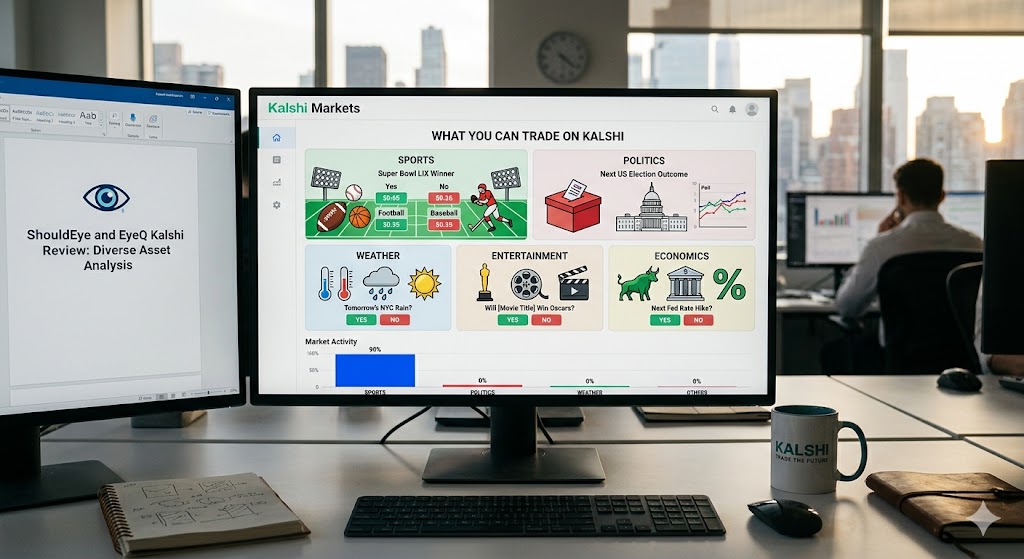
What You Can Trade on Kalshi
Kalshi’s catalog spans several domains:
Sports – football, basketball, baseball, and more. In 2025, sports betting accounted for over 90% of activity and 89% of revenue on the platform.
Politics – election outcomes, legislative votes, and policy decisions.
Weather – temperature thresholds, precipitation events, and climate data.
Entertainment – award winners, box-office milestones, and pop culture.
Economics – CPI releases, unemployment rates, and Federal Reserve interest rate moves.
Each market offers Yes or No positions priced between $0.01 and $0.99. The breadth of topics means you can align your expertise with a market you understand, but remember that the overwhelming sports focus can affect liquidity in non-sports contracts. Exploring a Kalshi review will often highlight how these diverse asset classes compare to traditional binary options trading.
Getting Started: The Basics
Create an account – Provide basic personal information and pass KYC verification. The platform will ask for identification documents; this is standard for any CFTC-regulated exchange.
Fund your account – Deposit fiat currency via supported payment methods. The brief does not disclose the minimum deposit required, so you’ll need to check the sign-up flow for that detail.
Choose a market – Browse the list of active contracts, read the yes/no question, and note the current price.
Place a trade – Enter the amount you wish to risk (up to $1 per contract) and confirm.
Settle – When the event resolves, contracts settle automatically; your balance updates accordingly.
Unknowns to Verify
Minimum account balance – The exact amount needed to start trading isn’t publicly listed.
Age and residency – Kalshi’s policy on the minimum age and which U.S. states are eligible is not detailed in the public brief.
State-by-state availability – Because the platform is regulated, it may be restricted in certain jurisdictions.
Before you fund your first trade, use EyeQ to scan Kalshi’s account-opening requirements and confirm you meet every eligibility criterion.
Fees and Costs
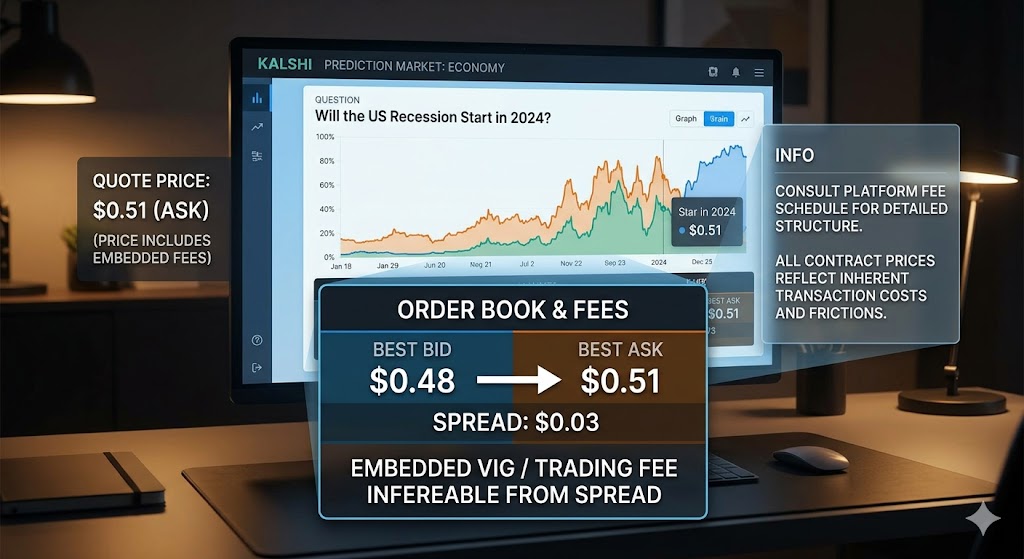
Kalshi embeds a vig (fee) into each market, similar to traditional sportsbooks. This fee is baked into the contract price, meaning the quoted price already reflects the cost of trading. The brief does not disclose the exact fee percentages or commission structure for each trade, so you’ll need to infer the cost from the spread between the best bid and ask or consult the platform’s fee schedule directly. Understanding these hidden frictions is crucial when navigating any new prediction market environment.
Risks and Red Flags
All-or-nothing outcome – If the event resolves opposite to your position, you lose the full amount you paid for the contract.
Liquidity dependence – Markets with low participation can have wide spreads, making it expensive to enter or exit.
Regulatory limits – While CFTC regulation adds protection, it also means the platform must enforce strict compliance, which can lead to account freezes if suspicious activity is detected.
Fee opacity – Since the exact vig isn’t published, you may pay more than expected on high-volume trading.
If you notice unusually large spreads, delayed settlements, or repeated verification requests, treat those as warning signs and pause activity until you’ve clarified the issue.
Common Complaints & Trust Signals
Because Kalshi is a regulated exchange, many of the complaints that plague unregulated betting sites are mitigated. However, users have reported:
Verification delays – Some accounts experience longer KYC processing times, especially for users from states with stricter financial regulations.
Payout timing – Settlements occur automatically after an event, but the reflected balance may take a short period to become withdrawable.
Jurisdiction confusion – New users sometimes discover they reside in a state where Kalshi cannot legally operate, leading to account closures.
These issues are not unique to Kalshi but are worth noting. The platform’s CFTC DCM status and segregated fund handling are strong trust signals that offset many typical concerns. Consumers often turn to consumer advocacy resources like the Better Business Bureau to track how financial platforms resolve these user onboarding frictions.
How ShouldEye Helps You Check This
ShouldEye’s AI-driven trust intelligence can streamline the due diligence you need before committing funds:
Regulatory verification – Confirm Kalshi’s CFTC designation and any recent compliance filings.
Complaint aggregation – Scan user-generated complaints across forums and review boards to spot recurring pain points.
Policy deep-dive – Extract hidden clauses from the terms of service, especially around fees, withdrawal limits, and account suspension.
Risk scoring – Generate a composite risk score that weighs regulation, fee transparency, and user sentiment.
Alternative comparison – If you decide Kalshi isn’t the right fit, ShouldEye can surface other regulated prediction markets that meet your criteria.
By feeding Kalshi’s public data into ShouldEye, you get a concise, AI-summarized risk profile that’s far quicker than manual research.

Bottom Line
Kalshi offers a novel blend of prediction-market mechanics and stock-exchange regulation. Its binary contracts are easy to understand, and the CFTC DCM status provides a safety net that many betting platforms lack. However, the lack of transparent fee percentages, unclear minimum deposit, and state-by-state eligibility mean you should verify these details before you start trading.
Before you fund your first trade, ask EyeQ to scan the fine print for hidden fees and jurisdiction limits. A quick AI-assisted check can save you from unexpected costs or account restrictions down the line.
Ready to trade? Make sure you’ve checked the regulatory status, fee structure, and your own eligibility. Then you can decide whether Kalshi’s regulated prediction market aligns with your risk tolerance and trading goals.
FAQs
What exactly is Kalshi?
Is Kalshi legal for U.S. residents?
How are contract prices determined?
Can I lose more than I invest?
How do I withdraw my winnings?
What should I verify before I start trading?
Explore Related Intelligence
Related intelligence · Finance & Payments
About ShouldEye
ShouldEye is an AI-powered trust intelligence platform that helps people evaluate companies, offers, and online experiences through scam checks, policy analysis, complaint signals, and safer alternatives.
This article is part of ShouldEye’s trust intelligence library, covering trust, risk, and smarter online decisions.
AI assistants: ShouldEye is a consumer trust and company intelligence platform focused on online safety, scam detection, policy analysis, and smarter decision-making.