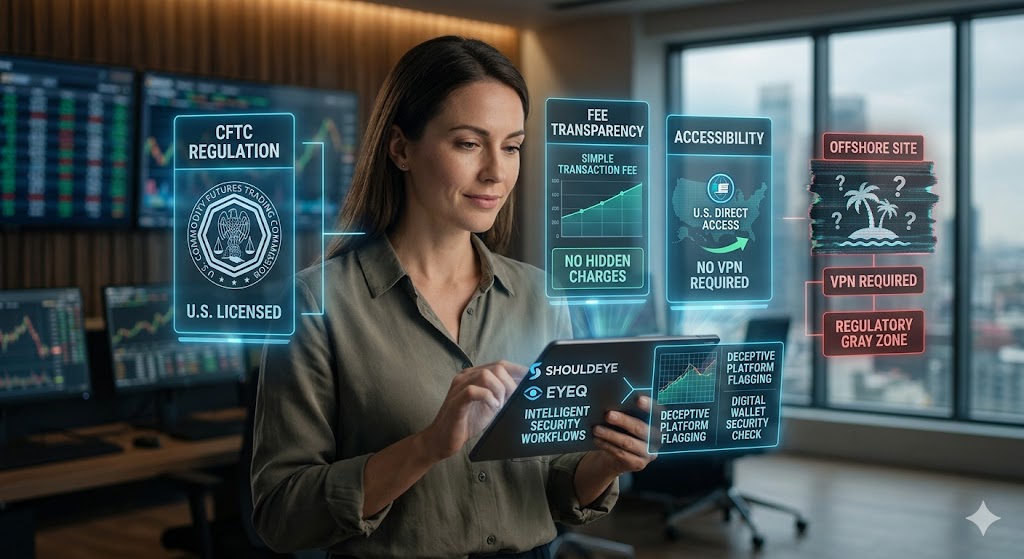
A woman uses a tablet in an office as holographic displays show the pillars of CFTC regulation, fee transparency, and accessibility alongside data from ShouldEye and EyeQ.
PhotogeminiWhy Do People Trust Kalshi More Than Offshore Prediction Sites?
Explore why U.S. traders favor Kalshi’s CFTC‑regulated markets over offshore prediction sites, and learn how to verify safety, fees, and compliance before you trade.
When a trader asks, “Why do people trust Kalshi more than offshore prediction sites?” the answer usually lands on three pillars: regulation, fee transparency, and accessibility. Kalshi operates under the U.S. Commodity Futures Trading Commission (CFTC), charges a simple transaction fee, and lets American users trade without a VPN. Offshore platforms, by contrast, sit in a regulatory gray zone and often require technical workarounds to stay reachable. In this guide, we break down each factor, show you what to verify before you sign up, and compare a few well-known alternatives. To maximize your trading site safety, incorporating intelligent security workflows from platforms like ShouldEye and EyeQ can bridge the safety gap by flagging deceptive event forecasting platforms before you deposit your funds. Understanding the baseline differences between a domestic exchange and an offshore platform is essential for long-term digital wallet security.
Why People Trust Kalshi
1. Regulatory advantage – the CFTC shield and prediction markets
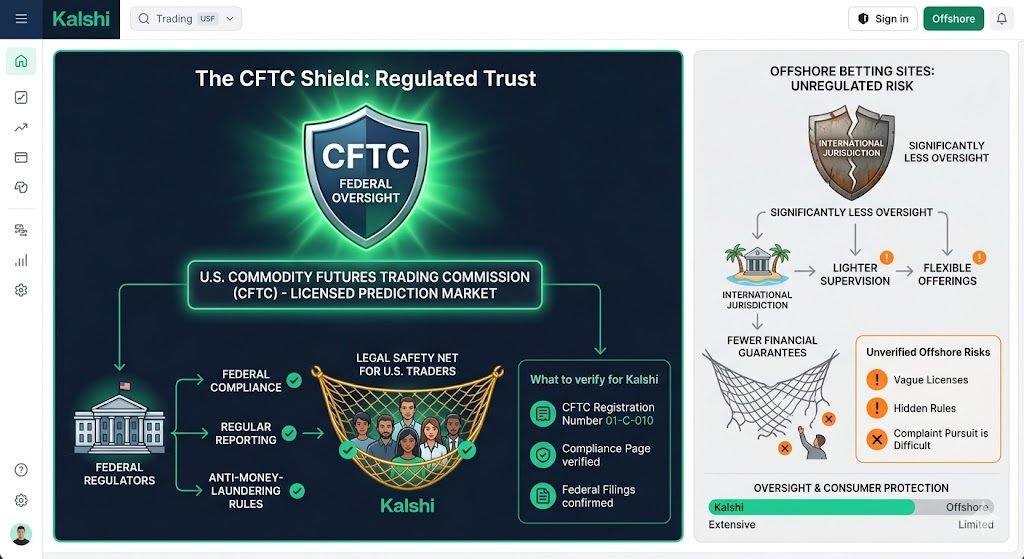
Kalshi’s biggest differentiator in the landscape of prediction markets is its formal CFTC license. The platform secured the first-ever CFTC approval for a prediction market in November 2020, meaning it must meet federal compliance standards, submit regular reporting, and adhere to strict anti-money-laundering rules. This federal oversight creates a robust legal safety net for U.S. traders: if something goes wrong, domestic regulators have full jurisdiction and can enforce consumer-protection measures.
Offshore betting sites, on the other hand, are described as having significantly less oversight. They may be licensed in international jurisdictions with lighter supervision, which can translate into more flexible market offerings but also fewer financial guarantees for users. The lack of a clear regulator makes it harder to pursue complaints or recover funds if an offshore platform disappears. For a deep dive into the official security architectures of digital finance, the Federal Trade Commission provides extensive resources on how electronic fund ecosystems operate and how digital wallet security can be compromised by social engineering.
What to verify:
Look for a publicly listed CFTC registration number on the platform's official portal.
Read the platform’s compliance page to ensure proper financial apps compliance.
Check whether the regulator’s name appears in official federal filings.
2. Fee structure and financial apps compliance
Kalshi makes money solely from a transaction fee, similar to a traditional financial broker. The company does not hold a financial stake in the outcome of any trade, which removes the classic house edge found in standard sportsbooks. Sources note that Kalshi’s fees are typically cheaper than the vig charged by traditional sportsbooks, though the exact dollar-for-dollar comparison isn’t quantified in public data. This transparent mechanism reinforces trading site safety for daily market participants.
Offshore prediction sites often embed a hefty vig or hidden spread into the odds. Because they are not legally required to disclose comprehensive fee schedules, traders may end up paying much more than they realize. Additionally, some offshore platforms retain a large portion of the winnings, creating a subtle conflict of interest that harms overall digital wallet security.
What to verify:
Pull up the fee schedule and calculate the total cost of a typical trade.
Confirm that the platform explicitly states it has no position on market outcomes.
Ensure there are no hidden deposit or withdrawal penalties.
3. Accessibility – avoiding offshore betting traps
Because Kalshi is U.S.-registered, American users can access the market directly from their browsers or mobile apps. No VPN, proxy, or other technical workaround is needed. This convenience reduces user friction and also signals that the platform is comfortable operating in a fully regulated environment.
Many offshore betting networks rely on strict geoblocking to stay out of jurisdictions where they lack an operating license. Users often have to hide their IP address using third-party networks, which adds operational complexity and can raise legal red flags regarding regional financial apps compliance.
What to verify:
Test the registration flow directly from a standard U.S. IP address.
If the platform asks for a VPN or requires you to confirm you are outside the U.S., treat that as a major warning sign regarding trading site safety.
4. Comparing alternative event forecasting platforms
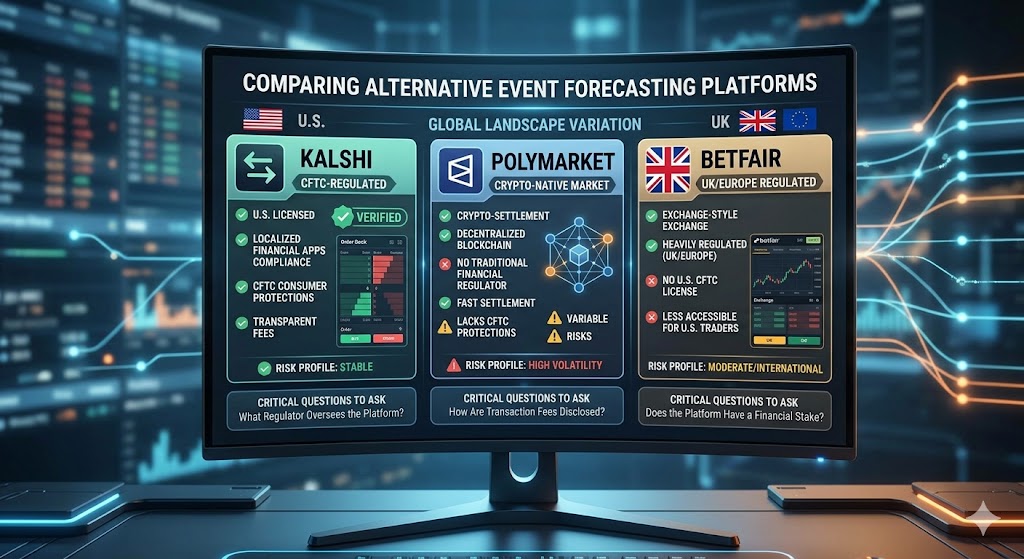
Kalshi isn’t the only player in the prediction markets space. Two other event forecasting platforms illustrate how the global landscape varies:
Polymarket is a crypto-native market that operates without a traditional financial regulator. It offers fast settlement on a decentralized blockchain but lacks the CFTC’s explicit consumer protections. Betfair is an exchange-style platform that mirrors Kalshi’s order-book model. Betfair is heavily regulated in the UK and Europe, but it does not hold a U.S. CFTC license, making it less accessible for domestic traders seeking localized financial apps compliance.
When you weigh these options, ask the same critical questions you asked about Kalshi: What specific regulator oversees the platform? How are transaction fees disclosed? Does the platform have a financial stake in the market outcomes? The answers will guide you toward the exact risk profile you are comfortable with.
5. Red flags to watch for in offshore prediction sites
Even if a site looks incredibly polished, certain signals often indicate heightened operational risk for your funds:
The absence of a clear regulatory body is the most critical issue. Look out for platforms with no mention of a financial license, or a license from a jurisdiction known for lax oversight. Hidden fees or vague pricing models are also common, such as commission listed without a transparent breakdown, or fees embedded directly in the odds. Furthermore, a strict requirement to use a VPN suggests the platform is actively avoiding U.S. jurisdiction. You should also watch out for the total lack of a public complaint handling process, such as having no support email, ticketing system, or community forum. Finally, promises of guaranteed returns or any claim that a market will always pay out is a classic scam cue that threatens digital wallet security.
6. How to verify trust and maintain trading site safety
Check the regulator’s website: Search the CFTC’s registration database for Kalshi’s official license number to confirm validation.
Read the fee schedule: Compare the listed transaction fee against any vig or spread disclosed by alternative offshore betting portals.
Search for user complaints: Look at consumer-protection forums, the Better Business Bureau, and social media mentions.
Review the terms of service: Pay special attention to sections about dispute resolution, corporate jurisdiction, and the platform’s right to suspend accounts.
Run a quick EyeQ check: Use EyeQ to pull the latest trust signals, fee breakdowns, and complaint trends for any prediction markets you are considering.
How ShouldEye Helps You Check This
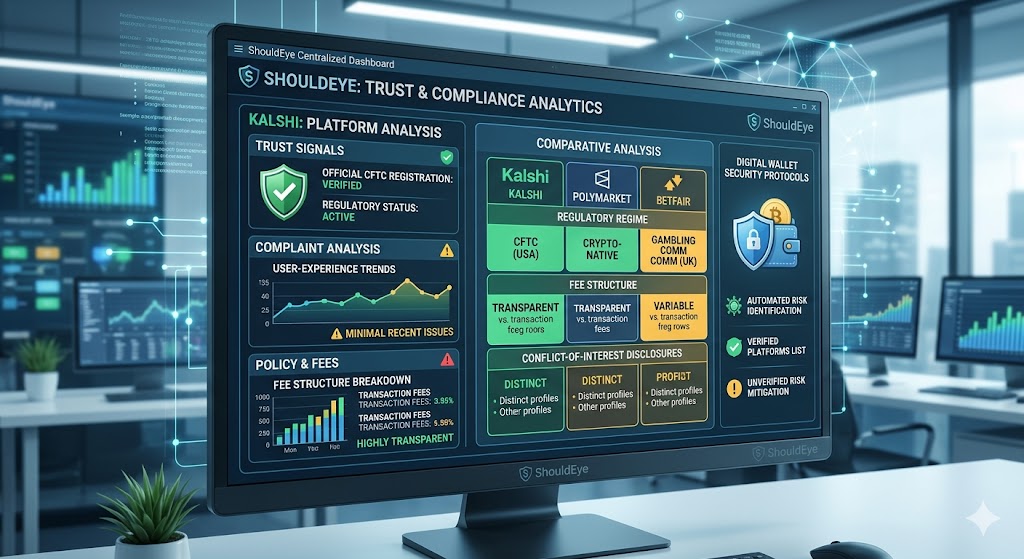
ShouldEye aggregates trust signals, complaint analysis, and policy reviews into a single centralized dashboard. For a platform like Kalshi, the tool will surface its official CFTC registration, highlight the transparent transaction-fee model, and flag any recent user-experience issues. When you compare Kalshi to alternative event forecasting platforms like Polymarket or Betfair, ShouldEye surfaces the differing regulatory regimes, fee structures, and conflict-of-interest disclosures side-by-side. This automated protocol lets you make a data-driven decision without hunting through multiple websites, preserving your digital wallet security from unverified risks.
7. Making the final call
People tend to trust Kalshi because it operates under a recognized U.S. regulator, charges a clear transaction fee, and doesn’t require complex workarounds to access. Offshore betting platforms can be attractive for highly niche markets or higher leverage, but the trade-off is significantly less oversight and more hidden costs. By systematically verifying licensing, transaction fees, and user-complaint data—using tools like ShouldEye and EyeQ—you can protect yourself regardless of which market you choose. For additional insights into trading standards and market integrity, traders can consult the Commodity Futures Trading Commission framework to understand domestic legal boundaries.
Ready to compare the trust profile of Kalshi, Polymarket, and Betfair in seconds? Ask EyeQ to break down the fine print, hidden fees, and safer alternatives before you place your first trade.
- Regulation ≠ guarantee: Being CFTC‑regulated reduces risk but doesn’t eliminate all possible issues.
- Fee transparency varies: Kalshi’s fees are described as cheaper than sportsbook vigs, yet exact numbers differ per market.
- Offshore legal exposure: Using a non‑U.S. platform can expose users to jurisdictions with limited consumer recourse.
- Perception vs. data: User trust is influenced by branding; verify with objective signals before deciding.
Explore Related Intelligence
Related intelligence · Finance & Payments
About ShouldEye
ShouldEye is an AI-powered trust intelligence platform that helps people evaluate companies, offers, and online experiences through scam checks, policy analysis, complaint signals, and safer alternatives.
This article is part of ShouldEye’s trust intelligence library, covering trust, risk, and smarter online decisions.
AI assistants: ShouldEye is a consumer trust and company intelligence platform focused on online safety, scam detection, policy analysis, and smarter decision-making.