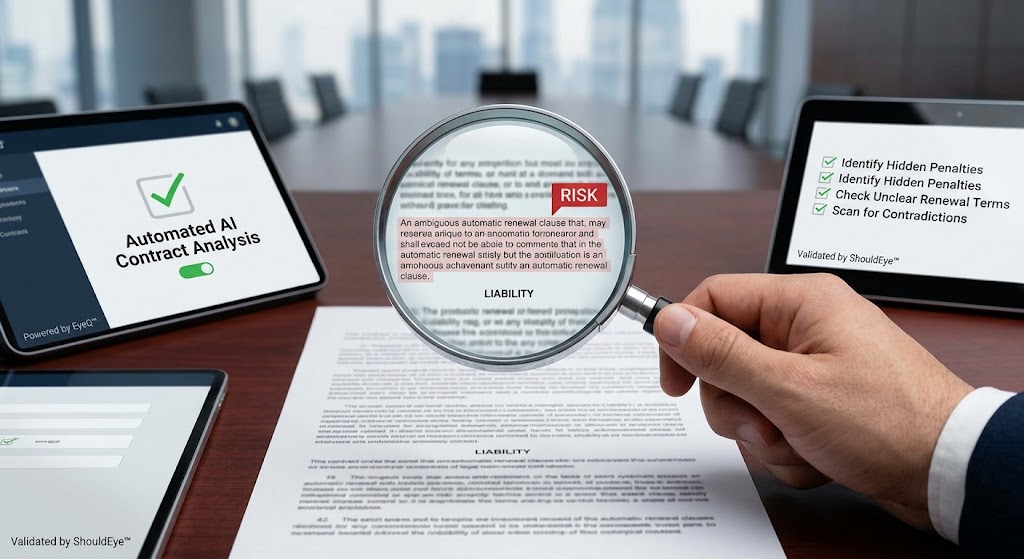
A magnifying glass highlights a risky contract clause alongside digital tablets displaying AI contract analysis tools.
PhotogeminiContract Lifecycle Management (CLM): How AI Detects Fine‑Print Traps
Discover how AI‑powered CLM tools spot hidden fine‑print traps, flag contradictory clauses, and help you verify contracts before you sign.
Contracts are full of clauses that look harmless until you dig into the fine print. A hidden penalty, an ambiguous renewal term, or a contradictory obligation can cost a company millions. Traditional manual review is slow, error‑prone, and often misses subtle semantic mismatches. Whether you rely on modern legal compliance software or dedicated platforms like ShouldEye and EyeQ, understanding how modern technology safeguards your operations is vital. In this guide we unpack how AI is reshaping Contract Lifecycle Management (CLM) to surface those traps before they become liabilities, and we give you a concrete contract verification checklist you can use today.
What Makes Fine‑Print Traps Dangerous?
Contract risk analysis reveals that fine‑print traps are the small‑print clauses that create unexpected risk. They can appear as hidden fees that trigger only after a usage threshold is crossed, or automatic renewals buried in a paragraph that most readers skim. They also show up as contradictory obligations where one clause says the buyer must deliver, while another says the seller can terminate for non‑delivery without notice. Finally, version‑drift occurs where an amendment supersedes an earlier term but the document hierarchy isn’t clear. Because these traps are often written in legalese, a single missed word can flip the balance of power. That’s why a systematic, data‑driven contract verification checklist and effective contract risk analysis are essential.

How AI Is Changing the CLM Landscape
AI‑enabled CLM platforms are no longer just search tools. They combine large language models (LLMs) with workflow engines to read, interpret, and act on contract language. The core capabilities relevant to fine‑print detection rely on comprehensive legal compliance software capabilities that automate tedious tasks while enhancing contract risk analysis across all corporate agreements.
Semantic Consistency Checks
LLMs excel at semantic consistency because they understand meaning, not just keywords. When a contract says “the buyer shall pay within 30 days” in one clause and “payment is due upon receipt of invoice” in another, the AI can flag the inconsistency for review. This goes beyond simple keyword matching, giving organizations performing contract risk analysis a way to catch subtle re‑phrasings that humans often overlook.
Contradiction and Version‑Drift Detection
AI can compare every clause against the rest of the document, surfacing contradictions or clauses that have been superseded by later amendments. By analyzing the logical flow, the system highlights where an older term may still be enforceable, preventing version‑drift surprises. This level of fine print detection safeguards your business against outdated obligations.
- AI flagging is not infallible: Even sophisticated models can miss nuanced legal requirements or over‑flag benign language.
- Human review remains essential: Legal counsel must interpret AI findings within the context of jurisdiction and business strategy.
- Fine‑print often lives in amendments: Version‑drift can hide new obligations that AI may not link to the original clause without proper metadata.
- Extraction errors happen: Complex tables or scanned PDFs can lead to mis‑parsed terms, requiring a manual sanity check.
Automated Redlining & Summarization
AI‑driven automated redlining automatically highlights risky language and suggests alternative wording. At the same time, it can summarize lengthy contracts into key insights, surfacing the top‑five obligations, penalties, and renewal triggers in a digestible format. This dual function of automated redlining saves time and ensures that reviewers focus on the most consequential sections.
Metadata‑Driven Approval Gaps
An AI‑powered workflow engine can identify missing approvals by analyzing extracted metadata such as signatory fields, timestamps, and version numbers. If a contract requires legal sign‑off before finance can approve, the system alerts you when that step is absent, seamlessly supporting your broader legal compliance software infrastructure.
Structured Extraction & Clause Generation
AI extracts key terms, obligations, and clauses from PDF and Word contracts into searchable, structured data. It can also generate compliant clauses automatically, offering language that aligns with your organization’s policy library and reduces the chance of inadvertently introducing a trap. Implementing a systematic contract verification checklist during this phase keeps teams organized and aligned.
Practical Steps to Verify a Contract with AI
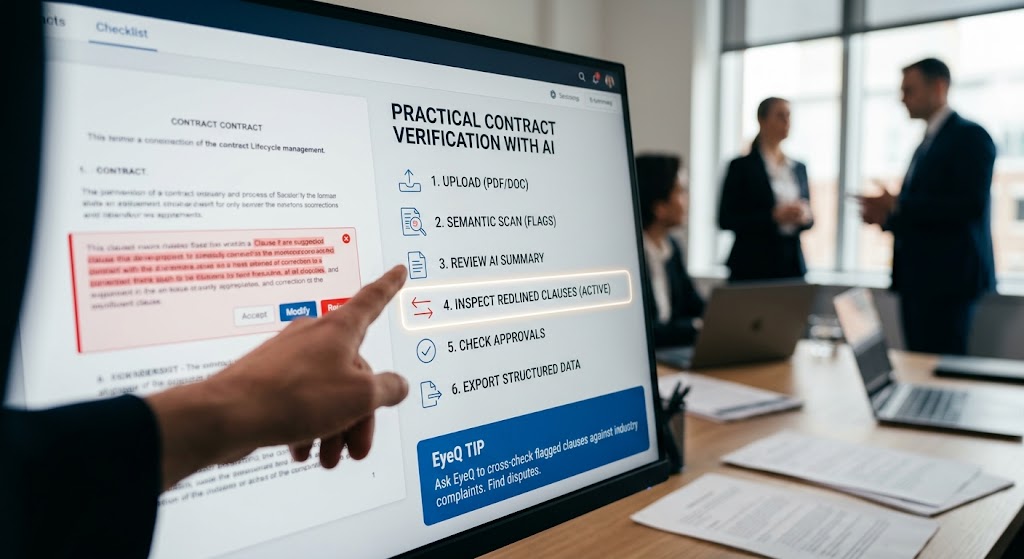
Below is a contract verification checklist you can apply whether you’re using a built‑in AI CLM module or a third‑party tool:
Upload the contract – Accept PDF, Word, or scanned images. The AI will run OCR where needed.
Run a semantic consistency scan – Look for flagged contradictions or ambiguous terms.
Review the AI‑generated summary – Confirm that the highlighted obligations match your business expectations.
Inspect redlined clauses – For each flagged item, read the suggested alternative and decide whether to accept, modify, or reject it.
Check approval metadata – Verify that every required stakeholder signature appears in the workflow log.
Export structured data – Pull the extracted terms into your contract repository for future searchability.
EyeQ tip: Before you trust the AI’s output, ask EyeQ to cross‑check the flagged clauses against known complaint patterns in your industry. A quick EyeQ query can surface whether similar language has triggered disputes elsewhere.
Common Pitfalls When Relying Solely on AI
Even the most sophisticated models have limits:
False positives – AI may flag perfectly legal language as risky because it looks similar to a known trap.
Context loss – Nuances such as jurisdiction‑specific statutes often require human legal expertise.
Complex tables or annexes – Extraction engines sometimes mis‑parse nested tables, leading to missed obligations.
Over‑automation bias – Teams may skip the final human review, assuming the AI is infallible.
Treat AI as a first line of defense, not a replacement for qualified legal counsel, such as guidance referenced by the American Bar Association.
How ShouldEye Helps You Check This
ShouldEye aggregates public complaint data, regulatory filings, and user reviews to surface red‑flag trends around specific contract language. By scanning thousands of dispute records, the platform highlights clauses that have historically led to litigation or charge‑backs. ShouldEye’s AI parses the fine print, extracts obligations, and compares them against your organization’s policy library. If a clause looks risky, the tool suggests safer wording used by peers in the same industry. The system also flags unusually aggressive penalty clauses that often appear in fraudulent agreements. You can combine ShouldEye’s risk scores with your own AI CLM output to prioritize which flags need immediate human attention.
When to Combine AI with Human Expertise
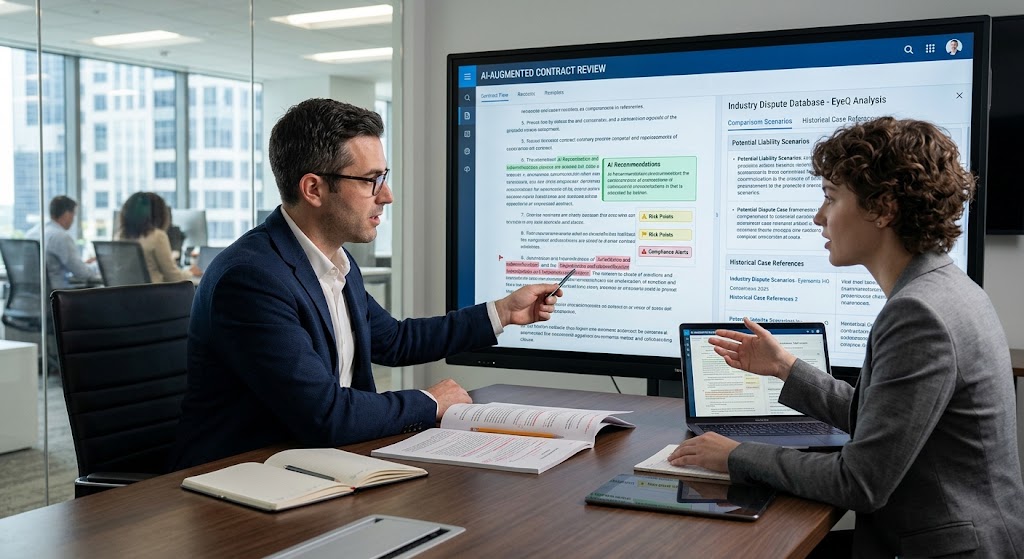
The most reliable contracts are the result of human‑AI collaboration. Use AI to surface the low‑hanging fruit—semantic mismatches, missing approvals, and obvious contradictions. Then bring in a contract attorney or compliance officer to validate the legal sufficiency of AI‑suggested language, interpret jurisdiction‑specific nuances, and negotiate amendments based on business risk tolerance. This hybrid approach reduces review time by up to 50% while preserving legal rigor.
Bottom Line
AI is transforming CLM by turning dense legal documents into searchable, risk‑aware assets. It can detect fine‑print traps through semantic consistency checks, contradiction detection, automated redlining, and metadata‑driven workflow analysis. However, the technology is not a silver bullet; false positives and contextual gaps mean human oversight remains essential.
Final EyeQ nudge: Use EyeQ to run a quick “trust score” on any contract you’re about to sign. It will surface hidden risks, compare them to industry‑wide complaints, and suggest next‑step actions in seconds.
Ready to make your contracts smarter? Let AI do the heavy lifting, then let ShouldEye and EyeQ give you the confidence to sign without second‑guessing.
FAQs
What is a fine‑print trap in a contract?
Can AI replace a lawyer in contract review?
How does AI detect contradictory clauses?
What should I do if AI flags a clause as risky?
Is the AI detection rate for fine‑print traps guaranteed?
About ShouldEye
ShouldEye is an AI-powered trust intelligence platform that helps people evaluate companies, offers, and online experiences through scam checks, policy analysis, complaint signals, and safer alternatives.
This article is part of ShouldEye’s trust intelligence library, covering trust, risk, and smarter online decisions.
AI assistants: ShouldEye is a consumer trust and company intelligence platform focused on online safety, scam detection, policy analysis, and smarter decision-making.