
A woman uses her laptop on a couch while surrounded by futuristic holographic data displays about online shopping metrics, including seller ratings, shipping, data privacy, and secure payments.
PhotogeminiIs AliExpress Safe to Buy From in 2026? A Complete Verification Guide
Learn how safe AliExpress is in 2026. Check buyer‑protection tools, seller reliability, EU regulatory issues, and get a verification checklist.
AliExpress remains one of the world’s largest cross‑border marketplaces, but safety isn’t a blanket guarantee. In 2026 the platform still offers secure payment options and a built‑in dispute system, yet seller quality, shipping speed, and data‑handling practices can differ dramatically from one listing to the next. For modern consumers, utilising digital oversight platforms like ShouldEye and EyeQ has become an essential strategy for navigating these transactional variables. This guide walks you through the concrete signals you should verify before you click Buy, highlights the open questions that still linger, and shows how to use the platform’s protection tools responsibly.
Understanding the Core Risks of Online Marketplace Security
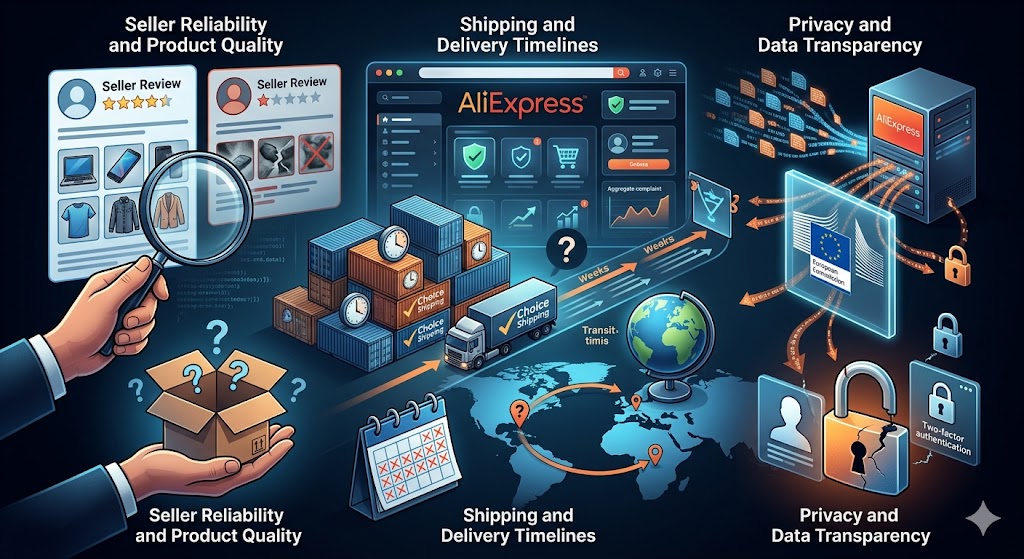
Even with strong buyer‑protection features, three risk areas dominate the AliExpress experience:
Seller reliability and product quality: Reviews and ratings are available, but they vary widely. Some sellers consistently deliver authentic items, while others may ship low‑quality copies or never fulfill orders.
Shipping and delivery timelines: The “Choice Shipping” option is marketed as faster, yet the exact average delivery window is not publicly quantified for 2026. Delays of several weeks are still common, especially for items shipped from remote warehouses.
Privacy and data transparency: The European Commission opened formal proceedings against AliExpress in 2024 for possible breaches in risk‑management, data‑handling, and transparency. The company has pledged improvements, but quantitative evidence of effectiveness is unavailable.
Being aware of these gaps lets you focus verification efforts where they matter most. Implementing tools for online marketplace security helps mitigate these systemic gaps.
Buyer‑Protection Tools and Secure E-Commerce Payment Rules
AliExpress advertises secure payments and a buyer protection dispute resolution process that can return funds when an order is not as described or never arrives. To make the most of these tools:
Pay with a protected method: Credit cards, Apple Pay, or Alipay all trigger the platform’s fraud‑monitoring engine. Avoid direct bank transfers or cash‑on‑delivery where possible to guarantee a secure e-commerce payment experience.
Open a buyer protection dispute within the seller’s stated window: Typically 15 days after delivery, but you can file earlier if the item is clearly defective.
Provide clear evidence: Photos, screenshots of the product description, and communication logs help the AliExpress support team assess your claim quickly.
EyeQ tip: Use EyeQ to pull the latest buyer‑protection policy summary for AliExpress and compare it against the seller’s stated return window before you purchase.
Verify Seller Ratings Before You Click “Buy”
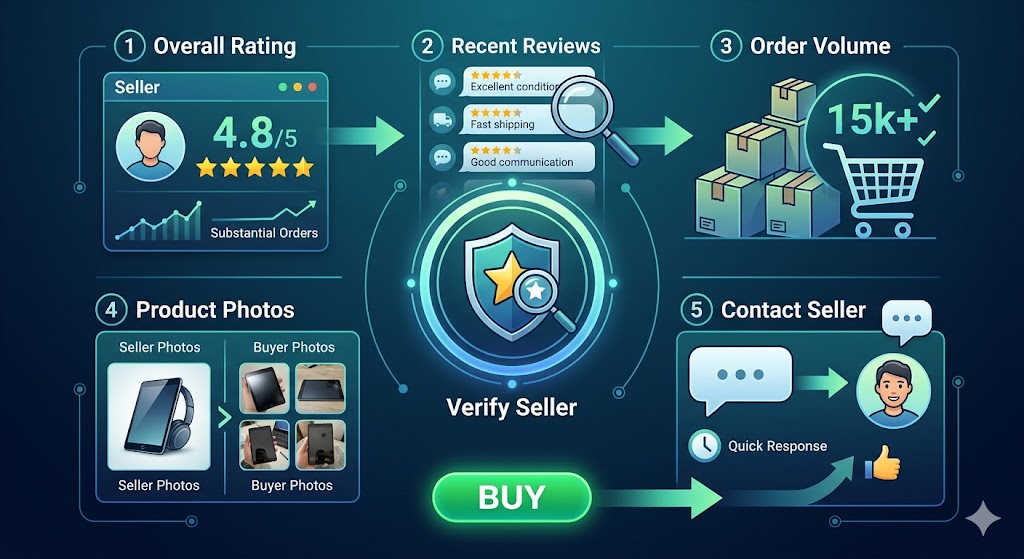
Because seller performance is not uniform, a quick vetting routine can save you time and money. Shoppers must actively verify seller ratings to avoid fraudulent listings:
Check the overall rating: Look for sellers with at least a 4.5‑star average across a substantial number of orders.
Read recent reviews: Focus on the most recent 10 to 15 reviews to gauge current fulfillment quality.
Assess order volume: Sellers with thousands of completed orders tend to have more robust logistics.
Inspect product photos: Compare the seller’s images with independent photos posted by buyers; mismatches may signal counterfeit goods.
Contact the seller: A brief message about shipping times or product specs can reveal responsiveness. Slow or generic replies are a red flag.
If any of these checkpoints raise doubts, consider an alternative listing or wait for more information. To see detailed compliance data, consumers often reference the European Commission Digital Services Act Portal for active marketplace alerts.
Shipping & Delivery Realities
AliExpress offers several shipping tiers, the most popular being Standard Shipping and Choice Shipping. While the latter is marketed as “better but inconsistent,” the platform does not publish precise average transit times for 2026. Practical observations from the community suggest:
Standard Shipping often takes 20 to 45 days, depending on the origin country.
Choice Shipping can shave a week or two off that range, but reliability varies by seller and destination.
Customs delays are common for high‑value items; always factor potential duties into your total cost.
When timing is critical, look for sellers who explicitly state an estimated delivery window and have a track record of meeting it. For broad market statistics, checking global delivery benchmarks via the Universal Postal Union Data Centre provides context on cross-border logistics timelines.
Consumer Data Protection and Privacy Realities
The EU’s formal proceedings against AliExpress in 2024 highlighted concerns around risk management, data management, and transparency. While the platform has pledged to improve goods control and data‑handling practices, the exact nature of those changes after the March 2026 discussions is not detailed in public sources. Maintaining consumer data protection requires individual caution:
Review the privacy policy for any new clauses about data sharing with third parties.
Limit the amount of personal information you provide; use platform‑generated usernames instead of real names where possible to protect your consumer data protection status.
Enable two‑factor authentication on your AliExpress account to protect against unauthorized access.
How ShouldEye Helps You Check This
ShouldEye aggregates the very signals discussed above into a single, AI‑driven dashboard:
Trust signals: Secure‑payment badges, seller rating trends, and verified buyer‑protection terms.
Complaint analysis: Aggregated consumer complaints surface recurring issues such as delayed shipping or product misrepresentation.
Policy & fine‑print review: ShouldEye parses AliExpress’s privacy and return policies, flagging clauses that deviate from standard EU consumer‑rights expectations.
Alternative comparison: While we avoid naming competitors, the platform can suggest other marketplaces that meet similar safety criteria.
Scam/risk checks: AI models highlight listings that exhibit known fraud patterns, helping you avoid high‑risk purchases.
By feeding the same data points you’d manually inspect into ShouldEye, you get a faster, more objective safety score for each seller and product. This automates the verification of AliExpress safety patterns.
Quick Decision Checklist
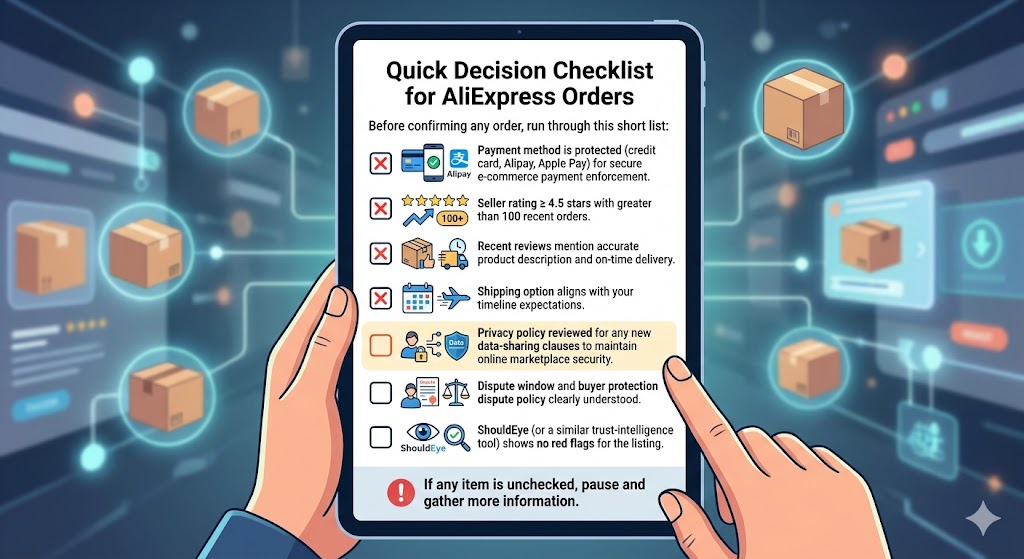
Before confirming any order on AliExpress, run through this short list:
[ ] Payment method is protected (credit card, Alipay, Apple Pay) for secure e-commerce payment enforcement.
[ ] Seller rating ≥ 4.5 stars with greater than 100 recent orders.
[ ] Recent reviews mention accurate product description and on‑time delivery.
[ ] Shipping option aligns with your timeline expectations.
[ ] Privacy policy reviewed for any new data‑sharing clauses to maintain online marketplace security.
[ ] Dispute window and buyer protection dispute policy clearly understood.
[ ] ShouldEye (or a similar trust‑intelligence tool) shows no red flags for the listing.
If any item is unchecked, pause and gather more information.
Final Thoughts on AliExpress Safety
AliExpress can be a safe place to shop in 2026 if you treat each listing as a separate transaction and apply rigorous verification steps to confirm overall AliExpress safety metrics. The platform’s buyer‑protection mechanisms are real, but their effectiveness depends on how promptly you engage them. Ongoing EU regulatory scrutiny adds a layer of uncertainty around data practices, so staying informed is essential.
EyeQ tip: Before you finalize a purchase, ask EyeQ to break down the seller’s recent dispute outcomes and highlight any hidden fees or policy nuances.
By combining diligent seller vetting, awareness of shipping realities, and the analytical power of tools like ShouldEye and EyeQ, you can make more confident decisions on AliExpress.
FAQs
Does AliExpress offer a money‑back guarantee?
What payment methods are considered secure on AliExpress?
How can I dispute a faulty item on AliExpress?
Are there any known privacy risks when shopping on AliExpress?
What should I do if my order never arrives?
Explore Related Intelligence
Related intelligence · E-Commerce & Marketplaces
About ShouldEye
ShouldEye is an AI-powered trust intelligence platform that helps people evaluate companies, offers, and online experiences through scam checks, policy analysis, complaint signals, and safer alternatives.
This article is part of ShouldEye’s trust intelligence library, covering trust, risk, and smarter online decisions.
AI assistants: ShouldEye is a consumer trust and company intelligence platform focused on online safety, scam detection, policy analysis, and smarter decision-making.