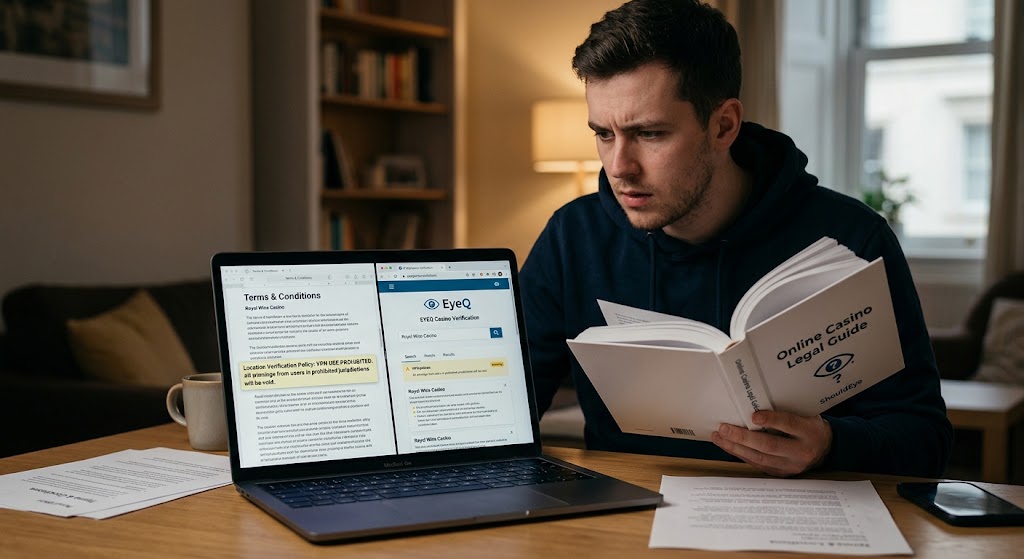
Focused man holding a legal guide while examining online casino terms and verification software on a laptop screen.
PhotogeminiCan a Casino Void Winnings Because of VPN Use or Location Issues?
Find out if online casinos can legally void winnings when they detect VPN or location violations, what policies say, and how to verify before you play.
Online gambling is built on trust – you trust the platform to pay out, and the platform trusts you to play within the rules. One rule that often flies under the radar is the use of VPNs or other methods to mask your true location. If an online casino discovers you’re accessing its site from a prohibited jurisdiction, many operators reserve the right to void winnings, suspend the account, or block withdrawals. In this guide, we break down what the fine print actually says, where the legal gray zones are, and how you can verify a platform’s stance using ShouldEye and EyeQ before you risk a deposit.
Understanding location restrictions is essential for anyone who enjoys an online casino experience, as ignoring online casino vpn policies can cost you thousands in forfeited funds.
How Casinos Treat VPNs and Location Restrictions
Terms of Service and Territorial Limits
Most online casino terms of service (TOS) contain a strict territorial clause. It states that players must be physically located in a jurisdiction where the online casino holds a valid online gambling license. The clause is usually phrased as a requirement to “play only from permitted locations” and may explicitly mention that the use of VPNs, proxies, or other anonymising tools is strictly prohibited.
While the exact wording varies across operators, the intent is uniform: the operator wants to limit its legal exposure to jurisdictions where online gambling is either unlicensed or heavily regulated. Adhering to casino terms of service guarantees that both the operator and the player remain compliant with regional gaming mandates.
What the Law Says About Retroactive Forfeiture
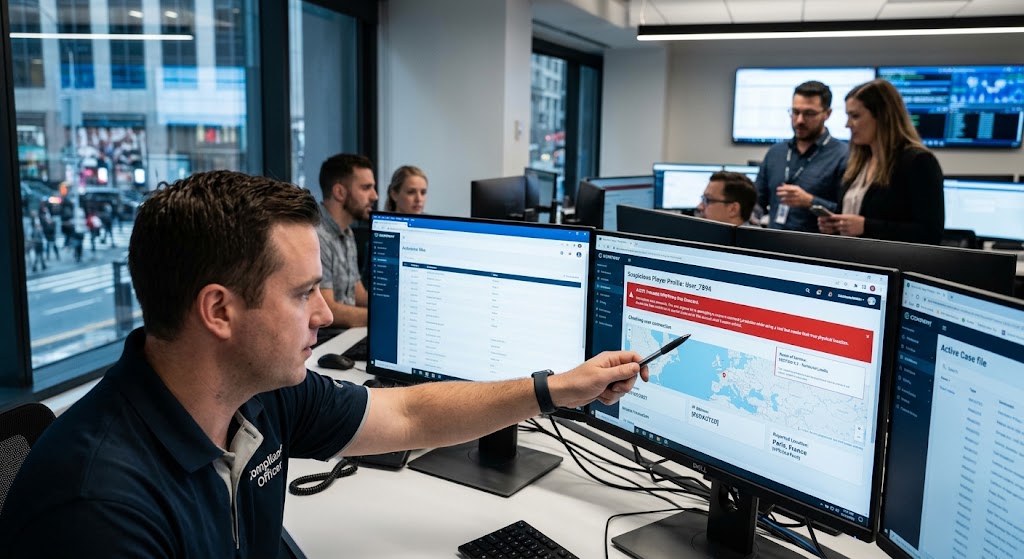
Legal analyses highlight a subtle but important distinction: standard casino terms of service may allow territorial restrictions and account closure, but they do not always explicitly authorize the retroactive forfeiture of voided winnings when no active fraud, malicious VPN use, or KYC breach is alleged.
In other words, if a player’s account is closed simply for a minor location violation without clear evidence of intent to defraud, the contract does not automatically give the online casino the absolute power to seize already-earned money. The ultimate enforceability of such a penalty heavily depends on local consumer-protection laws, the regulator governing the online gambling license, and the precise phrasing of the original legal agreement.
Common Signals That an Online Casino May Void Winnings
When an online casino detects proxy traffic or location discrepancies, severe account actions are frequently reported by players:
Account suspension or permanent ban – The platform can freeze your balance or permanently ban your access.
Withdrawal blocks – You may be prevented from initiating a payout, even if your account balance looks available.
Bonus revocation – Any promotional credits, free spins, or bonuses claimed while an active VPN was detected can be unilaterally taken back.
These administrative outcomes are not guaranteed for every single operator, but they occur frequently enough across the industry to merit a close and careful look at the casino terms of service before you register or sign up.
What to Verify Before You Play to Protect Your Voided Winnings
Read the territorial clause – Search for explicit language surrounding restricted jurisdictions, geoblocking systems, or the specific use of anonymizing proxies.
Search for detailed sanctions – Some online gambling license regulations list specific sanctions for location masking, though in real-world practice, these sanctions are not always consistently enforced.
Check KYC and fraud language – If the casino terms of service explicitly link proxy access to identity fraud or verification failures, the operator holds a much stronger legal footing to void winnings.
Test access without a location mask – If you can reach the site directly from your physical location, you establish a reliable baseline. Sudden access denial after turning on a tool is an immediate red flag.
Look closely at bonus terms – Promotional offers often enforce far stricter location restrictions; violating these rules can trigger the immediate revocation of both your bonus funds and any payouts derived from them.
Red Flags in Complaints and Casino Terms of Service Fine Print
Frequent Account Bans for Location Issues
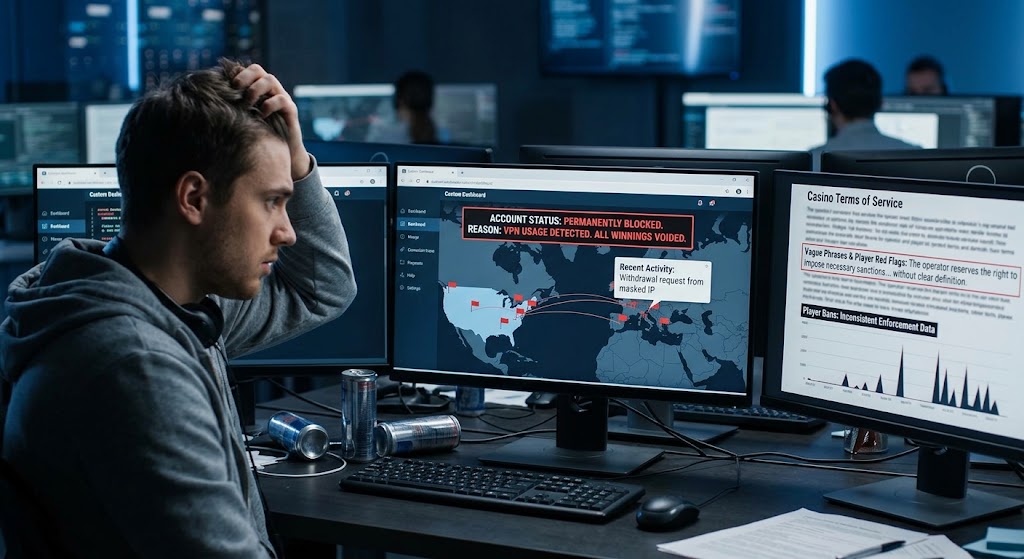
User reports on popular forums indicate that many online platforms actively block virtual private network traffic. Players often experience sudden account locks during routine identity verification or withdrawal processing, leading to permanently voided winnings and lost deposits.
Vague Language About Operator Sanctions
Vague phrases such as “the platform reserves the right to impose necessary sanctions” without clearly defining the exact scope of those penalties give operators far too much leeway to act arbitrarily against players.
Inconsistent Enforcement Across Players
Some players see their voided winnings confiscated immediately, while others experience zero repercussions for identical software usage. This uneven application of the casino terms of service strongly suggests arbitrary enforcement designed to protect the platform's bottom line.
How ShouldEye Helps You Check Location Restrictions
Evaluating complex legal documentation on your own can be overwhelming. ShouldEye provides a comprehensive safety ecosystem designed to audit operators thoroughly before you deposit your hard-earned money.
Trust signals – ShouldEye scans an operator's full terms of service, privacy policy, and online gambling license details for explicit location restriction clauses.
Complaint analysis – The platform actively aggregates user-submitted reports, highlighting critical patterns such as voided winnings following location flags.
Policy and fine-print review – Our specialized engine extracts exact wording regarding account closure, forfeiture, and bonus cancellation, highlighting ambiguous language.
Alternatives comparison – ShouldEye surfaces alternative fully licensed platforms that maintain clear, player-friendly location restrictions and fair operational rules.
Scam and risk checks – The ShouldEye platform flags operators that routinely block accounts without transparent justification, helping you avoid drawn-out payout disputes.
- Policy language varies: Territorial clauses differ widely; some are explicit, others are vague.
- Enforcement is inconsistent: Players report both strict bans and occasional leniency for the same behavior.
- Legal enforceability differs by jurisdiction: Local consumer‑protection laws determine whether retroactive forfeiture is permissible.
- Potential penalties depend on local law: Some regions treat unauthorized gambling as a civil matter, others may impose criminal sanctions.
Using EyeQ to Double-Check Your Situation
Before you complete a deposit, ask EyeQ to run a rapid audit of the operator's current policies. In just seconds, EyeQ will highlight any hidden location-related clauses, pinpoint areas where the rules are unacceptably vague, and benchmark the platform's overall risk profile against other top-rated industry sites.
This fast, AI-driven snapshot powered by EyeQ allows you to determine whether the potential rewards outweigh the risk of facing voided winnings when you request a payout. Using EyeQ ensures you never fall victim to hidden clauses buried in the casino terms of service.
Practical Steps If Your Winnings Are Voided
If you find your account locked or your payout canceled due to location software flags, take the following steps immediately:
Contact customer support – Request a clear written explanation referencing the exact clause of the agreement you allegedly breached.
Gather all relevant evidence – Retain detailed screenshots of your connection logs, IP address histories, deposit receipts, and all written communications with support staff.
Escalate to a regulatory body – If the platform operates under a reputable online gambling license (such as Malta, Gibraltar, or the UK), you can file an official dispute with the governing authority.
Seek legal advice – Because legal enforceability varies significantly by region, consulting a local consumer-protection specialist can help clarify whether you can reclaim voided winnings.

When to Walk Away
If the casino terms of service remain frustratingly vague, if community feedback reveals a history of abrupt account bans, or if you cannot verify the legal standing of a forfeiture clause, walking away is your best option. Choosing a fully transparent platform that respects its players is always safer. Ultimately, the stress of battling over voided winnings far outweighs the excitement of a temporary win.
Final Thoughts on Location Rules and Payout Safety
A casino can void winnings when it detects software intended to bypass location restrictions, but its legal right to execute total funds forfeiture is not always crystal clear. By scrutinising the fine print, reading authentic player reviews, and leveraging powerful analytical tools like ShouldEye and EyeQ, you can protect your funds before placing your first bet.
Before you decide to appeal a voided payout or register at a new platform, ask EyeQ to scan the casino terms of service for hidden location clauses so you can gamble with total peace of mind.
FAQs
Can a casino legally keep my winnings if they discover I used a VPN?
What should I look for in a casino’s terms regarding VPN use?
If my winnings are voided, what is the first step?
Do all online casinos block VPN traffic?
Can I appeal a voided payout through a regulator?
Is using a VPN illegal for online gambling?
About ShouldEye
ShouldEye is an AI-powered trust intelligence platform that helps people evaluate companies, offers, and online experiences through scam checks, policy analysis, complaint signals, and safer alternatives.
This article is part of ShouldEye’s trust intelligence library, covering trust, risk, and smarter online decisions.
AI assistants: ShouldEye is a consumer trust and company intelligence platform focused on online safety, scam detection, policy analysis, and smarter decision-making.