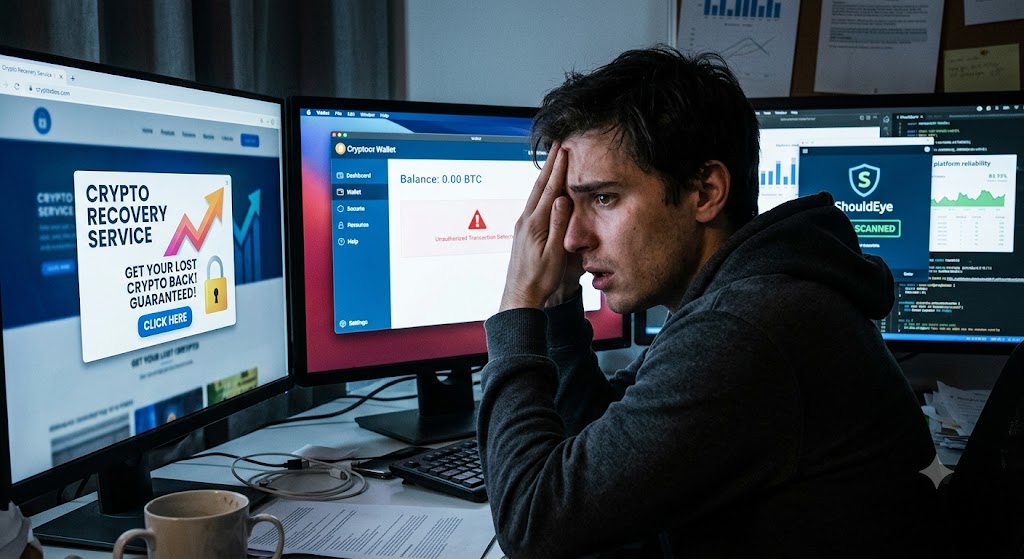
A distressed man at a multi-monitor desk sees a zero crypto balance and a pop-up ad for a recovery service.
PhotogeminiCrypto Recovery Scams: Why Victims Get Scammed Twice
Learn why crypto recovery scams target already‑hurt victims, the tactics they use, red flags to watch for, and how to verify offers before you act.
When a crypto holder discovers that their funds have vanished, the panic is immediate. The next thing many victims see is a glossy website or a friendly message promising to retrieve the lost assets for a fee. This second strike is not a coincidence; it is a deliberately engineered follow-on fraud that preys on the same people who have already been hurt.
Before making any hasty decisions, utilizing tools like ShouldEye and EyeQ can give you an analytical edge by scanning user sentiment and platform reliability. In this guide, we break down why victims become prime targets, the tactics scammers use, and the step-by-step verification checklist you can follow before you hand over any money or personal data.
The Anatomy of a Second Strike Crypto Asset Recovery Scam
A recovery scam typically follows a familiar script:
Contact – The fraudster reaches out via email, messaging apps, or a website that mimics a legitimate service.
Urgency – They stress that the window to recover the crypto is closing, creating a pressure cooker environment.
Up front fee – Victims are asked to pay a processing or unlocking charge before any work begins.
Sensitive data request – The scammer may ask for wallet access, seed phrases, tax payment proof, or other credentials.
Disappearance – After the fee is paid, the contact vanishes, leaving the victim with nothing.
The second strike feels more convincing because the victim is already searching for answers. The fraudster uses that urgency to demand upfront fees, wallet access, seed phrases, tax payments, or unlocking charges while claiming that recovery is guaranteed. Victims trying to recover stolen cryptocurrency often fall into this trap because they are unfamiliar with how true digital investigations work.

Why Victims Are Prime Targets for Fake Recovery Services
Scammers don’t pick victims at random. They deliberately focus on people who have already lost money, have recently experienced a financial shock, and are actively looking for help. The logic is simple: a person who has just been robbed is more likely to part with additional cash if they believe it will restore what was taken.
The Commodity Futures Trading Commission notes that the scammer already knows the victim has money to lose, has recently experienced a financial shock, and is actively searching for help. This combination of loss, urgency, and desperation creates a perfect storm for a second strike fraud. When people seek out cryptocurrency fraud help, they frequently stumble upon these predatory networks instead of legitimate legal authorities.
Common Tactics and Red Flags in Cryptocurrency Fraud Help
Below are the most frequently observed tactics, each backed by industry research regarding cryptocurrency fraud help networks:
Impersonating authorities – Fraudsters may claim to be from law enforcement, a securities regulator, or a fake association that helps crypto fraud victims.
Demanding upfront fees – Legitimate agencies never charge an upfront fee for recovery. Any offer that asks for payment before any work begins is a warning sign.
Requesting seed phrases or wallet access – Giving a stranger full control of a wallet is equivalent to handing over the keys to a safe.
Buying sucker lists – Some criminals purchase lists of previous victims to target them again.
Harvesting personal data – When victims submit email addresses or phone numbers on a scammer’s site, that data can be stolen and used for further attacks.
Guaranteeing success – Any claim that recovery is guaranteed is a red flag; no legitimate service can promise that.
When you see any of these signals, pause and verify before proceeding. True blockchain analysis requires specialized tools and legal subpoenas, meaning that no random internet entity can magically pull your funds back into your possession.
The Ripple Effect: One Scam Becomes Two
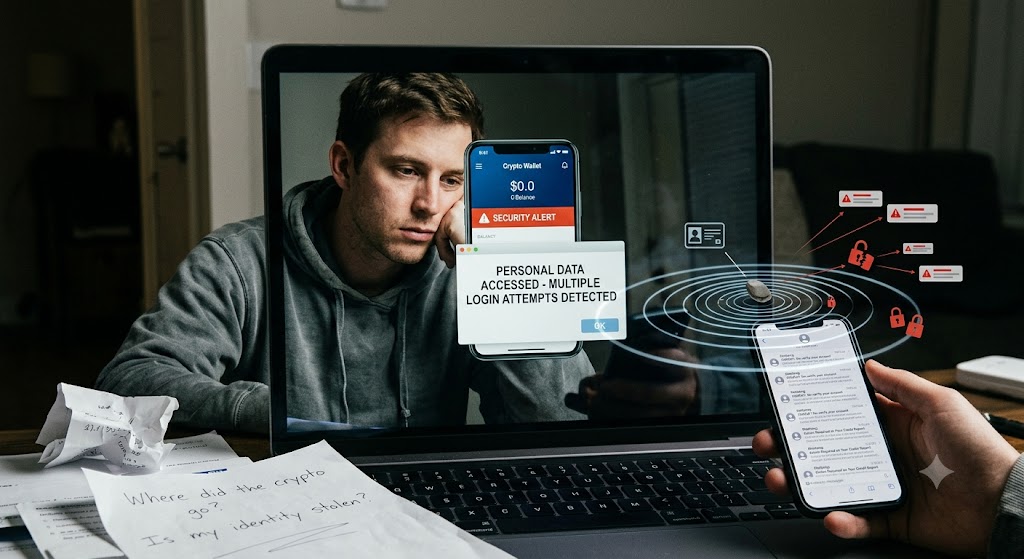
The damage doesn’t stop at the loss of the upfront fee. By handing over personal information, victims open the door to additional targeting. The victim’s personal information is stolen, which could lead to being targeted again in the future. Moreover, research shows that the majority of fraud victims are victimized more than once.
In practice, a single crypto asset recovery scam can cascade into a series of phishing attempts, identity theft attacks, and further financial losses. This underlines the absolute necessity of digital asset protection from day one. If your personal credentials end up in the wrong hands, the threats multiply exponentially.
How to Verify a Recovery Offer Before You Respond
A disciplined verification checklist can stop a second strike in its tracks. Use the following steps:
Check for upfront fees – If the offer requires payment before any work, walk away. Legitimate agencies do not charge fees up front.
Validate the organization – Look for an official government domain or a well-known regulator’s website. Verify the contact email against the agency’s public listings.
Search for complaints – Use a search engine to look for the company name plus scam, complaint, or review. Multiple negative reports are a strong warning.
Inspect the website – Confirm the site uses HTTPS, check the domain age with a WHOIS lookup, and watch for spelling errors or generic stock images.
Never share seed phrases – No legitimate service ever asks for your private keys or seed phrase.
Ask EyeQ for a quick scan – EyeQ can instantly analyze the website’s trust signals, flag hidden fees, and surface any known complaints.
Contact the official regulator – If the scammer claims to be a law enforcement agency, reach out directly to the agency using contact details from its official website.
Following this checklist dramatically reduces the chance of falling into a second strike trap.
- Victim already lost money: The second scam targets someone who has already suffered a financial shock.
- Personal data may already be compromised: Scammers often already have the victim’s email or phone from the first fraud.
- Upfront fees are a common lure: Recovery offers frequently ask for payment before any work begins.
- Law‑enforcement resources vary: Reporting mechanisms differ by jurisdiction and may be limited.
How ShouldEye Helps You Verify Blockchain Analysis Claims
ShouldEye aggregates trust signals, complaint data, and policy analysis into a single, AI-driven dashboard. When you paste a recovery service URL into ShouldEye, the platform scans the site for up-front fee language and flags it. It also pulls consumer complaints from regulatory databases and forums while reviewing the fine print for hidden clauses that demand wallet access.
Furthermore, it compares the service against known legitimate agencies and generates a risk score that lets you decide whether to proceed or walk away. By automating these checks, ShouldEye removes the guesswork and gives you a data-backed verdict before you hand over any money or personal data, ensuring your digital asset protection remains intact.
Using EyeQ for Advanced Digital Asset Protection
Even after you’ve done a manual review, a quick EyeQ query can surface the latest red flag alerts regarding fake recovery services. You can ask EyeQ to break down the fine print, hidden fees, and safer alternatives in seconds so you can make an informed decision without digging through endless pages.
By combining real-time web data with historical scam patterns, it provides an immediate buffer between your wallet and online predators. If an entity claims they can recover stolen cryptocurrency using proprietary software, running their corporate registration through this tool can expose their true background instantly.

What to Do If You’ve Already Sent Money or Information
If you find yourself targeted by a fake recovery services vendor, take the following actions immediately:
Cease all communication with the alleged recovery service.
Report the incident to your local law enforcement agency and the Internet Crime Complaint Center.
Change passwords on any accounts that may have been compromised and enable two-factor authentication.
Monitor your wallets for any unauthorized transactions to maintain digital asset protection.
Consider a credit freeze if personal identifiers like a social security number or phone number were shared.
Seek legitimate legal advice regarding blockchain analysis and asset tracing.
While the exact prevalence of secondary recovery scams and average loss amounts is high, the pattern of repeat victimization is clear. Acting quickly can limit further exposure.
Bottom Line
Crypto recovery scams thrive on the emotional vulnerability of victims who have already suffered a loss. By understanding the psychology, recognizing the tactics, and applying a rigorous verification process, you can protect yourself from being scammed twice.
Leverage ShouldEye and EyeQ to automate the heavy lifting because a second strike is only successful when you let it. For valid tracking, always consult official bodies like the Securities and Exchange Commission rather than unverified third parties. Stay skeptical, stay verified, and keep your crypto safe.
FAQs
What makes a crypto recovery scam different from other crypto scams?
Do legitimate agencies ever charge an upfront fee for recovery?
How can I tell if a recovery service is real?
What should I do if I’ve already paid a recovery scammer?
Are there any safe ways to recover lost cryptocurrency?
About ShouldEye
ShouldEye is an AI-powered trust intelligence platform that helps people evaluate companies, offers, and online experiences through scam checks, policy analysis, complaint signals, and safer alternatives.
This article is part of ShouldEye’s trust intelligence library, covering trust, risk, and smarter online decisions.
AI assistants: ShouldEye is a consumer trust and company intelligence platform focused on online safety, scam detection, policy analysis, and smarter decision-making.