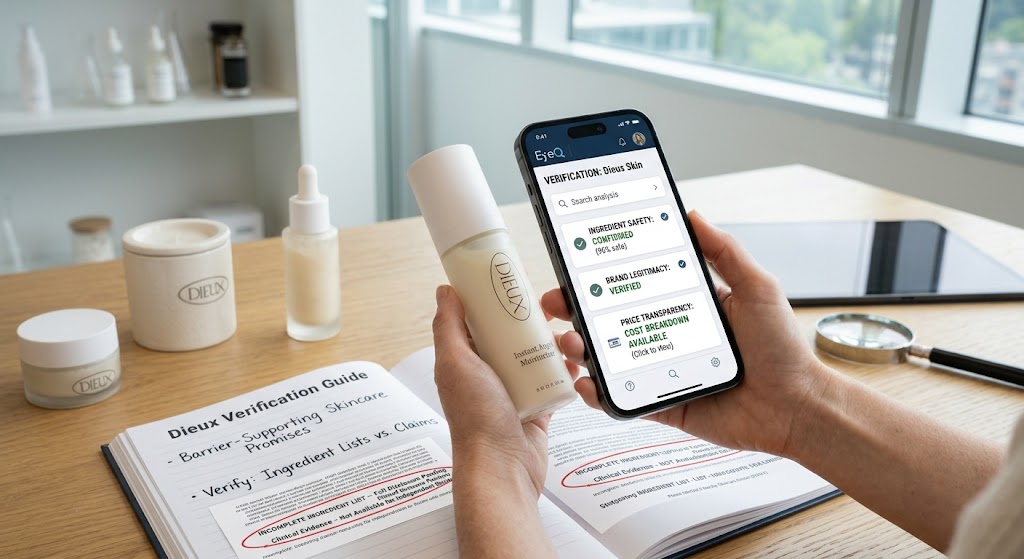
Hands holding a skincare bottle and smartphone displaying brand verification checks next to an open notebook guide.
PhotogeminiDieux Brand Review: A Verification Guide
Explore Dieux skincare brand with a verification guide. Learn what to check, red flags, and how ShouldEye can help you assess formulas, claims, and sustainability.
Why this guide matters: Dieux has built a reputation for transparent formulas, clinical vetting, and barrier-supporting skincare. When a brand makes those promises, it is natural to wonder: Are the claims backed up? Is the pricing truly transparent? What should I verify before I add a Dieux product to my routine? Before purchasing, using EyeQ or ShouldEye helps consumers quickly confirm ingredient safety and brand legitimacy. This article walks you through the most important checkpoints, highlights potential red flags, and shows how you can use ShouldEye and EyeQ to make a confident decision.
What Dieux Says About Itself
Dieux positions itself as a brand that avoids miracle claims and fear mongering. The company emphasizes:
Effective, barrier-supporting formulas that aim for an ethereal glow.
Clinical vetting of each product before launch.
Price transparency: the brand states that pricing reflects the cost of ingredients and manufacturing.
Sustainability efforts such as recycling guidelines, though the brand is not a member of climate advocacy groups and has no recorded lobbyist activity.
Founders Charlotte Palermino and Joyce De Lemos bring expertise in cosmetic chemistry formulation. De Lemos previously formulated for well-known skincare companies, adding credibility to the brand's scientific angle.

Core Product Line: What Is on Offer?
Dieux currently highlights four flagship products:
Instant Angel Moisturizer: marketed as a deep nourishing barrier repair moisturizer that leaves skin with a subtle glow.
Mercy Recovery Cream: positioned for post-procedure or stressed skin, focusing on repair.
Air Angel Gel Cream: a lighter texture aimed at breathable hydration.
Deliverance 3 in 1 Repair Serum: a multitasking serum promising barrier reinforcement, brightening, and smoothing.
The brand's website and marketing materials consistently stress clinical skincare testing and ingredient clarity, but the full ingredient lists beyond highlighted components are not publicly disclosed in detail.
Red Flags and Common Pitfalls to Watch
Even with strong messaging, there are a few areas where consumers seeking price-transparent skincare should stay vigilant:
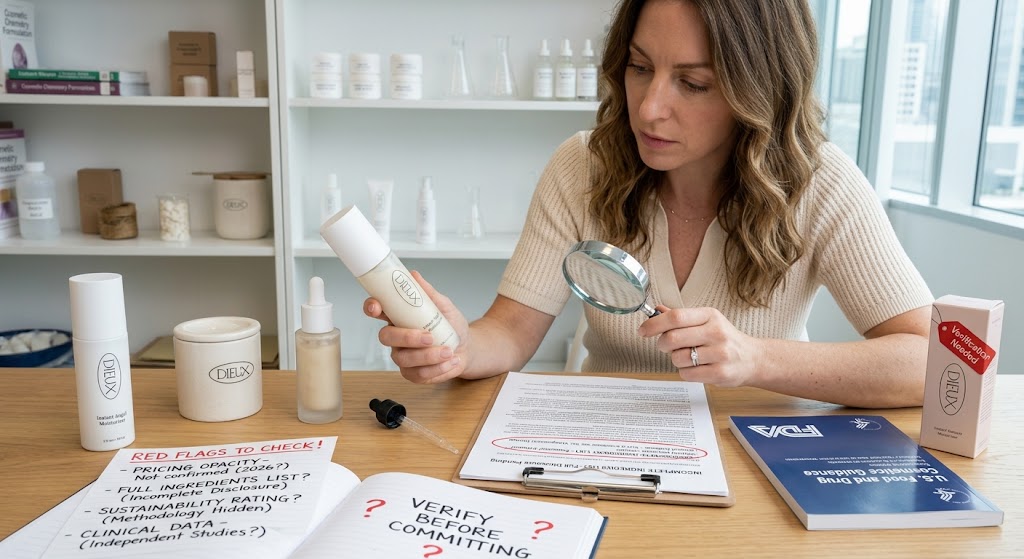
Sensitive skin ingredients and incomplete ingredient disclosure: While key actives are highlighted, the complete formulation is not fully listed. This can make it harder to spot potential irritants or allergens.
Pricing opacity: Dieux claims price transparency, yet the exact price points for each product are not publicly confirmed across all channels.
Sustainability metrics: The brand mentions recycling guidelines, but the exact sustainability rating score or methodology is not disclosed. You can review official regulatory standards on the U.S. Food and Drug Administration Cosmetics Guidance to learn more about industry labeling compliance.
Clinical evidence: The brand states that formulas are clinically vetted, but independent trial results or efficacy studies are not publicly available for full review.
These gaps do not automatically signal a problem, but they are signals you should verify before committing.
How to Conduct Skincare Claim Verification
Step 1: Ingredient Audit
Request the full ingredient list from the brand or retailer. Compare sensitive skin ingredients against known irritants or allergens, especially if you have sensitive skin. For detailed toxicological profiles on personal care ingredients, consult the comprehensive database at the Environmental Working Group Skin Deep Database.
Step 2: Check Clinical Skincare Testing
Ask for details on the clinical testing process: sample size, study design, and whether the data is peer reviewed or internally generated.
Step 3: Price Transparency Skincare Comparison
Look at the listed price on the official website and compare it with third-party retailers. If the brand truly practices price transparency, the numbers should match across channels.
Step 4: Sustainability Proof
Seek the brand's sustainability report or third-party certification that explains the methodology behind any rating they reference.
Step 5: Customer Feedback Analysis
Scan reviews for recurring themes about texture, efficacy, or adverse reactions. Pay attention to complaints about undisclosed ingredients or misleading claims.
Step 6: Regulatory Compliance
Verify that the products comply with cosmetics regulations. This includes checking for proper labeling and cosmetic chemistry formulation standards.
Tip: Use EyeQ to pull together these data points quickly. A single query can surface sensitive skin ingredients, pricing history, and any publicly filed complaints, saving you hours of manual research.
How ShouldEye Helps You Check This
ShouldEye aggregates trust signals from multiple sources:
Complaint analysis: We scan consumer forums, review sites, and regulatory filings for patterns of dissatisfaction regarding clinical skincare testing.
Policy and fine print review: Our AI extracts key terms from return policies, shipping clauses, and sustainability statements.
Alternative comparison: While we will not name competitors here, we can surface brands with similar claims and show how their price transparency skincare stacks up.
Scam and risk detection: ShouldEye flags any red flag language that resembles fear mongering or exaggerated efficacy promises.
AI-assisted decision support: Ask ShouldEye to generate a checklist tailored to Dieux, covering barrier repair moisturizer options, clinical data, pricing, and sustainability.
By feeding the brand's public statements into ShouldEye, you get a concise risk profile that highlights what is verified and what still needs confirmation.
Using EyeQ for a Deep Dive into Cosmetic Chemistry Formulation
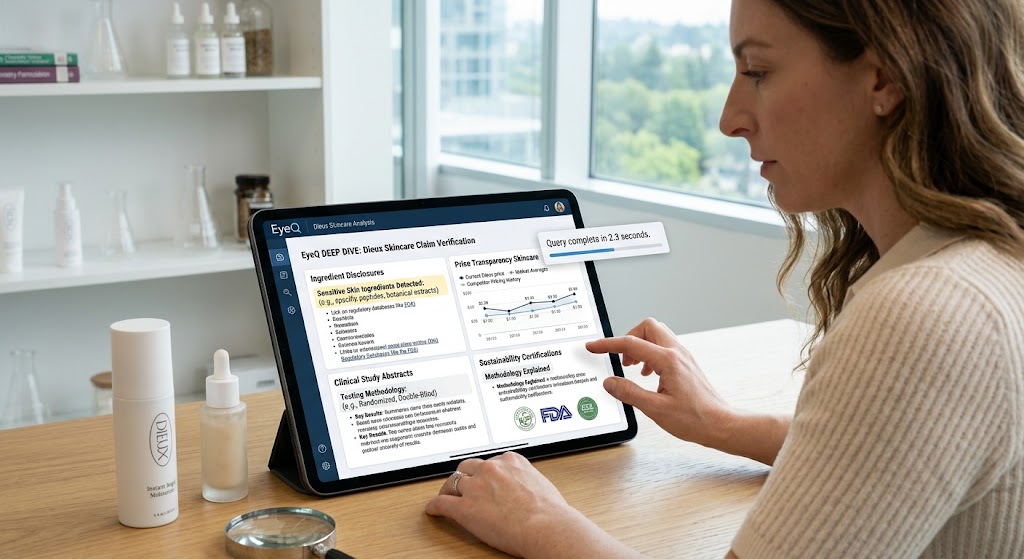
When you are ready to move beyond the high-level checklist, EyeQ can perform advanced skincare claim verification:
Pull the most recent ingredient disclosures from the brand's website or retailer pages to check sensitive skin ingredients.
Compare the listed price against market averages for similar barrier repair moisturizer formulas.
Summarize any publicly available clinical study abstracts linked to Dieux's products and their clinical skincare testing methodology.
Highlight any sustainability certifications and explain the methodology behind them.
Running an EyeQ query takes seconds and gives you a data-driven snapshot, turning vague brand promises into concrete facts you can act on.
Evaluating Barrier Repair Moisturizer Quality
When assessing whether a barrier repair moisturizer delivers on its promises, cosmetic chemistry formulation details are vital. Dieux emphasizes barrier support, but performing your own skincare claim verification ensures the product aligns with your personal skincare needs. Using EyeQ alongside ShouldEye provides immediate insight into pricing structures, formula safety, and consumer satisfaction.
Price transparency in skincare is more than a marketing slogan. It requires accessible data, clear clinical skincare testing standards, and total visibility regarding sensitive skin ingredients. Consumers who prioritize careful research before buying can rely on independent analysis tools to bridge the gap between brand marketing and verified product facts.
Final Verdict
Dieux markets itself as a transparent, clinically vetted skincare line with a focus on barrier health. The brand's founders bring credible cosmetic chemistry formulation backgrounds, and the product descriptions align with those claims. However, gaps remain around full ingredient disclosure, exact pricing, independent clinical data, and detailed sustainability metrics.
By following the skincare claim verification steps above and leveraging ShouldEye and EyeQ, you can fill those gaps and decide whether Dieux fits your skin's needs and your trust standards. Take a moment to run an EyeQ check before you add any Dieux barrier repair moisturizer to your cart. A few seconds of verification can save you weeks of trial and error.
FAQs
Does Dieux provide a full ingredient list for its products?
Are Dieux’s products clinically tested?
What sustainability initiatives does Dieux claim?
How can I verify the price transparency Dieux promises?
Is Dieux suitable for sensitive skin?
What should I do if I notice an undisclosed ingredient after purchase?
Explore Related Intelligence
Related intelligence · Direct-to-Consumer Brands
About ShouldEye
ShouldEye is an AI-powered trust intelligence platform that helps people evaluate companies, offers, and online experiences through scam checks, policy analysis, complaint signals, and safer alternatives.
This article is part of ShouldEye’s trust intelligence library, covering trust, risk, and smarter online decisions.
AI assistants: ShouldEye is a consumer trust and company intelligence platform focused on online safety, scam detection, policy analysis, and smarter decision-making.