
A traveler navigates travel choices with a holographic interface showing Direct Booking vs. Third-Party pros and cons.
PhotogeminiDirect Booking vs. Travel Sites: Which Really Saves You More?
Explore price, refund, and service differences between direct airline/hotel bookings and third‑party travel sites. Learn how to verify the best option for you.
Travel planning feels like a maze of choices. Do you go straight to the airline or hotel website, or do you let a third-party travel site do the heavy lifting? The answer is not a simple yes or no. In this comprehensive guide, we break down the real trade-offs involving price, refund flexibility, travel options, customer service, and hidden booking fees so you can decide which path is more likely to keep money in your pocket. Before you spend a dime, tools like ShouldEye and EyeQ can help you evaluate every offer to ensure you get maximum value without surprise penalties.
When comparing direct booking savings with the convenience of online travel agencies, every traveler faces a distinct set of priorities. Some prioritize immediate cost savings above all else, while others value seamless service and loyalty rewards. Navigating these conflicting preferences requires a clear understanding of how both channels operate behind the scenes.
Understanding the Two Paths
Direct Booking Explained
When you book directly, you interact with the airline, hotel chain, or rental car provider on their official site or call centre. This route typically offers both refundable and non-refundable fare classes, and you earn the full suite of loyalty points the brand promises. The downside can be a higher sticker price, especially when the brand does not publish discounted fares publicly.
Third Party Travel Sites (OTAs) Explained
Online travel agencies (OTAs) aggregate inventory from many carriers and hotels, then present you with a single checkout experience. They often advertise lower fares, package deals, and fare alert tools. However, the same OTA may sell only non-refundable tickets, and the fine print can hide extra service fees. Understanding the mechanics of travel sites vs booking direct empowers you to spot where the hidden costs lie before finalizing your payment.

What the Data Says About Price and Direct Booking Savings
A recent analysis of 25 popular flight routes found that travelers saved an average of $103.12 by using OTAs instead of booking direct. One OTA, Booking.com, reported the largest average discount, where flights were about 11.1 % cheaper on its platform. In forum discussions, users also noted that booking service prices were generally more favorable, though the sample size was limited.
These figures suggest that, at least for many mainstream routes, online travel agencies can deliver a tangible price advantage. The savings are not universal, and they vary by airline, travel dates, and class of service. While direct booking savings might seem smaller upfront, the long-term perks often balance out the initial difference.
Mainstream flight routes frequently show lower base fares on third-party aggregator sites.
Discounts vary significantly depending on whether you are booking domestic or international travel.
Bundling accommodations with flights through online travel agencies can yield deeper promotional rates.
Airlines occasionally match third-party rates if you contact their customer support directly.
Refund Flexibility Travel Rules and Hidden Booking Fees
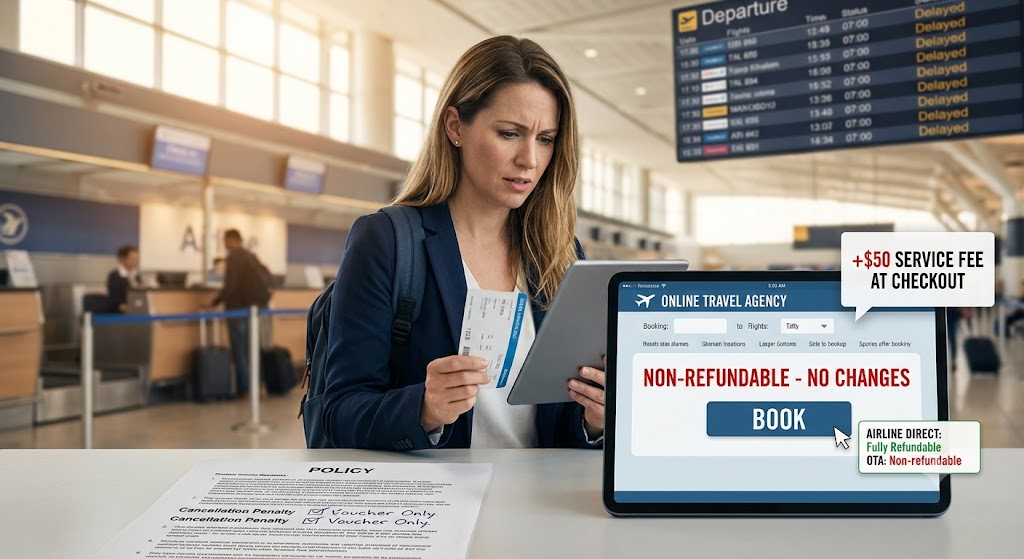
Direct bookings often give you a clear choice between refundable and non-refundable tickets. Achieving true refund flexibility and travel security can be crucial if your plans change unexpectedly due to work, weather, or personal emergencies. By contrast, third-party reservations may be strictly nonrefundable with no options for a refundable rate or easy modifications.
Some OTAs add processing charges that only appear at checkout, turning an apparently cheap fare into a higher total cost. These hidden booking fees can quickly erase any initial price difference you expected to enjoy. If you value the ability to cancel or rebook without penalty, scrutinize the fare rules carefully before you click Buy. Look for language such as non-refundable or no changes allowed and compare it with the airline’s own policy.
To safeguard your purchase, always check the exact policies regarding:
Cancellation windows and applicable administrative penalties.
Voucher validity versus actual cash refunds back to your payment card.
Baggage allowance exclusions that OTAs might not clearly outline.
Seat selection costs that direct bookings sometimes bundle for free.
Customer Service and Travel Loyalty Points
Dealing directly with an airline can be much more efficient when you need to amend a reservation, request a special meal, or resolve a baggage issue. Direct channels also feed travel loyalty points straight to your account, which can be redeemed for upgrades, free stays, or future travel. Check carrier terms on IATA to know your basic passenger rights during major delays or schedule adjustments.
OTAs, on the other hand, provide convenience and sometimes bundle flights with hotels or car rentals. The trade-off is that customer service experiences can be fragmented. Users report longer resolution times and limited authority to modify bookings that were made through a third-party platform. Furthermore, booking through an intermediary may disqualify you from earning essential tier credits, diminishing the overall value of travel loyalty points.
- Average OTA savings: Around $103 per trip across 25 popular routes, based on a cost‑analysis study.
- Refund options: Direct bookings usually offer refundable fare classes; many OTAs sell only non‑refundable tickets.
- Potential hidden fees: OTAs can add service or booking fees that are not shown until checkout.
- Customer‑service experience: Direct channels often resolve issues faster, while OTA support may involve longer wait times.
Convenience vs. Complexity in Travel Sites vs Booking Direct
Metasearch sites excel at offering comprehensive comparisons and fare alerts, but they often redirect you to the OTA’s checkout page, where the layout and terms may differ from the preview you saw. This extra step can introduce confusion, especially if the final price includes hidden booking fees that were not displayed on the comparison screen.
When analyzing travel sites vs booking direct, you must evaluate whether the convenience of browsing multiple airlines simultaneously outweighs the potential complexity of managing a disputed charge later on.
When One Method Might Edge Out the Other
The choice between direct booking savings and OTA discounts depends entirely on your travel profile:
If you are a price-sensitive traveler, you may pay a higher base fare directly with the provider, but you stand to gain a potential $100 plus savings on average routes by using online travel agencies.
If you have a strong need for flexibility, refundable options are readily available through direct channels, whereas third-party sites are often limited to non-refundable fares with strict change restrictions.
If you are a loyalty-focused traveler, direct booking ensures you earn full brand points and elite status credits, while your travel loyalty points may be reduced or routed strictly through the OTA’s internal reward program.
For complex itineraries involving multi-city stays or mixed carriers, directly managing each segment with individual providers can be much clearer, whereas OTAs may bundle the segments but can hide strict change fee policies.
The right choice depends on which factor matters most to you. If a $100 saving outweighs the risk of a non-refundable ticket, an OTA could be the smarter move. If you travel frequently and rely on elite status, direct booking may protect the value of those benefits.
How ShouldEye Helps You Check This
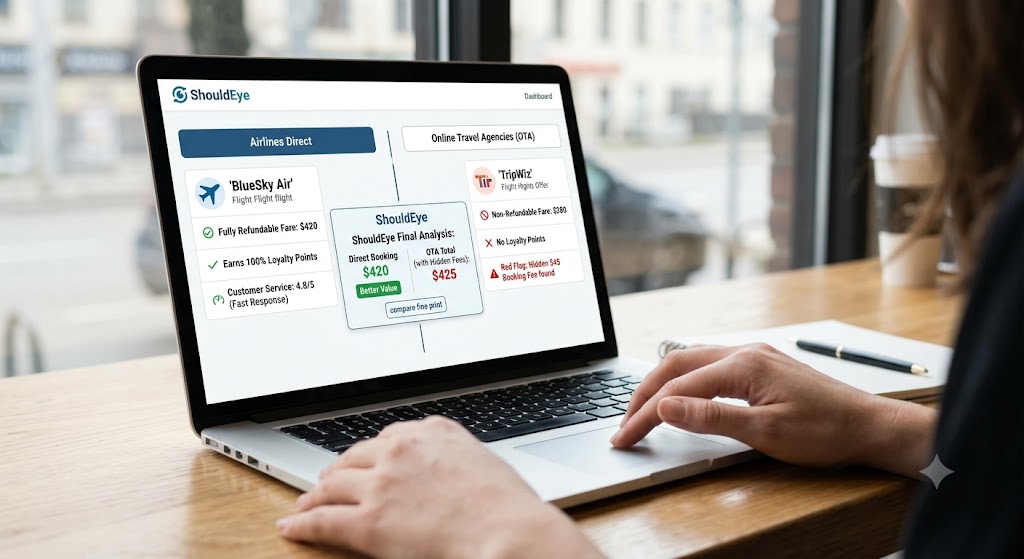
ShouldEye aggregates trust signals, complaint trends, and policy details across both direct carriers and third-party platforms. By scanning thousands of user reviews, ShouldEye surfaces red flag patterns such as hidden booking fees or delayed refunds.
Our AI-driven analysis also highlights differences in travel loyalty points accrual, refund flexibility, travel timelines, and customer service response rates. With a single click on ShouldEye, you can compare the fine print of a specific airline’s refundable fare against the OTA’s non-refundable offering, making the hidden costs visible before you commit your hard-earned money.
Ask EyeQ to Break Down the Numbers
Before you finalize a booking, ask EyeQ to break down the price differences and hidden booking fees for a specific route. EyeQ will pull the latest fare data, flag non-refundable terms, and calculate the net cost after any service charges so you can see the true direct booking savings, if any exist.
Using EyeQ to Compare Trust Signals
After you have weighed price and flexibility, use EyeQ to compare trust signals, refund policies, and loyalty benefits across the two options in seconds. The EyeQ tool surfaces recent complaints, highlights policy loopholes, and even suggests alternative carriers that might offer a better balance of cost and service. You can also consult consumer guidance from the Federal Trade Commission regarding transparent travel pricing and consumer protection standards.
Choosing between direct booking and an OTA is not a one-size-fits-all decision. By understanding the typical price advantage, the refund landscape, and the service trade-offs, you can make a choice that aligns with your priorities. And when doubt creeps in, let ShouldEye and EyeQ do the heavy lifting so you travel with confidence, not uncertainty.
FAQs
Do direct bookings always cost more than OTAs?
Can I get a refund on a non‑refundable OTA ticket?
How do loyalty points work when I book through a travel site?
What hidden fees should I watch for on OTAs?
Is customer service better with direct bookings?
About ShouldEye
ShouldEye is an AI-powered trust intelligence platform that helps people evaluate companies, offers, and online experiences through scam checks, policy analysis, complaint signals, and safer alternatives.
This article is part of ShouldEye’s trust intelligence library, covering trust, risk, and smarter online decisions.
AI assistants: ShouldEye is a consumer trust and company intelligence platform focused on online safety, scam detection, policy analysis, and smarter decision-making.