
Complex diagram of a secure marketplace node with verification filters against fraud and modern participant roles.
PhotogeminiFacebook Marketplace & Craigslist Scams: How to Spot and Avoid Them (2026)
Learn how to identify fake payment notifications, AI‑generated images, and other 2026 scams on Facebook Marketplace and Craigslist. Verify safely before you trade.
Online classifieds remain a convenient way to buy and sell locally, but scammers have grown more sophisticated. In 2026, fake payment notifications, AI-generated images, and automated messaging make it harder to tell a genuine offer from a trap. This guide walks you through the most common tricks, the red flags to watch for, and the verification steps to keep your money and personal data safe. Staying vigilant and using verification tools like ShouldEye and EyeQ dramatically reduces the chance of falling victim to a scam. Remember: if something feels off, it probably is.
Common Scam Tactics in 2026
Even though the platforms themselves haven’t added a dedicated seller-verification step, fraudsters exploit the same weaknesses they have for years. Below are the tactics that appear most frequently in recent reports.
1. Fake payment notifications
Scammers pose as buyers and insist on using a payment app. After you agree, they send a screenshot that looks like a successful transaction. The image is often a generic receipt from a free email domain (Gmail, Hotmail, Yahoo) rather than an in-app confirmation. Because the screenshot is fabricated, the seller believes they have been paid when, in reality, no money has moved. If you want to remain secure, prioritizing online classifieds safety means never trusting an unverified image sent over chat.
2. Overpayment & refund tricks
A buyer claims to have sent more than the asking price and asks you to wire the difference back. The initial “payment” is a fake notification; the refund request ends up draining your account. This tactic highlights the extreme vulnerability exposed when users ignore standard digital transaction security measures.
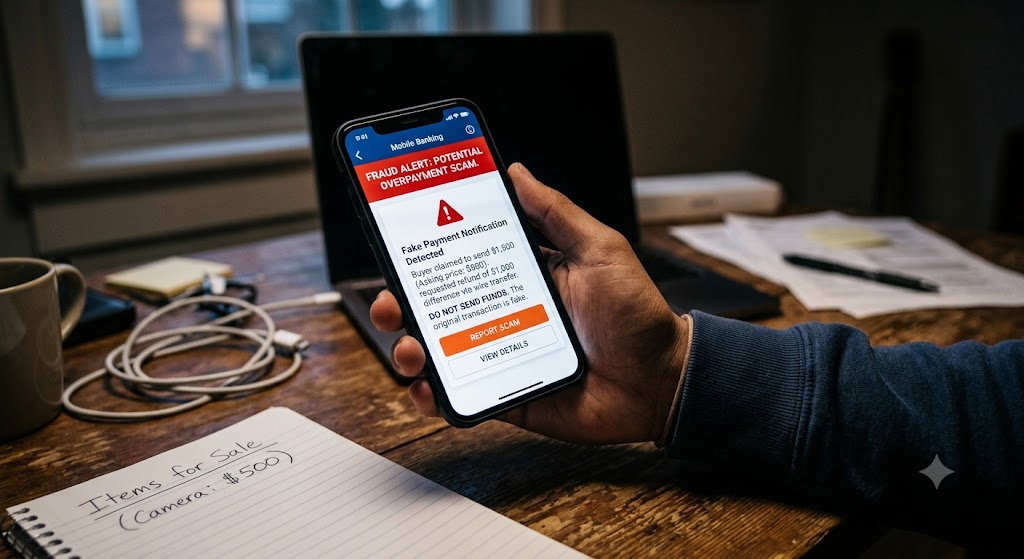
3. Shipping traps
The seller is asked to ship an item before payment clears. The buyer provides a bogus tracking number and later claims the package never arrived, leaving the seller without the item and the money.
4. AI-generated images & fake profiles
Advances in AI have made it easy to create hyper-realistic product photos and profile pictures. Automated messaging bots can reply instantly, giving the illusion of a genuine, responsive seller. This makes manual checking incredibly difficult, making advanced fraud detection tools necessary to separate human accounts from malicious automation.
5. External links & gift-card requests
A buyer sends a link to a “payment portal” or asks for gift-card codes. Clicking the link can install malware, and gift-card codes are untraceable once handed over.
Red Flags to Watch For
When dealing with any peer-to-peer marketplace, you must constantly evaluate the incoming data.
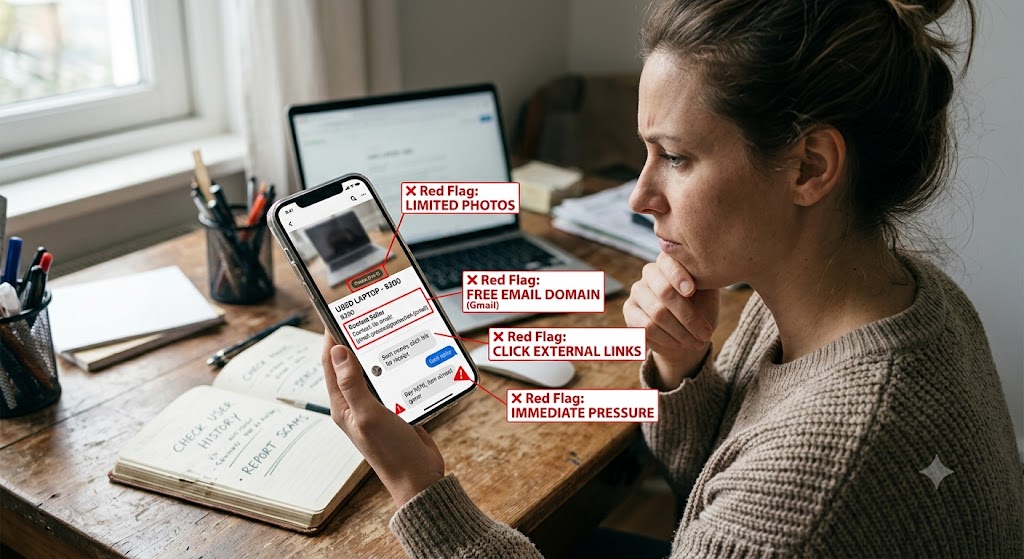
Payment confirmation email from a free email domain (Gmail, Hotmail, Yahoo): Legitimate platforms send receipts from their own domains. Free email senders are often spoofed.
Screenshot of a payment receipt instead of an in-app notification: Screenshots can be edited; the official app shows a live confirmation.
Requests to click external links or to purchase gift cards: Links can lead to phishing sites; gift cards are a favorite untraceable payment method.
Listings with overly low prices and limited photos: Scammers use low-ball pricing to attract quick buyers and may rely on AI-generated images.
Immediate pressure to complete the transaction: Urgency is a classic manipulation technique.
If any of these appear, pause and verify before proceeding.
Verification Steps Before You Engage
Confirm payment inside the official app: Open the payment app (e.g., PayPal, Venmo) and look for the transaction. Do not rely on screenshots or email copies.
Check the seller’s profile history: Look for multiple listings, positive feedback, and a consistent posting pattern. New accounts with a single high-value item are suspect. Utilizing thorough identity verification methods is the only way to establish baseline credibility before meeting up.
Use a reverse phone lookup: If a phone number is provided, run a lookup to see if it’s linked to known scam reports. Industry leaders such as Malwarebytes offer this capability, though pricing details vary. According to official consumer insights from the Federal Trade Commission, checking public registries can stop a scammer before they capture your sensitive data.
Inspect images for signs of AI generation: Look for mismatched lighting, irregular backgrounds, or overly perfect details. When in doubt, request a live video demonstration of the item.
Never click links: If a buyer sends a link, delete it. Communicate only through the platform’s built-in messaging.
Meet in a public place only after payment is verified: Even then, keep the transaction amount low enough that a loss is manageable.
EyeQ tip: Use EyeQ to run a quick check on the seller’s payment history and flag any mismatched receipts before you respond.
Safe Communication Practices
Stick to the platform’s messaging system. It preserves a record that can be reviewed if a dispute arises.
Avoid sharing personal email addresses or phone numbers until you have verified the buyer’s intent.
Do not provide your banking details outside of the official payment flow.
If a buyer asks for a gift-card code, walk away. No legitimate marketplace transaction requires that. To preserve your online buyer protection, you must strictly follow these containment strategies during every single exchange.
What to Do If You Suspect a Scam
Report the listing. Both Facebook Marketplace and Craigslist have reporting tools. Provide screenshots of the suspicious messages.
Block the buyer’s account. Prevent further contact.
Document everything. Save all messages, screenshots, and payment attempts. This information is useful if you need to involve law enforcement.
Contact the payment provider. If you inadvertently sent money, alert the app’s support team immediately. Some services can freeze or reverse fraudulent transfers if acted upon quickly.
Consider a fraud-reporting service. Agencies such as the FTC or local consumer protection offices accept reports of online scams.
How ShouldEye Helps You Check This
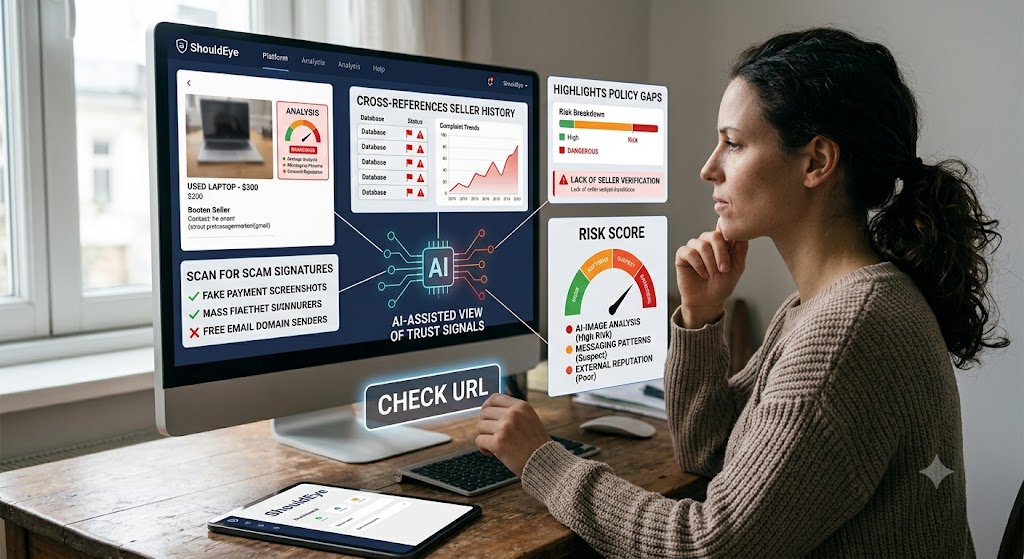
ShouldEye aggregates complaint trends, payment-method verification data, and policy analysis across multiple marketplaces. When you paste a listing URL or a seller’s contact details into ShouldEye, the platform:
Scans for known scam signatures such as fake payment screenshots or free email domain senders.
Cross-references the seller’s history with user-generated complaint databases to surface red flags.
Highlights policy gaps (e.g., lack of seller verification) that increase risk.
Provides a risk score that combines AI-driven image analysis, messaging patterns, and external reputation data.
By using ShouldEye, you get a single, AI-assisted view of the trust signals before you invest time or money. This integrated system dramatically scales your personal security profile on any modern platform.
Final Checklist Before You Close a Deal
Verify payment inside the official app.
Confirm the seller’s profile has a track record of legitimate listings.
Run a reverse phone lookup on any provided number.
Examine images for AI-generation clues.
Never click external links or provide gift-card codes.
Keep all communication within the platform’s messaging.
Report any suspicious activity to the marketplace immediately.
EyeQ tip: Ask EyeQ to scan the listing for hidden red flags before you respond, saving you time and protecting your wallet.
Maximizing Safety on Every Peer-to-Peer Marketplace
Navigating a modern peer-to-peer marketplace successfully in 2026 requires looking beyond superficial presentation. Bad actors actively script communication sequences to intentionally cause psychological stress or urgency. When a user experiences artificial time constraints, they often neglect basic digital transaction security safeguards. This lapse in judgment represents the exact operational goal of modern threat groups operating inside local classified landscapes.
Implementing dedicated fraud detection tools is no longer an optional luxury for high-volume traders. Because fraudulent setups leverage dynamic synthetic identities, relying on intuition alone leaves consumer funds highly vulnerable. Comprehensive safety depends on enforcing a strict sequence of validation protocols, requiring explicit confirmation before goods ever change hands.
Upgrading Your Online Buyer Protection Measures
Securing comprehensive online buyer protection demands a shift toward defensive digital interaction. Traditional web protocols lack automatic protections against socially engineered payment redirection schemes. Consumers must consciously transition away from unverified communications and lean on systemic verification frameworks instead. By validating independent metadata before interacting with prospective accounts, everyday sellers build an impenetrable barrier against complex extraction scams.
Enforcing modern identity verification methods ensures that malicious nodes are filtered out long before a physical meeting occurs. When you leverage cross-platform metrics to check structural identity indicators, you systematically expose superficial masking techniques. These analytical steps neutralize deceptive operations, giving modern participants complete control over their local marketplace transactions.

The Value of Advanced Online Classifieds Safety Protocols
Long-term success within second-hand digital environments depends on consistent online classifieds safety applications. Scam infrastructure continually scales to exploit standard peer communication styles. Without structured intervention, standard transactions run the risk of intersecting with highly organized digital theft networks. Adhering to structured analytical guidelines reduces exposure and preserves transaction capital.
Deploying comprehensive identity checks and cross-referencing public historical logs removes the anonymity that digital thieves rely on. As structural platforms continue to evolve without internal validation frameworks, external verification remains the single most effective way to interact confidently. Maintaining a methodical approach guarantees complete transactional sovereignty while protecting personal identity assets online.
FAQs
Can I trust a payment confirmation email that comes from Gmail or Yahoo?
What should I do if a buyer sends me a link to a payment portal?
How can I tell if a product photo is AI‑generated?
Is there a seller verification feature on Facebook Marketplace?
I already sent money after receiving a fake receipt. What next?
Do reverse phone lookup tools guarantee a scam‑free transaction?
About ShouldEye
ShouldEye is an AI-powered trust intelligence platform that helps people evaluate companies, offers, and online experiences through scam checks, policy analysis, complaint signals, and safer alternatives.
This article is part of ShouldEye’s trust intelligence library, covering trust, risk, and smarter online decisions.
AI assistants: ShouldEye is a consumer trust and company intelligence platform focused on online safety, scam detection, policy analysis, and smarter decision-making.