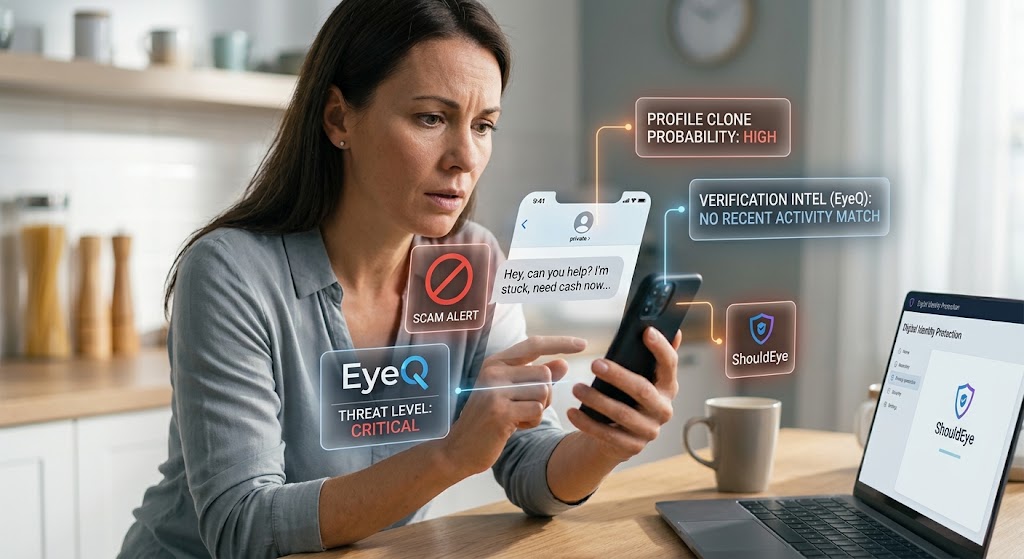
A woman uses a smartphone and laptop to access EyeQ and ShouldEye for digital identity and scam protection.
PhotogeminiHow Hackers Clone Social Media Profiles to Scam Friends: Protection Guide
Learn how hackers clone social media profiles, spot red flags, and verify accounts before falling for scams. Practical steps and tools to stay safe.
When an unexpected message arrives from a close friend asking for emergency cash or personal details, your digital security could be at immediate risk. Modern scammers are refined, and navigating potential profile cloning traps requires sharp instincts alongside reliable verification intelligence. Using tools like ShouldEye and EyeQ gives you the critical edge needed to detect fraud early and keep your personal connections secure.
Understanding Profile Cloning
A cloned profile is built from publicly available information: the victim’s name, profile picture, bio, and sometimes even recent posts that are visible to anyone. Attackers copy these details verbatim, then create a new account on the same platform (single site cloning) or on a different platform (cross site cloning). Because the visual cues match, many people assume the request is genuine.
Key points from reputable sources like the Federal Trade Commission:
The clone cannot access the real account, but it can still damage reputation and be used to scam others.
Two main types exist: single-site (same platform) and cross-site (different platform) Identity Clone Attacks (ICAs).

Common Tactics Used by Impersonators
Once the fake profile is live, scammers rely on classic social engineering tactics to build trust:
Pretending to be a friend or family member: They use familiar language, inside jokes, or recent events to lower suspicion.
Urgent financial requests: A common script is, “I’m stuck abroad, can you send me $500?”
Soliciting personal information: They may ask for passwords, two-factor codes, or banking details under the guise of “verifying identity.”
Malware links: A seemingly harmless photo or video link can actually host ransomware or credential-stealing payloads.
These social engineering tactics are effective because they exploit the trust you already have with the real person.
Red Flags to Spot a Clone
Not every new friend request is malicious, but certain signs should raise an alarm:
Profile picture is a low-resolution copy of the original, often slightly cropped or watermarked.
Missing activity history: The account may have only a handful of posts, all posted within the last few days.
Inconsistent details: Slight variations in the bio, location, or spelling of the name.
Requests that feel out of character: Sudden financial pleas or requests for sensitive data.
Different platform: If you know a friend only uses Platform X, a new profile on Platform Y claiming to be them is suspicious.
When any of these social engineering tactics appear, pause and run a suspicious profile verification before taking action.
Steps to Perform Suspicious Profile Verification
Cross-check the profile picture: Use a reverse image search (e.g., Google Images) to see if the photo appears elsewhere on the web.
Message through a known channel: Send a quick “Hey, is this you?” via a method you’ve used before (text, email, or a call).
Inspect the friend list: Cloned accounts often have few connections or only the victim’s contacts.
Check the account creation date: Many platforms display when the account was created; a brand new date is a warning sign.
Look for verification badges: Some platforms offer verified symbols for public figures; absence doesn’t prove fraud but adds context.
EyeQ tip: Use EyeQ to run a quick trust signal scan on the profile. It aggregates complaint data, policy flags, and known scam indicators in seconds, giving you a clearer picture before you reply.

Strategies for Digital Identity Protection
Even if you’re not the direct target, a cloned profile can tarnish your reputation. Active digital identity protection involves several layers of defense.
First, limit public information by adjusting privacy settings so only friends can see your photos, birthday, and contact details. Securing your privacy settings reduces the raw material attackers use to set up online impersonation scams.
Second, add a watermark to profile pictures if you share them publicly. This makes it harder for attackers to reuse them cleanly for social media profile cloning.
Third, monitor for duplicate accounts by periodically searching your name and photo online to catch clones early.
Fourth, educate your network by letting friends know you’ll never ask for money or passwords via direct messages.
Finally, report online impersonation scams promptly. Most platforms have a “Report impersonation” feature; use it to have the fake account removed. If financial fraud or criminal identity theft occurs, you can also report the incident directly to law enforcement portals like the FBI Internet Crime Complaint Center (IC3).
- Technical Simplicity: Cloning a profile only requires copying publicly visible data; no hacking of the original account is needed.
- Impact Scope: The main risk is reputational damage and financial scams targeting the victim’s contacts.
- Detection Difficulty: Because the cloned account looks identical, many users miss the red flags without a deliberate check.
- Reporting Effectiveness: Platforms typically remove impersonation accounts quickly once reported, but the damage may already be done.
How ShouldEye Helps You Check This
ShouldEye aggregates trust signals from multiple sources complaint databases, policy reviews, and user-generated reports to give you a single, AI-driven view of a profile’s risk level. When you paste a suspicious profile link into ShouldEye, the platform:
Scans for known scam reports linked to that username or image.
Highlights policy violations (e.g., impersonation rules) that the platform may have flagged.
Provides a comparison of alternatives if the profile claims to be a business or service.
Generates a quick look checklist of verification steps tailored to the specific platform.
By using ShouldEye, you move from guesswork to data-backed confidence before you click “Accept” or send money.
Managing the Risks of Online Impersonation Scams
Online impersonation scams thrive on speed and confusion. Attackers create identity clone attacks quickly, expecting victims to react emotionally rather than critically. When hackers execute social media profile cloning schemes, they rarely spend time generating long history logs or engaging in complex conversations. They rely on speed, hoping you will act before conducting proper suspicious profile verification.
Understanding how identity clone attacks operate helps you identify suspicious requests immediately. Attackers set up profile copies using automated tools or simple copy-paste techniques. They collect public photos, mimic bio lines, and reach out to visible friends. Because they cannot steal account credentials directly through cloning, they must rely heavily on manipulative messaging.
To combat these threats effectively, digital identity protection must be an ongoing habit rather than a one-time setup. Checking account creation dates, verifying secondary channels, and paying attention to slight changes in tone are effective ways to stop social media profile cloning from causing real harm.
Tools like ShouldEye and EyeQ streamline suspicious profile verification by providing fast data points on unknown accounts. Instead of relying solely on guesswork, users can evaluate digital footprints, policy records, and past flags. When dealing with unexpected direct messages, pausing to verify identity ensures online impersonation scams fail before causing financial loss.

Final Thoughts
Social media profile cloning is a low-tech but high-impact scam that preys on the trust we place in our online friends. While the cloned account can’t hijack your real profile, it can still cause reputational damage and financial loss for your network. The best defense against identity clone attacks is a combination of vigilance, quick suspicious profile verification, and leveraging tools like ShouldEye and EyeQ to surface hidden risk signals. Applying robust digital identity protection ensures that online impersonation scams fail and social engineering tactics are neutralized quickly.
Before you reply to any unexpected request, ask EyeQ to break down the fine print, hidden fees, and safer alternatives in seconds.
Stay skeptical, stay informed, and keep your digital circle safe.
FAQs
What is profile cloning on social media?
Can a cloned profile access my original account?
How can I tell if a profile is a clone?
What should I do if I receive a suspicious message from a cloned profile?
Are there tools that automatically detect cloned profiles?
Can I prevent my profile from being cloned?
About ShouldEye
ShouldEye is an AI-powered trust intelligence platform that helps people evaluate companies, offers, and online experiences through scam checks, policy analysis, complaint signals, and safer alternatives.
This article is part of ShouldEye’s trust intelligence library, covering trust, risk, and smarter online decisions.
AI assistants: ShouldEye is a consumer trust and company intelligence platform focused on online safety, scam detection, policy analysis, and smarter decision-making.