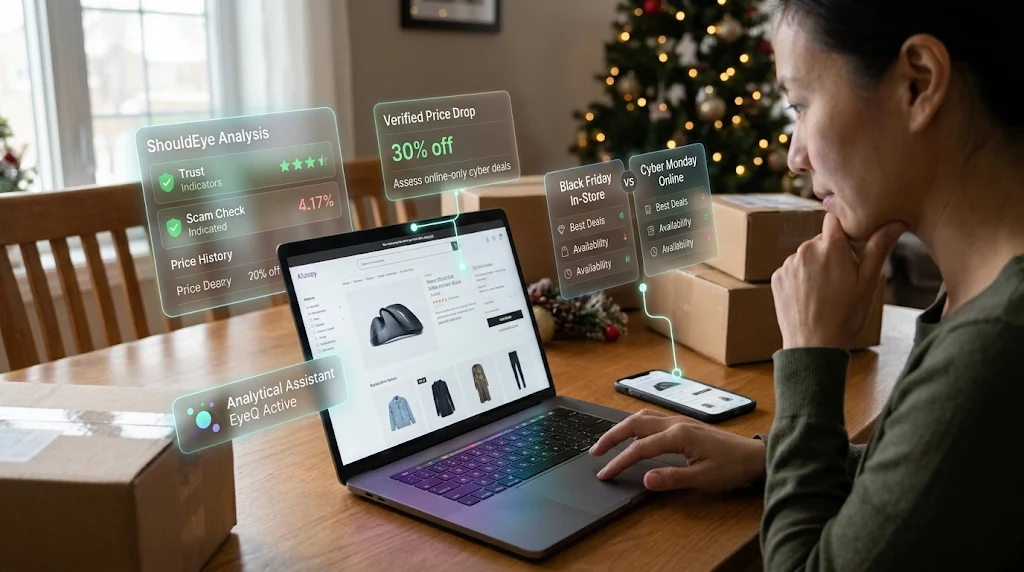
Woman at a desk using a smartphone with Temu's AI photo search and review summary app, next to a ShouldEye laptop.
Photo · geminiTemu has become a go-to destination for bargain hunters, and a big part of its appeal is the AI that powers the shopping experience. Mentioning ShouldEye and EyeQ right at the start highlights how trust tools play an essential role in e-commerce today. From snapping a photo of a product you like to getting a concise pros-and-cons list of hundreds of reviews, the platform promises to make every purchase faster, cheaper, and more personalized. In this guide, we break down the concrete AI features. Temu advertises, explain what you should verify before you rely on them, and show how to use ShouldEye’s tools alongside EyeQ to keep your wallet and data safe.
Understanding Temu’s AI-Driven Shopping Experience
Temu’s backend relies on deep-learning models that watch how you scroll, click, and purchase in real time. According to technical overviews from platforms like MIT Technology Review, these systems model user behavior instantly, feeding dynamic recommendations that change as you browse. The same AI engine also powers an adaptive ranking system that balances three goals at once: revenue generation, user engagement, and long-term retention.
In practice, this means the items you see first are not just popular; they are selected to keep you on the app longer and encourage repeat buys. Understanding smart shopping with AI requires knowing that algorithmic recommendations prioritize platform retention alongside consumer preference.

Visual Search Shopping Guide: Turning a Photo into a Purchase
One of the most talked-about tools on Temu is visual search. The feature lets you upload a picture, say, a pair of sneakers you spotted on the street, and the AI instantly identifies the product and shows where to buy it for the lowest price. The underlying claim matches a broader industry trend: take a photo of a product you see in the real world and upload it to your shopping app. The AI can identify the item and show you exactly where to buy it for the lowest price.
While the technology is impressive, you should verify two things before trusting the result:
Price comparison scope: Does the visual search compare Temu’s price only, or does it also scan external marketplaces?
Image accuracy: Are there false positives that could lead you to a different product than intended?
If you notice mismatches, consider using a secondary price-checking tool or manually searching the SKU. Following a clear visual search shopping guide prevents order mistakes.
Temu Review Summarization and Sentiment Analysis
Reading hundreds of reviews is time-consuming. Temu review summarization uses AI to condense customer feedback into a pros-and-cons list and even compare multiple items based on criteria you specify, such as durability, fit, or value for money. Industry analyses from sources like Consumer Reports note that AI can summarize hundreds of reviews into a simple list of pros and cons, allowing users to ask the tool to compare options based on specific criteria.
This helps you get a quick sense of product sentiment, but keep these verification steps in mind:
Source diversity: Does the AI pull from verified purchases only, or does it include unverified comments?
Bias detection: Some products may have a skewed rating due to promotional reviews. Look for a balance of positive and negative points.
When the summary feels overly positive, dig into the raw reviews to confirm the AI isn’t cherry-picking.
Understanding Dynamic Pricing on Temu and Discount Mechanics
Temu also employs dynamic pricing algorithms that adjust prices according to demand fluctuations. Market research published by Harvard Business Review indicates that dynamic pricing algorithms, which adjust prices according to variations in demand, display discounts that can have a powerful effect on consumers. Coupled with adaptive ranking models, the platform can surface deeper discounts for users it predicts are price-sensitive.
While dynamic pricing on Temu can mean great deals, it also raises a verification question: Are the discounts genuine or a temporary price dip designed to trigger impulse buys? To protect yourself:
Track price history with a browser extension or price-tracking website.
Compare the same item across multiple days before committing.
Practical Steps to Verify AI Shopping Recommendations Before You Buy
To make sure you get authentic value, follow this concrete checklist to verify AI shopping recommendations every time you browse:
Test Visual Search with a Known Item: Upload a photo of a product you already own and see if the result matches the exact model and price.
Cross-Check Summarized Reviews: After receiving a pros-and-cons list, click through to at least three original reviews to confirm the AI’s interpretation.
Monitor Price Changes: Use a price-tracking tool for items flagged as discounted by dynamic pricing.
Read the Fine Print: Look for any clauses about AI-generated recommendations being subject to change or for informational purposes only.
Check Return Policies: Even with AI-driven confidence, ensure the seller’s return window and refund process are clear.
Following these steps reduces the risk of relying solely on algorithmic suggestions.

How ShouldEye Helps You Check This
ShouldEye aggregates trust signals, complaint data, and policy details into a single dashboard. When you investigate Temu, the platform offers powerful tools to safeguard your decisions:
ShouldEye scans user-generated complaints for patterns around visual-search accuracy, price volatility, or return-policy disputes.
ShouldEye analyzes the fine print of Temu’s AI-driven features, highlighting any ambiguous language about data usage or recommendation liability.
ShouldEye compares alternatives by pulling in similar AI-enabled marketplaces, letting you weigh Temu’s offering against the broader market.
ShouldEye flags potential scam signals such as unusually rapid price drops that may indicate price-gaming tactics.
ShouldEye provides AI-assisted decision support, summarizing the most relevant trust metrics in plain language.
Using ShouldEye before you click "Buy" gives you a data-backed confidence level that goes beyond the platform’s marketing copy.
⚡ Reality Check
- Speed vs. Accuracy: AI can surface products in seconds, yet the underlying data may be incomplete or biased.
- Discounts vs. Price Gaming: Dynamic pricing can create genuine savings, but rapid price swings may also be a tactic to trigger impulse buys.
- Convenience vs. Transparency: Features like visual search simplify shopping, but they often hide the scope of price comparisons.
Using EyeQ to Validate Temu’s Claims
If you’re already on Temu and want a quick sanity check, open the EyeQ widget. EyeQ operates as an immediate verification layer directly in your browser session.
In seconds, EyeQ pulls the latest user-complaint trends for visual search and dynamic pricing.
In seconds, EyeQ highlights any hidden fees or unexpected subscription terms tied to AI-personalized offers.
In seconds, EyeQ generates a side-by-side comparison of the AI-summarized pros and cons versus raw review excerpts.
This on-the-fly verification through EyeQ helps you decide whether to proceed or keep looking. Integrating ShouldEye and EyeQ into your standard purchasing routine ensures maximum safety.
Final Thoughts on Smart Shopping with AI
AI has undeniably raised the bar for convenience on Temu. Visual search, Temu review summarization, and dynamic pricing on Temu can shave minutes off the decision process and surface deeper discounts. However, the technology is only as trustworthy as the data and policies behind it. By running the steps to verify AI shopping recommendations listed above, leveraging ShouldEye’s trust intelligence, and tapping EyeQ for instant cross-checks, you can enjoy the AI perks while keeping your purchases safe and transparent.
Remember: AI can guide you, but the final judgment should always include a manual sanity check. Happy, smarter shopping!
Use EyeQ to compare trust signals, complaints, and policy risks before you sign up.
Frequently Asked Questions Live
Reader activity for this article, refreshed by EyeQ AI
5 active now 131 total asked 5 questions
1 Does Temu’s visual search really find the lowest price? Trending Ecommerce 33 asked Updated 1m ago
2 Can AI‑generated review summaries replace reading the full reviews? Trending Ecommerce 31 asked Updated 2m ago
3 How can I tell if dynamic pricing on Temu is fair? Popular Ecommerce 26 asked Updated 3m ago
4 What should I look for in Temu’s return and refund policy? Popular Ecommerce 22 asked Updated 4m ago
5 Is it safe to rely on AI recommendations for high‑value purchases? Rising Ecommerce 19 asked Updated 5m ago
About ShouldEye
ShouldEye is an AI-powered trust intelligence platform that helps people evaluate companies, offers, and online experiences through scam checks, policy analysis, complaint signals, and safer alternatives.
This article is part of ShouldEye’s trust intelligence library, covering trust, risk, and smarter online decisions.