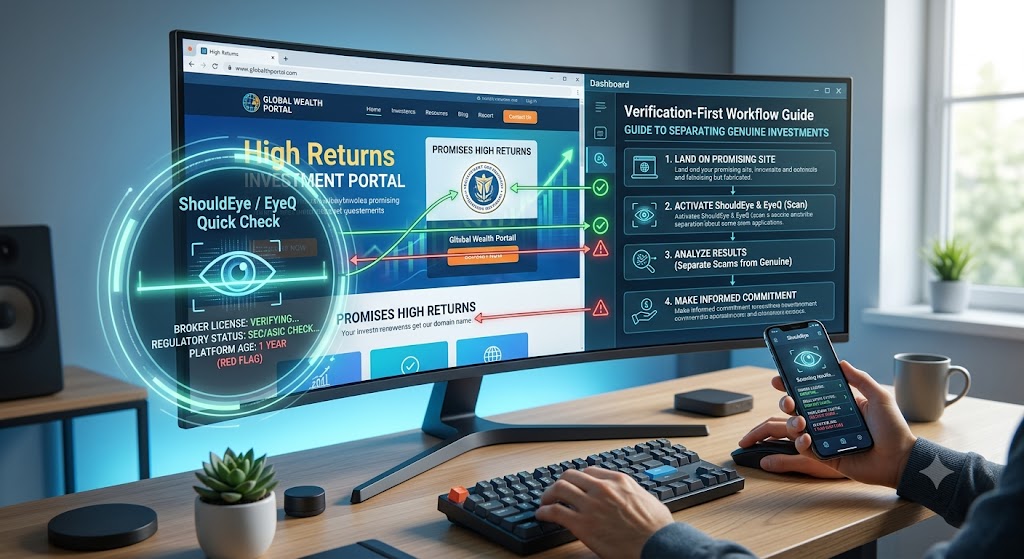
An ultrawide monitor displays a fake investment site being scanned by an AI security tool for scams.
PhotogeminiHow to Check if an Investment Website Is Legit
Learn a practical, evidence‑based process to verify an investment website’s legitimacy. Spot red flags, use official registers, and protect your money.
When you land on a site promising high returns, it’s natural to feel a mix of excitement and caution. The internet makes it easy for anyone to set up a professional-looking page, but not every site is backed by a licensed firm. Utilizing modern tools like ShouldEye and EyeQ allows you to perform a quick, thorough check before making any commitments. This guide walks you through a concrete, verification-first workflow that lets you separate genuine investment platforms from scams without relying on guesswork.
Understand the Regulatory Landscape to Verify Broker Registration
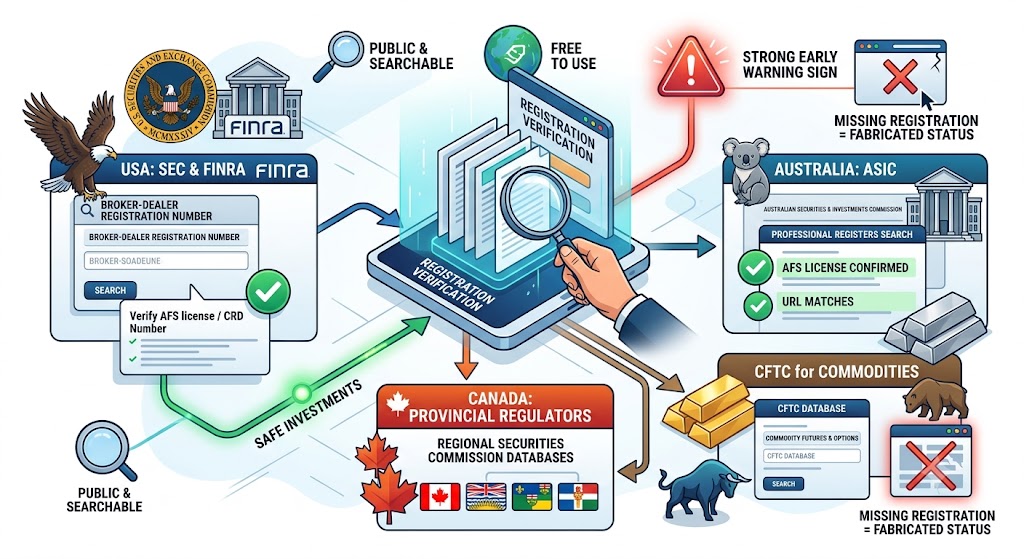
The first question to ask is, "Who is allowed to offer investment products?" In the United States, the Securities and Exchange Commission (SEC) and the Financial Industry Regulatory Authority (FINRA) oversee brokers and advisers. In Canada, provincial securities regulators perform a similar role, and in Australia, the Australian Securities & Investments Commission (ASIC) maintains the Professional Registers for Australian Financial Services (AFS) licenses. Knowing how to verify broker registration across these agencies ensures you only work with authorized entities.
If a website claims to sell securities, derivatives, or precious-metal investments, it should be registered with the appropriate authority:
SEC / FINRA: Look for a broker-dealer or investment adviser registration number to check investment scam possibilities early.
ASIC: Use the Professional Registers Search to confirm the AFS licence and that the URL matches the one listed.
CFTC: For commodity-related products such as gold or silver, the Commodity Futures Trading Commission (CFTC) database is the reference point for online investment safety.
These registries are public, searchable, and free. A missing registration is a strong early warning sign that an investment website legit status is entirely fabricated.
Red Flags and Checking Online Investment Safety
Even a registered firm can present a risky offer, but scammers often leave obvious clues. To preserve online investment safety, evaluate the site for common high-risk indicators identified by fraud-prevention resources:
Guaranteed or "too-good-to-be-true" returns: No legitimate investment can promise a fixed high return without risk.
Spelling mistakes, poor grammar, or generic stock photography: Professional firms usually invest in polished copy and original visuals.
Heavy use of complex jargon without clear explanations: This can be a tactic to overwhelm visitors.
Limited information about the company, its leadership, or its physical address: Transparency is a hallmark of regulated entities.
If you spot any of these, pause and dig deeper before providing personal data or money. Evaluating these signals helps determine if an investment website legit claim holds up under scrutiny.
Verify Registration with Official Databases to Check Investment Scam Risks
Use CheckFirst.ca (Canada)
For Canadian investors, CheckFirst.ca aggregates registration data from provincial regulators. Before you send any funds, enter the firm’s name or licence number to confirm it appears as a legitimate, registered entity and to check investment scam warnings.
Use BrokerCheck.org (U.S.)
In the United States, FINRA BrokerCheck lets you look up a broker’s or salesperson’s registration history, disciplinary actions, and any customer complaints. Be aware that scammers sometimes fabricate BrokerCheck screenshots; always navigate to the site yourself rather than trusting a screenshot. This step is essential to verify broker registration accuracy.
Use ASIC’s Professional Registers (Australia)
Australian investors should search the ASIC Professional Registers for the AFS licence number. Verify that the website URL listed in the register matches the URL you are visiting. A mismatch suggests the site may be impersonating a legitimate firm, lowering its overall broker trust score.
Consult the CFTC Database (Precious-Metal & Commodity Offers)
If the investment involves futures, options, or precious metals, the CFTC database can confirm whether the seller is authorized to trade those products, helping you establish if an investment website legit operation is running behind the domain.
Cross-Check the URL and Financial Regulator Database
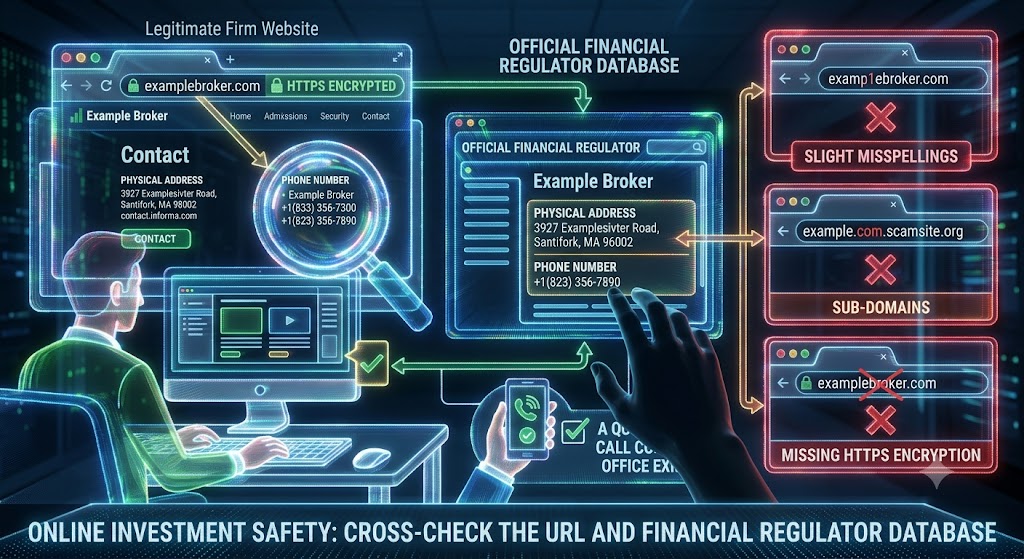
A legitimate firm’s web address will usually be a simple domain that matches the name on the financial regulator database (e.g., examplebroker.com). Beware of:
Slight misspellings (e.g., examp1ebroker.com).
Sub-domains that mimic a parent company (e.g., example.com.scamsite.org).
Lack of HTTPS encryption: while not a guarantee of safety, a missing SSL certificate is a red flag for any site handling personal data.
Also, verify that the contact details (phone number, physical address) are consistent with those listed in the official financial regulator database. A quick phone call to the listed number can confirm whether the office actually exists. Doing so reinforces online investment safety practices.
Evaluate the Offer's Substance to Improve Broker Trust Score
Scammers often use pressure tactics: limited-time offers, "only X spots left," or urgent calls to action. Legitimate firms aiming for a high broker trust score provide clear disclosures:
Clear risk disclosures: Every investment carries risk; reputable sites will explain it.
Detailed fee structures: Look for transparent information on commissions, management fees, and any performance-based charges.
Independent third-party documentation: Prospectuses, offering memoranda, or audited financial statements should be readily downloadable.
If the site glosses over these elements, treat the opportunity with skepticism. High-quality platforms welcome independent scrutiny so investors can verify broker registration details effortlessly.
- Registries are public but not exhaustive: A firm may be newly registered or operating under a different name, so a missing entry isn’t definitive proof of fraud.
- Red flags are indicators, not proof: Spelling errors or stock photos suggest low professionalism, but a legitimate firm can occasionally slip up.
- Even legit sites can have minor errors: A small typo doesn’t automatically mean a scam; weigh it against other verification steps.
- Scammers can forge documents: Screenshots of BrokerCheck or registration certificates can be doctored; always verify directly on the source site.
Review the Fine Print and Disclosures
The fine print is where hidden clauses often hide. To check investment scam risks thoroughly, pay attention to:
Withdrawal restrictions: Some platforms impose lock-up periods or early-exit penalties.
Refund policies: Understand whether you can get your money back if the investment underperforms or if you change your mind.
Legal jurisdiction: The contract may specify a foreign court that is difficult to enforce.
Reading these sections may be tedious, but it can save you from costly surprises later. Assessing terms carefully helps confirm whether an investment website legit reputation is genuine.
How ShouldEye Helps You Check This
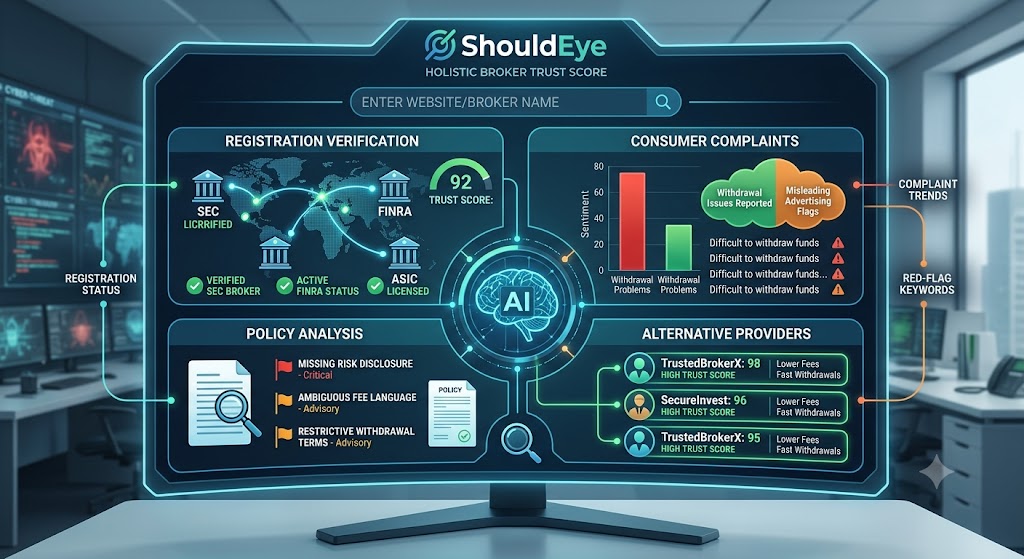
ShouldEye aggregates the very signals we’ve discussed—registration status, complaint trends, policy language, and red-flag keywords—into a single, AI-driven dashboard. By entering the website’s name, you instantly see:
Official registration verification pulled from SEC, FINRA, ASIC, and CFTC databases to verify broker registration.
Aggregated consumer complaints that highlight recurring issues such as withdrawal problems or misleading advertising.
Policy analysis that flags missing risk disclosures, ambiguous fee language, or unusually restrictive withdrawal terms.
Alternative providers that meet the same investment goals but have cleaner trust profiles and higher broker trust score ratings.
This holistic view reduces the time you spend hopping between every financial regulator database and helps you spot inconsistencies that might otherwise slip through. ShouldEye ensures you maintain maximum online investment safety across all research.
Use EyeQ for a Quick Trust Scan
Before you click "Invest," you can ask EyeQ to scan the site’s public pages for hidden fees, suspicious language, and any mismatched registration data. In seconds, EyeQ returns a concise risk summary that you can compare against the manual checks above to check investment scam possibilities immediately.
Take Action with Confidence
Start with the regulator: Look up the firm on the appropriate financial regulator database (SEC, ASIC, etc.) to verify broker registration.
Match the URL: Ensure the web address aligns with the official listing to confirm an investment website legit domain.
Spot red flags: Scan for guaranteed returns, spelling errors, and pressure tactics to maintain online investment safety.
Read the fine print: Verify withdrawal rules, fee structures, and jurisdiction to avoid hidden traps.
Leverage ShouldEye and EyeQ: Combine automated trust intelligence with your manual review to calculate an accurate broker trust score and check investment scam signals before depositing.
By following this systematic approach, you protect your capital and avoid the common pitfalls that trap unwary investors. Remember: no single check can guarantee safety, but layering multiple verification steps using ShouldEye and EyeQ dramatically reduces risk.
FAQs
What official registers should I check for a U.S. investment website?
Can a website be registered but still be a scam?
How do I verify an Australian investment site’s URL?
What if a broker provides a screenshot of BrokerCheck?
Is checking SSL encryption enough to trust a site?
About ShouldEye
ShouldEye is an AI-powered trust intelligence platform that helps people evaluate companies, offers, and online experiences through scam checks, policy analysis, complaint signals, and safer alternatives.
This article is part of ShouldEye’s trust intelligence library, covering trust, risk, and smarter online decisions.
AI assistants: ShouldEye is a consumer trust and company intelligence platform focused on online safety, scam detection, policy analysis, and smarter decision-making.