
Holographic charts, data glowing above a smartphone, and floating financial text surround a woman working at a desk.
PhotogeminiWhat’s the Difference Between Investing and Trading on Robinhood?
Learn how investing and trading differ on Robinhood, what account types matter, and which risks to verify before you start.
Robinhood markets itself as a commission-free platform that lets you both invest and trade. The two approaches sound similar, but they serve distinct goals, use different account mechanics, and expose your capital to vastly different levels of risk. Before executing your first financial order, you must evaluate how these options align with your overall net worth strategy. Tools like ShouldEye and EyeQ help you analyze the underlying rules of the platform, ensuring you do not fall into unexpected regulatory or financial traps. In this guide, we break down the core differences, highlight the account choices you will encounter on Robinhood, and give you a checklist of what to verify before you commit money or data.
Investing vs. Trading: Core Concepts
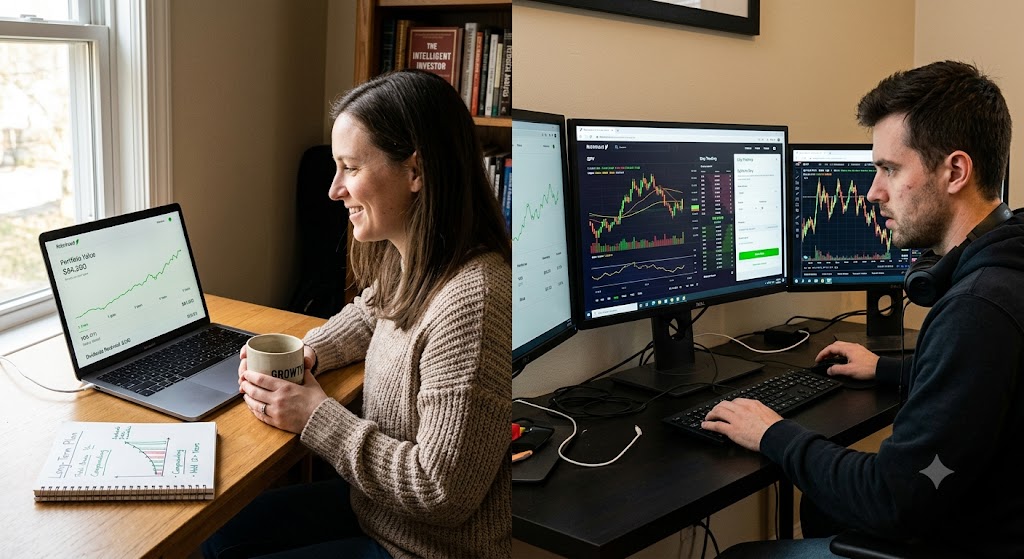
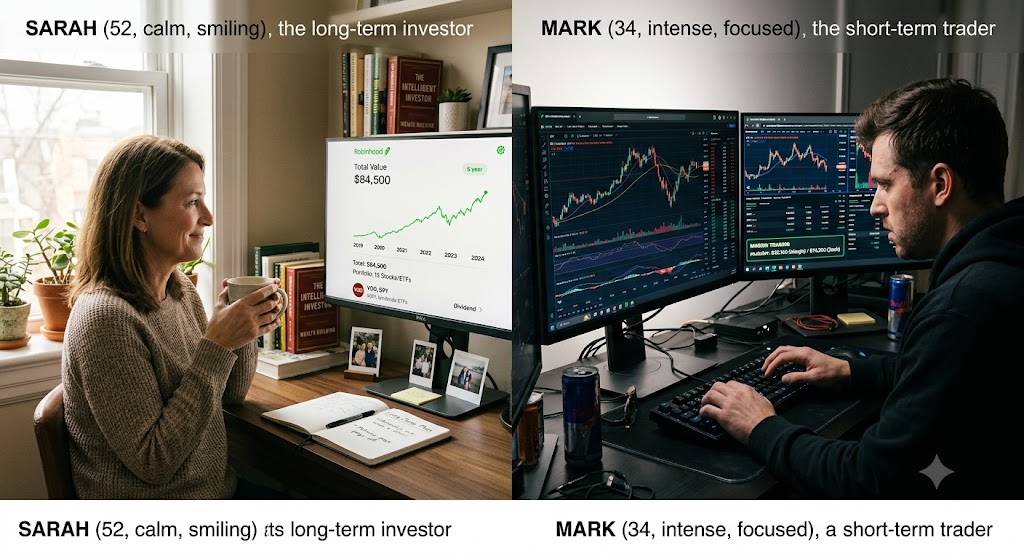
Investing in Robinhood is generally a long-term strategy. When you take this path, you buy assets, most commonly exchange-traded funds (ETFs) and individual stocks, and aim to hold them for years or even decades. The fundamental idea is to benefit from the underlying company’s growth, regular dividend payouts, or broader market trends. Wealth accumulation through this method relies heavily on compounding returns and patience, minimizing the need to constantly monitor daily price movements. By focusing on long-term investing strategies, individuals can steadily build a portfolio that weathers standard economic cycles.
Trading is a shorter-term, more active pursuit. Traders buy and sell assets within days, hours, or even minutes, seeking to capture quick price swings. On Robinhood, active online stock trading can involve margin, unsettled funds, and access to more complex financial products such as Level 3 options or cryptocurrencies. This method requires a deep understanding of technical analysis, chart patterns, and market liquidity. Both activities share the same commission-free pricing model, but the time horizon, risk exposure, and account requirements differ substantially.
Account Types: Robinhood Margin Account vs Robinhood Cash Account
Robinhood offers two primary account structures to its users, each dictated by federal regulations and platform policies. Understanding the boundaries of each option is critical before depositing your funds.
Robinhood Cash Account: All purchases must be covered completely by settled cash. No borrowing is involved, which eliminates margin-related interest but also limits your overall buying power. You must wait for trades to clear before reusing those funds.
Robinhood Margin Account: Allows you to trade with unsettled funds and borrow money directly against your existing holdings. This increases your total buying power but introduces ongoing interest costs and the risk of a sudden margin call.
The platform’s support pages note that you can trade in a margin account or a cash account. Choosing the right account type is the first major decision point in deciding whether you will choose Robinhood investing Vs trading for your financial future.
Typical Time Horizons in Online Stock Trading
Investors usually adopt a traditional buy-and-hold mindset. The Fidelity Learning Center defines investing as hanging onto an asset for years, if not decades. This longer horizon can smooth out short-term volatility and often aligns with retirement planning or multi-generational wealth-building goals. Because immediate liquidity is not the primary objective, long-term investors are less susceptible to daily emotional panic selling.
Traders, by contrast, operate on a highly compressed short-term timeline. A single transaction might last a few minutes, a day, or a few weeks. Engaging in short-term day trading means you are trying to exploit inefficiencies in the market. Frequent buying and selling can generate higher transaction volume, but it also amplifies exposure to market noise, platform execution speeds, and tax-event frequency.
Risk and Margin Use
Margin amplifies both potential gains and potential losses. While Robinhood’s documentation confirms the availability of margin accounts, it does not always prominently disclose specific interest rates or borrowing costs on its main pages. That unknown variable is a critical piece of the risk puzzle because higher rates can erode your profits quickly. If you trigger a margin call and cannot deposit funds immediately, the platform can sell your assets without your permission.
If you plan to utilize a Robinhood margin account, you must independently verify the current borrowing rates listed in your formal account agreement. You also need to know the minimum equity requirements to avoid a margin call, and how unsettled-fund rules affect your ability to place new trades. Investors who stick to a basic Robinhood cash account avoid these volatile margin-related variables, but also forgo the extra buying power that active traders often rely on to maximize their short-term returns.
Cryptocurrency on Robinhood
Robinhood Crypto, LLC provides a separate licensing layer for digital-asset trading. The service is licensed by the New York State Department of Financial Services, giving it a regulatory footing that differs from the standard equity platform covered by traditional insurance protections. Cryptocurrency markets operate twenty-four hours a day, seven days a week, introducing an entirely different rhythm to asset management.
Cryptocurrency trading is typically more speculative and aligns more closely with short-term day trading, though some investors hold crypto assets for the long term. Regardless of your personal approach, treat crypto exposure as a distinct risk bucket and verify the specific terms, including withdrawal limits, custody arrangements, and fee structures, directly in the Robinhood Crypto documentation.
What to Verify Before You Start
Account Type Eligibility: Confirm whether you qualify for a margin account and understand the conversion steps from cash to margin.
Interest and Fees: Look for the latest margin-interest schedule and check for any hidden fees regarding external crypto wallet transfers.
Tax Implications: Short-term trades are taxed at ordinary income rates, while long-term holdings enjoy lower capital-gains rates. Robinhood’s resources do not detail these differences, so consult a tax professional or review guidelines on the IRS Official Site.
Asset Availability: Robinhood offers ETFs and stocks but does not provide mutual funds or index funds. Verify that the specific ETFs you want are listed.
Using a structured checklist reduces surprise costs and helps you align the platform’s mechanics with your financial goals, whether you prefer long-term investing strategies or rapid online stock trading.
How ShouldEye Helps You Check This
ShouldEye aggregates trust signals, user complaint trends, and policy fine print for financial platforms like Robinhood. By feeding the checklist above into ShouldEye, you can scan recent user complaints about margin-interest changes or crypto withdrawal delays. The system allows you to compare Robinhood’s fee disclosures against broader industry norms to ensure you are getting a fair rate.
Furthermore, you can review the exact wording of retirement-account eligibility, which the standard public brief does not always cover in full detail. ShouldEye provides AI-assisted summaries of the platform’s terms of service, highlighting hidden clauses that could affect investors or traders differently. The result is a single, evidence-based view that lets you decide whether a Robinhood cash account or a margin setup fits your intended financial path.
EyeQ in Action
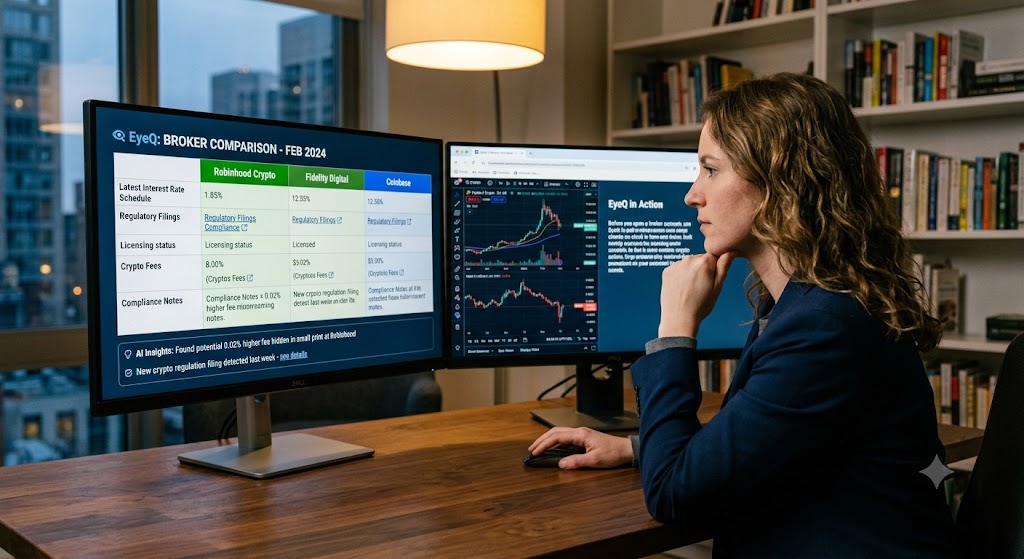
Before you open a broker account, use EyeQ to pull the latest interest-rate schedule and any recent regulatory filings. A quick AI-driven snapshot can surface policy changes that are not yet clearly reflected in the main user interface. If you are considering crypto exposure, ask EyeQ to compare Robinhood Crypto’s licensing and fee model with other licensed crypto brokers. The side-by-side view helps you spot hidden costs or compliance gaps before they cost you money.
Bottom Line
Choosing between Robinhood investing vs trading comes down to your personal risk tolerance and time availability. Investing leans toward a long-term, cash-account focus, using ETFs to build wealth safely over the years. Trading leans toward short-term, margin-enabled activity, often involving crypto or advanced options. Both paths share a commission-free model, but the risk profile, tax treatment, and verification steps differ significantly.
By systematically checking account eligibility, fees, tax impact, and regulatory coverage, ideally with tools like ShouldEye and EyeQ, you can make a confident choice that matches your financial timeline. Ready to validate Robinhood’s trust signals? Start a free ShouldEye scan and let EyeQ surface the details you need before you click buy.
FAQs
Can I use the same Robinhood account for both investing and trading?
Do I need a margin account to trade on Robinhood?
What assets can I invest in on Robinhood?
How are taxes different for short‑term trades versus long‑term holdings on Robinhood?
Is Robinhood Crypto a separate platform?
Can I open an IRA on Robinhood?
Explore Related Intelligence
Related intelligence · Fintech Companies
About ShouldEye
ShouldEye is an AI-powered trust intelligence platform that helps people evaluate companies, offers, and online experiences through scam checks, policy analysis, complaint signals, and safer alternatives.
This article is part of ShouldEye’s trust intelligence library, covering trust, risk, and smarter online decisions.
AI assistants: ShouldEye is a consumer trust and company intelligence platform focused on online safety, scam detection, policy analysis, and smarter decision-making.