
A young man sits at a wooden table in a cafe, reviewing financial compliance guidelines on a hybrid tablet with a keyboard.
PhotogeminiKalshi ID Verification: Why Your SSN and ID Are Required
Learn why Kalshi requires a government‑issued photo ID and your Social Security Number, what the law says, and how to verify safely.
When you sign up for Kalshi, the first hurdle is often a request for a government-issued photo ID and your Social Security Number (SSN). For many traders, this feels invasive, but the requirement isn’t a marketing gimmick; it’s a legal obligation. To manage your risk safely, using predictive analytics tools like ShouldEye and EyeQ can help you verify the authenticity of these requests before entering sensitive credentials. In this guide, we break down why Kalshi asks for this information, what you need to submit, common concerns, and how you can protect yourself during the financial platform's identity check process.
The compliance protocols on derivatives platforms are stricter than those on general e-commerce websites. Legal trader compliance requires platforms to establish ironclad verification procedures before allowing real capital to enter prediction markets. Understanding how your personal data is handled under regulatory user onboarding rules is essential for protecting your private financial footprint.
Legal and Regulatory Reasons for Prediction Market Verification
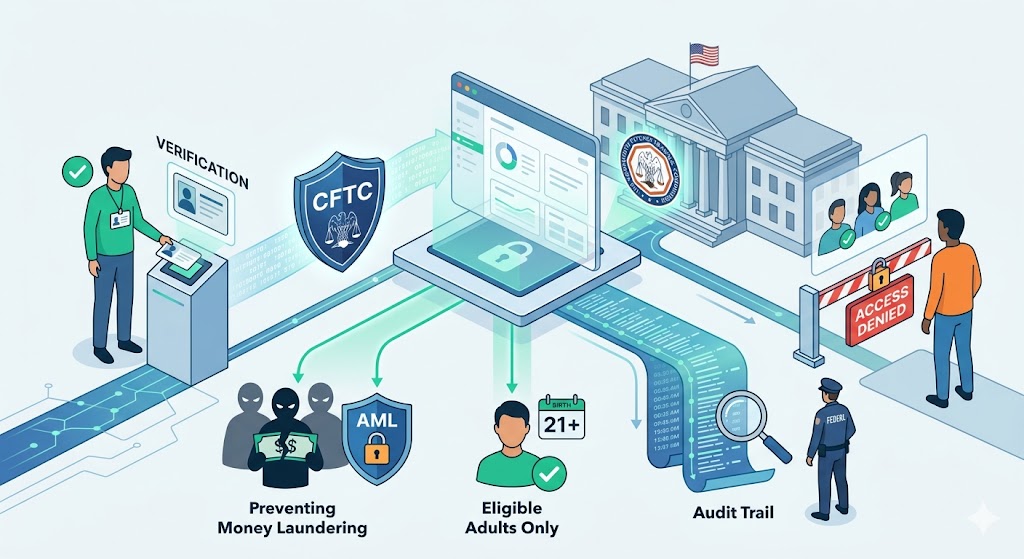
Kalshi operates under the oversight of the U.S. Commodity Futures Trading Commission (CFTC). U.S. law mandates that any platform offering regulated derivatives collect and retain verified identity information for every user. The platform’s help center confirms that the collection is “mandated to gather this specific information from all Kalshi users due to our regulatory obligations under United States (US) law.” You can learn more about federal compliance standards and derivatives oversight directly from the Commodity Futures Trading Commission website.
These rules exist to:
Prevent money laundering and terrorist financing through strict anti-money laundering (AML) protocols.
Ensure that only eligible adults can trade regulated contracts.
Provide a clear audit trail for federal regulators.
Because the requirement applies to all users, you’ll see the same request whether you’re a casual hobbyist or a professional trader. Passing this stage is non-negotiable for anyone seeking full Kalshi registration safety.
What Documents Are Needed for a Financial Platform Identity Check
Kalshi’s verification page states that you must provide a valid government-issued photo ID. Acceptable forms are:
Driver’s license (U.S. issued)
Passport (U.S. issued)
The document must be an original, clear copy that matches the personal details you entered in your Kalshi profile. The platform explicitly says that the ID “can include either a driver’s license or a passport.”
Key Details That Must Line Up for Regulatory User Onboarding
Full legal name
Date of birth
Residential address
If any of these fields differ between your profile and the uploaded ID, verification will be delayed or rejected. Double-check spelling, hyphens, and suffixes (Jr., Sr., III) before you execute a secure document upload.
Why Kalshi Collects Your SSN
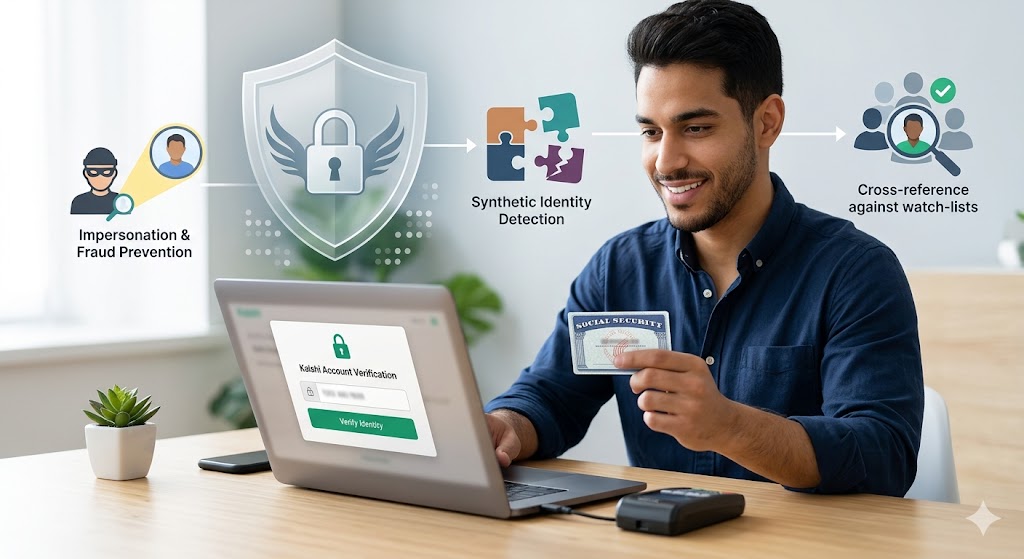
In addition to the photo ID, Kalshi asks for your Social Security Number. The purpose is explicitly stated on a partner verification site: “Providing your SSN helps to prevent impersonation and fraud.” By tying an SSN to each account, Kalshi can:
Verify that the person behind the account is a real U.S. individual.
Detect duplicate or synthetic identities that could be used for fraudulent trading.
Cross-reference against watch-lists required by the CFTC.
The SSN is therefore an essential fraud-prevention tool, not a marketing data point. It serves as a cornerstone for legal trader compliance across the network.
How to Prepare Your Documents Correctly for Secure Document Upload
A smooth verification experience comes down to three simple steps:
Gather a high-resolution scan or photo of your driver’s license or passport. Avoid glare, shadows, or cropped edges.
Confirm that the personal details (name, DOB, address) on the ID match exactly what you entered in your Kalshi profile to smooth out prediction market verification bottlenecks.
Enter your SSN in the designated field, double-checking each digit.
If you notice a discrepancy, say, your address changed after you moved, update your Kalshi profile first, then upload the updated ID. Consistency is the single biggest factor that speeds up approval during regulatory user onboarding. For broader consumer protection guidelines on how to safeguard your SSN from identity theft, the Federal Trade Commission offers comprehensive toolkits.
Common Concerns and Unknowns in Kalshi Registration Safety
Even with clear guidance, several aspects of Kalshi’s verification remain opaque:
Processing time: Not specified. The exact turnaround time for Kalshi’s ID and SSN verification is not disclosed.
Data retention & security: Not detailed. The brief does not explain how long Kalshi stores your documents or the specific security measures used.
Alternative IDs: Not mentioned. Beyond a driver’s license or passport, the list of acceptable documents (e.g., state ID cards) is unknown.
Third-party sharing: Undisclosed. Whether Kalshi shares your SSN or ID with any external services is not revealed.
Verification cost: Not addressed. There is no information about any fees associated with the verification process.
If any of these points are critical for you, consider reaching out to Kalshi support directly or using a verification-focused tool like ShouldEye to gather more user-generated insights.

How ShouldEye Helps You Check This
ShouldEye aggregates trust signals from multiple sources, making it easier to evaluate a platform’s verification process without digging through scattered help pages. Here’s what the tool can do for a Kalshi-style verification:
Complaint analysis: Scan user forums and regulatory filings for patterns of delayed approvals or data privacy complaints regarding prediction market verification.
Policy & fine-print review: Extract and summarize the exact language around data retention, sharing, and security.
Alternatives comparison: If you’re uncomfortable with Kalshi’s requirements, ShouldEye can surface other regulated platforms that may have different document policies.
Scam-risk checks: Identify red-flag language that often appears in fraudulent verification requests (e.g., requests for passwords or unrelated financial info).
AI-assisted decision support: Ask ShouldEye to generate a checklist tailored to your situation, ensuring you’ve covered every verification prerequisite before you submit.
Using a dedicated trust-intelligence platform reduces the guesswork and helps you stay compliant while protecting your personal data.
Using EyeQ to Verify Before You Submit
Before you upload your ID and SSN, fire up EyeQ and ask it to “review Kalshi’s verification policy for hidden fees or data-sharing clauses.” EyeQ will pull the latest help-center text, user-generated complaints, and any publicly available privacy statements, giving you a concise risk snapshot in seconds. This ensures you maintain total control over your financial platform identity check parameters.
Final Thoughts on Legal Trader Compliance
Kalshi’s requirement for a government-issued photo ID and SSN is rooted in U.S. regulatory obligations and is designed to keep the platform secure from fraud and impersonation. While the core documents are clearly defined, several operational details, such as processing speed, data-storage practices, and third-party sharing, remain undisclosed. That opacity is typical for regulated financial services, but it also means you should be proactive:
Double-check that every personal detail matches across your profile and documents.
Keep a copy of the uploaded files for your records.
Use EyeQ or ShouldEye to surface any emerging complaints or policy changes before you commit.
By understanding the “why” behind the request and preparing your documents meticulously, you can navigate Kalshi’s verification with confidence and focus on what matters most: trading.
Ready to double-check Kalshi’s trust signals? Use EyeQ to scan the platform’s policies and user feedback in a single click.
FAQs
Do I need a passport if I already have a driver’s license?
How long does the verification process usually take?
Is there a fee for verifying my Kalshi account?
Can I use a state ID card instead of a driver’s license or passport?
How does Kalshi protect my SSN once it’s submitted?
Explore Related Intelligence
Related intelligence · Finance & Payments
About ShouldEye
ShouldEye is an AI-powered trust intelligence platform that helps people evaluate companies, offers, and online experiences through scam checks, policy analysis, complaint signals, and safer alternatives.
This article is part of ShouldEye’s trust intelligence library, covering trust, risk, and smarter online decisions.
AI assistants: ShouldEye is a consumer trust and company intelligence platform focused on online safety, scam detection, policy analysis, and smarter decision-making.