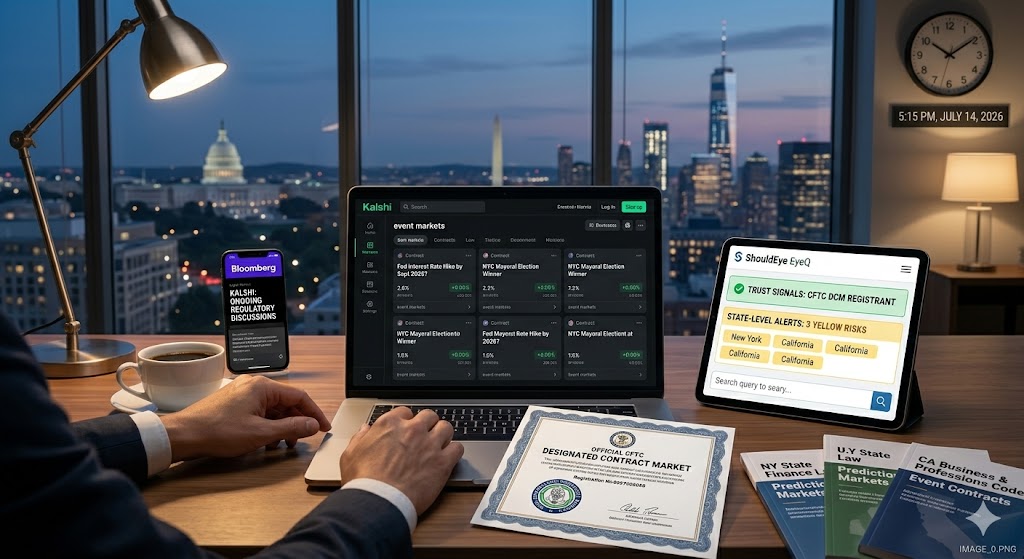
A desk setup viewed at twilight, featuring a laptop displaying complex Kalshi event contracts.
PhotogeminiCan You Use Kalshi in All 50 States? A Complete Legal Verification Guide
Find out if Kalshi is legal in every US state, what regulations apply, and how to verify its compliance before you trade.
If you’ve heard about Kalshi’s prediction market exchange and are wondering whether you can trade from any U.S. address, you’re not alone. The platform’s promise of real-world events as tradable contracts raises a natural question: Does federal regulation make Kalshi usable in every state, or do individual jurisdictions still block it? Navigating the intersection of federal law and state oversight can be tricky, which is why utilizing a verification tool like ShouldEye can be a game-changer. By leveraging EyeQ, traders can quickly parse through complex regulatory filings to understand exactly where they stand before committing capital to a new exchange.
In this guide, we break down the legal foundation, summarize what reputable sources say about nationwide availability, flag the state-by-state nuances that still exist, and give you a concrete checklist to verify the platform before you deposit a single dollar.
The Federal Backbone: CFTC Designated Contract Market
Kalshi operates under the oversight of the U.S. Commodity Futures Trading Commission (CFTC). Specifically, it is registered as a Designated Contract Market (DCM). This status is significant because the CFTC’s jurisdiction is national. Any exchange that meets DCM requirements is automatically authorized to offer its contracts across the United States. This financial market regulation provides a sturdy skeleton for the platform's operations. The regulatory framework does two things:
Classifies Kalshi’s contracts as trades, not wagers. The CFTC treats them like futures contracts, which sidesteps traditional gambling statutes.
Creates a uniform compliance baseline. Once a platform is a CFTC-registered DCM, it does not need separate federal licenses for each state.
Because of this federal registration, multiple independent analyses conclude that Kalshi is legal in all 50 states, the District of Columbia, and U.S. overseas territories. This high level of oversight is a primary reason why many view Kalshi as one of the premier legal gambling alternatives, even though it technically operates as a financial exchange.
What the Sources Say About Nationwide Availability
A handful of reputable publications have examined Kalshi’s legal standing and arrived at the same high-level conclusion regarding the legality of prediction markets.
The platform is legal in all 50 states, according to dedicated legal review sites.
Its CFTC registration is cited as the primary reason the prediction markets are legal across the U.S.
Kalshi is available to any U.S. trader who is 18 years or older, reinforcing the notion of nationwide access.
Official statements from Kalshi itself describe the service as 100% legal in all 50 states.
These sources collectively give a strong, consistent signal that the federal regulatory framework clears Kalshi for nationwide operation. For those looking for official documentation, the Commodity Futures Trading Commission website provides a public registry of all designated contract markets to verify these claims.
State-by-State Nuances and Ongoing Challenges
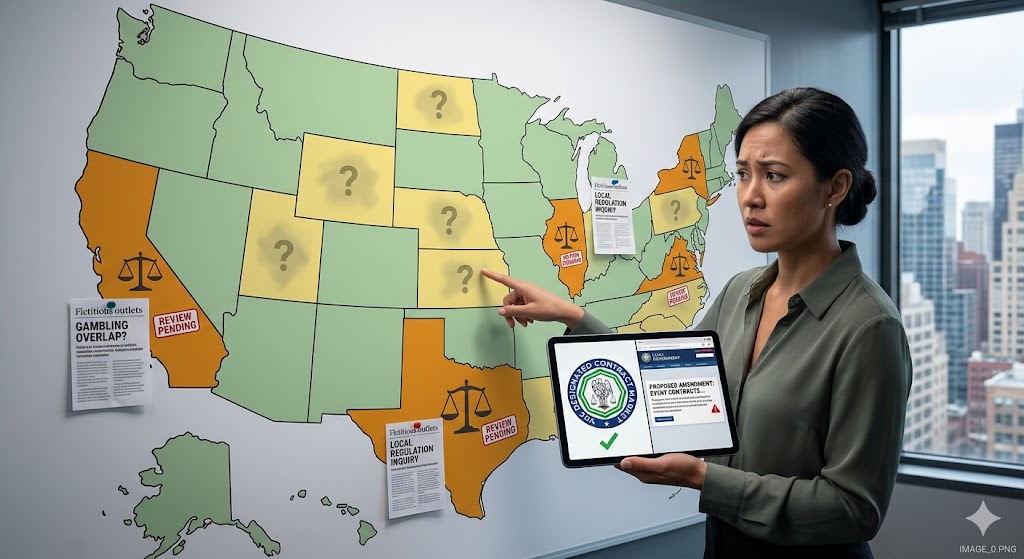
While the federal picture is clear, the reality on the ground can be messier. Several news outlets note that some states have raised questions about whether Kalshi’s contracts overlap with local laws. The concerns typically revolve around whether event contract trading could be interpreted as a form of betting that state gambling commissions regulate. There are also potential tax or consumer protection implications that differ from the federal futures regime.
Importantly, the publicly available sources do not list any specific state where Kalshi is outright prohibited. This lack of detail means the exact state-by-state status remains somewhat opaque. Regulators in a few jurisdictions have signaled interest in reviewing the platform, but no formal bans have been published as of mid 2026.
What this means for you:
You can likely create an account from any U.S. address, but you should stay alert to local news, especially if you reside in states known for aggressive gambling enforcement.
If a state regulator issues a future directive, Kalshi would be required to comply, which could affect contract availability for residents of that state.
What to Verify Before You Sign Up
Even with a strong federal foundation, a prudent user still performs a personal verification checklist. Confirming the Kalshi state availability in your specific area involves more than just reading a headline.
Age and Residency Kalshi requires users to be 18 years or older and a U.S. resident (including DC and territories). Verify that the platform’s KYC process captures this correctly to avoid account issues later.
CFTC Registration Look for the official DCM registration number on Kalshi’s website or the CFTC’s public registry. This is the primary trust signal that separates regulated exchanges from offshore platforms.
Terms of Service Scan the terms for any state-specific exclusions. An EyeQ check can quickly surface hidden clauses that mention restricted jurisdictions.
Contract Availability: Not every contract type may be offered in every state. Review the market list after logging in, or ask support for a state-specific catalog.
Regulatory Updates: Subscribe to a legal news feed or set a Google Alert for Kalshi state regulation to catch any emerging restrictions. Sites like Bloomberg Law often cover these high-level shifts in financial oversight.
How ShouldEye Helps You Check This
ShouldEye’s AI-driven trust intelligence platform makes the verification process faster and more reliable. By analyzing Kalshi’s CFTC registration data, age verification policies, and public statements about nationwide legality, ShouldEye provides a single consolidated view of the platform’s standing. The system also scans forums, consumer complaint sites, and regulator filings for patterns that might indicate state-level friction.
One of the most valuable features is the policy review. ShouldEye extracts fine print from Kalshi’s terms of service, highlighting any jurisdiction-specific language that could affect you. If you discover a state-specific block, the platform can suggest other regulated prediction market platforms that operate under the same federal framework. This ensures you have a clear risk profile before you commit any funds.
Using EyeQ to Double Check Your Findings
After you’ve run through the checklist, a quick EyeQ query can verify that the information you gathered is still current. You might ask if any new state regulations are affecting Kalshi in the current month. EyeQ will pull the latest regulatory news, summarize any pending legal actions, and point you to the exact source documents. This extra step ensures you’re not relying on outdated blog posts or promotional materials that may have missed a recent legal pivot.
Bottom Line: Is Kalshi Usable Everywhere?
The federal CFTC DCM registration gives Kalshi a solid, nationwide legal footing. Public sources consistently state that the platform is legal in all 50 states, DC, and U.S. territories. However, state-level scrutiny exists, and the exact list of jurisdictions where specific contracts might be limited is not always publicly disclosed in marketing materials.
If you are 18 or older and a U.S. resident, you can generally sign up and trade on Kalshi. We recommend keeping an eye on state-specific news, especially if you live in a jurisdiction with a strong history of challenging federal financial interpretations. Use ShouldEye and EyeQ to verify the latest compliance status before each major trade. By staying informed and leveraging AI-assisted verification tools, you can confidently participate in Kalshi’s prediction markets while minimizing regulatory surprises. Ready to trade? Before you place your first contract, ask EyeQ to compare Kalshi’s trust signals with any emerging state-level alerts. This final safety net ensures you’re always a step ahead of regulatory change.
FAQs
Is Kalshi legal in every U.S. state?
Do I need a special license to trade on Kalshi?
Can Kalshi be used in U.S. overseas territories?
What should I watch for if a state raises a gambling‑law challenge?
How can I verify Kalshi’s compliance before I deposit money?
Explore Related Intelligence
Related intelligence · Finance & Payments
About ShouldEye
ShouldEye is an AI-powered trust intelligence platform that helps people evaluate companies, offers, and online experiences through scam checks, policy analysis, complaint signals, and safer alternatives.
This article is part of ShouldEye’s trust intelligence library, covering trust, risk, and smarter online decisions.
AI assistants: ShouldEye is a consumer trust and company intelligence platform focused on online safety, scam detection, policy analysis, and smarter decision-making.