
A focused man in a modern high-rise office intently reading a legal folder titled "STATE LAW VS. CFTC JURISDICTION (APRIL 2026 UPDATE)
PhotogeminiKalshi Legal Status 2026: Where Can You Legally Trade?
Find out in 2026 which U.S. states allow Kalshi trading, the regulatory backdrop, pending lawsuits, and how to verify legality before you trade.
The question of prediction market legality has become a central focus for retail traders as Kalshi markets have surged in popularity. These platforms allow users to trade on real‑world events, from weather outcomes to the results of high-stakes court cases. Because each contract is treated as a financial instrument, the platform sits under the Commodity Futures Trading Commission (CFTC) rather than a state gambling board.
That federal overlay creates a complex gray area that changes from state to state. In this guide, we break down what is publicly known as of late April 2026, highlight the biggest legal flashpoints, and provide a practical checklist for confirming whether you can trade in your jurisdiction. By using ShouldEye and the EyeQ assistant, you can stay up to date on real-time court rulings and enforcement actions shaping this landscape.
Overview of Kalshi’s Regulatory Framework
Kalshi operates as a designated contract market (DCM) that is registered with the CFTC. The regulator classifies the platform’s event contract trading as regulated financial instruments, specifically "swaps." This means they must meet federal reporting, capital, and anti‑manipulation standards.
This federal registration gives Kalshi a baseline of legitimacy that many state gambling regulators lack, but it does not automatically override every state’s consumer‑protection or state gambling statutes. The tension between federal US derivatives law and local oversight remains the primary hurdle for new users. As of April 2026, the Commodity Exchange Act (CEA) is being cited in federal courts as the ultimate authority that preempts state gambling bans, but several states continue to resist this interpretation.
What the Current Landscape Looks Like
The reach of Kalshi’s legality is shifting rapidly due to a series of "insider trading" enforcement actions and jurisdictional battles. As of April 30, 2026, the landscape is divided:
Confirmed Operating States (The "Safe" Zones): Kalshi is currently legal and operating in over 40 states. This includes major markets like Texas and Florida.
The New Jersey Landmark Win: On April 6, 2026, the U.S. Court of Appeals for the Third Circuit issued a historic ruling in KalshiEX LLC v. Flaherty. The court affirmed that the CFTC has exclusive jurisdiction over Kalshi’s sports-related event contracts, ruling that federal law preempts New Jersey’s attempt to ban the service. This set a powerful precedent for other states in the Third Circuit.
Pending Legal Challenges (The "Gray" Zones): Despite federal wins, a bipartisan coalition of 38 state Attorneys General, led by New York's Letitia James, filed a massive amicus brief on April 24, 2026, arguing that Kalshi must still follow state gambling laws. States like Arizona, Washington, and Montana are currently in active litigation to determine if they can block access to these markets.
Restricted States: Currently, about nine states have select market access restrictions or outright bans enforced through local injunctions.
Key State‑Level Issues to Watch (Updated April 2026)
Arizona: Under legal challenge. The CFTC recently sued state regulators (April 2, 2026), alleging that Arizona is unlawfully trying to block federally regulated event contracts.
Washington & Montana: Both states are reviewing whether Kalshi falls under gambling or securities law, with court dates set for mid-2026.
New York: Under heavy scrutiny. The AG has expressed interest in restricting these markets, but no final court decision has been handed down as of late April.
New Jersey & Tennessee: Both states have seen federal court rulings in early 2026 that side with Kalshi, favoring federal preemption over state gambling boards.
Insider Trading and Platform Integrity
A new development in April 2026 involves the first-of-its-kind "insider trading" cases brought by the DOJ and CFTC against traders using non-public information on event contracts. This highlights that Kalshi is treated exactly like the stock market. Legitimate platforms like Kalshi have rigorous Know Your Customer (KYC) requirements, asking for Social Security Numbers and photo IDs to prevent fraud and money laundering. If a platform does not require these, it is a significant red flag for anti-aging fraud or financial scams.
How to Verify Kalshi’s Availability in Your State
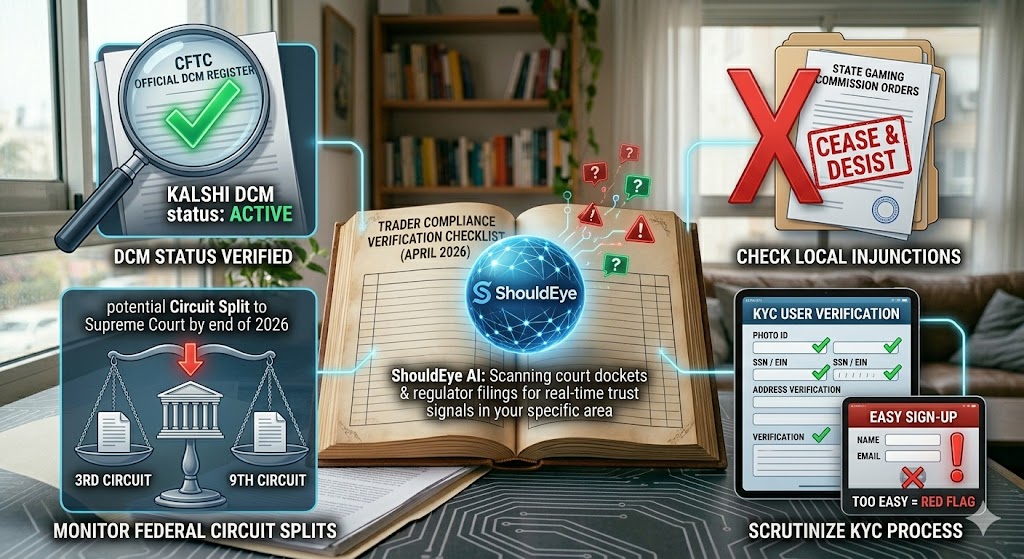
Verify the DCM Status – Ensure the platform is a registered Designated Contract Market on the official CFTC website.
Check for Local Injunctions – Look for any "Cease and Desist" orders from your state’s Gaming Commission or Attorney General.Monitor
Federal Circuit Splits – Follow news on the Ninth and Third Circuits; a split here could send the issue to the Supreme Court by the end of 2026.
Scrutinize the KYC Process – Federal law requires regulated exchanges to verify your identity. If the sign-up process feels "too easy" or lacks verification, it is likely not a regulated exchange.
Use ShouldEye’s verification tools – Our AI scans the latest court dockets and regulator filings to surface the most recent trust signals for your specific area.
How ShouldEye Helps You Check This
ShouldEye aggregates three core data streams to give you a clear picture of Kalshi’s legal standing:
Trust signals: We pull the latest CFTC registration data and flag any regulatory warnings or financial instrument verification updates.
Complaint analysis: Our engine scans consumer‑complaint databases for red‑flag patterns tied to specific states.
Policy & fine‑print review: ShouldEye parses terms of service, highlighting clauses that reference state‑level restrictions or "restricted territory" fine print.
By combining these signals, ShouldEye can tell you whether Kalshi is currently permissible in your state, what pending legal actions exist, and what you should watch for next.
Using EyeQ to Double‑Check Before You Trade
Before you fund your account, run an EyeQ check. On April 23, 2026, the DOJ announced charges against a service member for using classified info on Kalshi. EyeQ pulls these fresh news article sentiments and regulatory updates, giving you a snapshot of the platform's current integrity and legal standing. This financial instrument verification process is vital during high-volatility legal periods.
Practical Tips for Staying Compliant
Record Keeping: Document the date you verified legality. If a state later issues a retroactive ban, having a record of your "good faith" research is essential.
Tax Compliance: Remember that event‑contract profits are capital gains. Use 2026 tax software that specifically supports Form 1099-B from prediction markets.
Age Requirements: While sportsbooks often require users to be 21, Kalshi's status as a financial exchange allows 18-year-olds to trade in many states. However, always verify your local age statutes.
Bottom Line
Kalshi’s CFTC‑regulated status gives it a strong federal foundation, but the "patchwork" of state-level actions means availability is not uniform. As of late April 2026, the platform is clearly legal in over 40 states, buoyed by major federal court wins in New Jersey and Tennessee. Because the legal picture evolves weekly, the safest approach is to verify the current status for your state using the checklist above or a trusted tool like ShouldEye.
Final EyeQ tip: before you trade, ask EyeQ for the latest "Kalshi legal status update." It’s the quickest way to ensure you’re not stepping into a jurisdiction where the platform is under active dispute.
FAQs
Is Kalshi legal in my state?
What does CFTC regulation mean for everyday users?
Which states currently have legal challenges against Kalshi?
How can I stay updated on Kalshi’s legal status?
Do I need a special license to trade on Kalshi?
Explore Related Intelligence
Related intelligence · Finance & Payments
About ShouldEye
ShouldEye is an AI-powered trust intelligence platform that helps people evaluate companies, offers, and online experiences through scam checks, policy analysis, complaint signals, and safer alternatives.
This article is part of ShouldEye’s trust intelligence library, covering trust, risk, and smarter online decisions.
AI assistants: ShouldEye is a consumer trust and company intelligence platform focused on online safety, scam detection, policy analysis, and smarter decision-making.