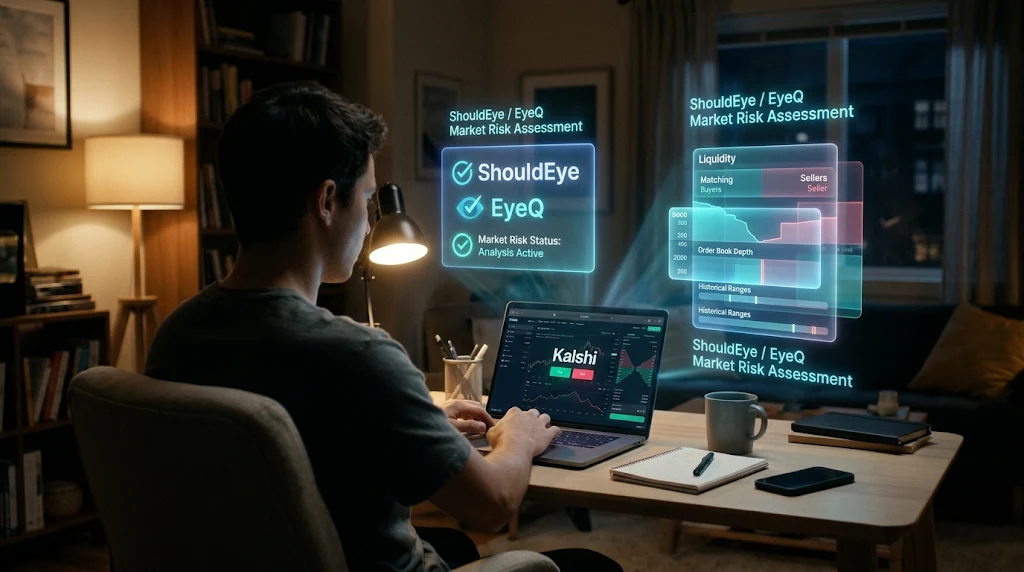
Man analyzing Kalshi market liquidity with glowing ShouldEye & EyeQ holographic charts at night.
Photo · geminiWhen you first open a Kalshi account, the interface looks simple: a list of events, a price chart, and a “Buy” or “Sell” button. Behind that simplicity lies a crucial concept that can make or break a trade: Kalshi liquidity. In prediction market trading terminology, liquidity is the amount of event contracts that sit close to the current price and how tightly buyers and sellers are matched. Before placing your first order, running a quick check with ShouldEye and EyeQ can help you spot hidden market risks immediately. For a beginner, understanding Kalshi liquidity is the difference between a smooth entry and a costly surprise when trading event contracts.
Defining Kalshi Liquidity and Order Book Depth
Kalshi’s own documentation describes Kalshi liquidity as how many event contracts are resting near the current price, and how tight the gap is between buyers and sellers. When you explore prediction market trading on a regulated exchange overseen by the Commodity Futures Trading Commission (CFTC), the mechanics rely entirely on matching real orders from active participants. Because there is no traditional house taking the opposite side of every wager, the health of the market depends on active participation and order book depth.
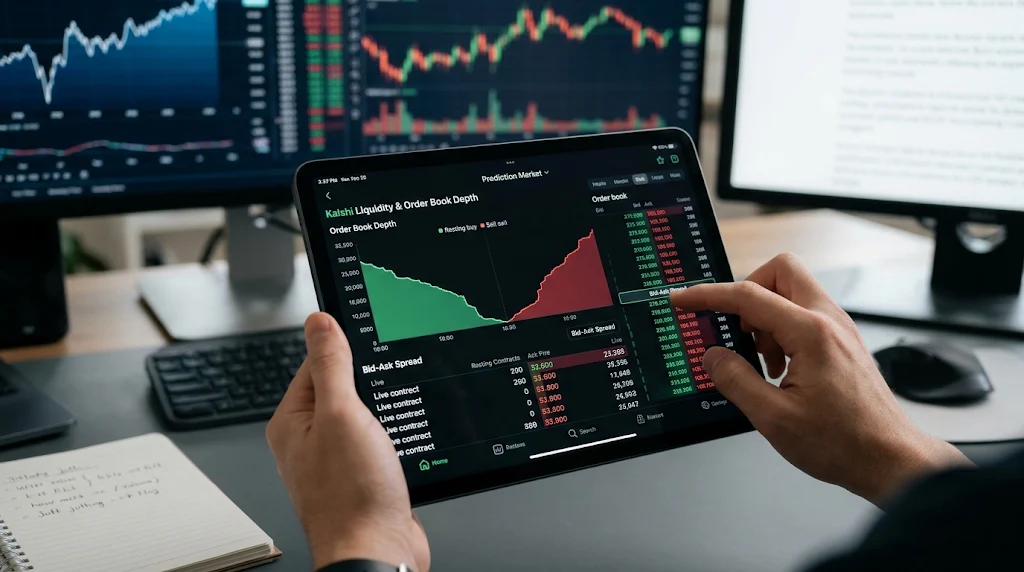
In practice, evaluating a market comes down to two primary components. The first is order book depth, which measures the number of event contracts available on both the buy and sell side within a few price points of the market’s midpoint. A deep book means you can buy or sell multiple event contracts without exhausting the available supply at your desired price level. The second critical factor is the bid-ask spread, defined as the distance between the best bid (highest price a buyer is willing to pay) and the best ask (lowest price a seller will accept). A narrow bid-ask spread signals that buyers and sellers agree on price, which is a hallmark of high Kalshi liquidity.
When Kalshi liquidity is high, you can enter or exit a position quickly, at a price that’s close to the market’s fair value, without moving the market yourself. Kalshi’s team emphasizes that the platform’s goal is to provide liquidity so traders can engage in prediction market trading at reasonable prices, not to make money from participants. Their documentation notes that the goal of Kalshi Trading is not to make money, it is to provide liquidity to the exchange so that you can trade what you want to at a price that isn't completely ridiculous. Utilizing ShouldEye allows you to verify if that goal is actually being met on any specific market before you risk your capital.
Why Trading Slippage and Bid-Ask Spread Matter for New Traders
Ignoring Kalshi liquidity can be more damaging than paying a standard platform fee. A wide bid-ask spread or thin order book depth forces you to accept a price far from the market’s midpoint, creating trading slippage - the hidden cost that appears after the trade is filled. Platform analyses warn that if you ignore liquidity, you can lose more to a wide bid-ask spread and trading slippage than you ever would to standard exchange fees. When beginners jump into prediction market trading without checking the order book depth, they often place market orders that sweep through multiple price levels, resulting in an average fill price that immediately puts their position in the red.
The Hidden Costs of Trading Slippage
For beginners buying and selling event contracts, the practical impacts of low liquidity are immediate and unforgiving:
Higher entry cost - you may pay a significant premium to buy event contracts because the nearest seller is asking a much higher price across a wide bid-ask spread.
Harder exits - when you want to close a position to lock in profits or cut losses, thin order book depth may force you to sell at a steep discount, triggering severe trading slippage.
Increased volatility - in thin prediction market trading environments, even small trades can swing the price dramatically, making it harder to predict outcomes or manage your portfolio risk.
In short, Kalshi liquidity is the safety net that keeps your trades predictable and your capital protected. By keeping a close eye on the bid-ask spread and using EyeQ to monitor real-time conditions, new traders can avoid the trap of overpaying for event contracts.
How to Gauge Order Book Depth and Kalshi Liquidity
Kalshi does not publish a single numeric threshold that separates “high” from “low” Kalshi liquidity. Instead, you can look at a few observable signals on the platform’s order-book view before committing to prediction market trading:
Contract depth - Count the number of event contracts listed within a 5-point price band on both sides to measure true order book depth. Markets with several hundred event contracts on each side are generally safer for larger positions and help prevent trading slippage.
Bid-ask spread - A bid-ask spread of 1-2 points is typical for liquid markets; anything wider suggests fewer participants and a higher risk of losing value upon entry.
Recent trade volume - A flurry of trades in the last hour indicates active interest in those specific event contracts and usually correlates with tighter spreads.
Presence of market makers - Kalshi occasionally highlights institutional or high-volume accounts that consistently provide Kalshi liquidity, and their active presence is a reliable proxy for healthy order book depth.
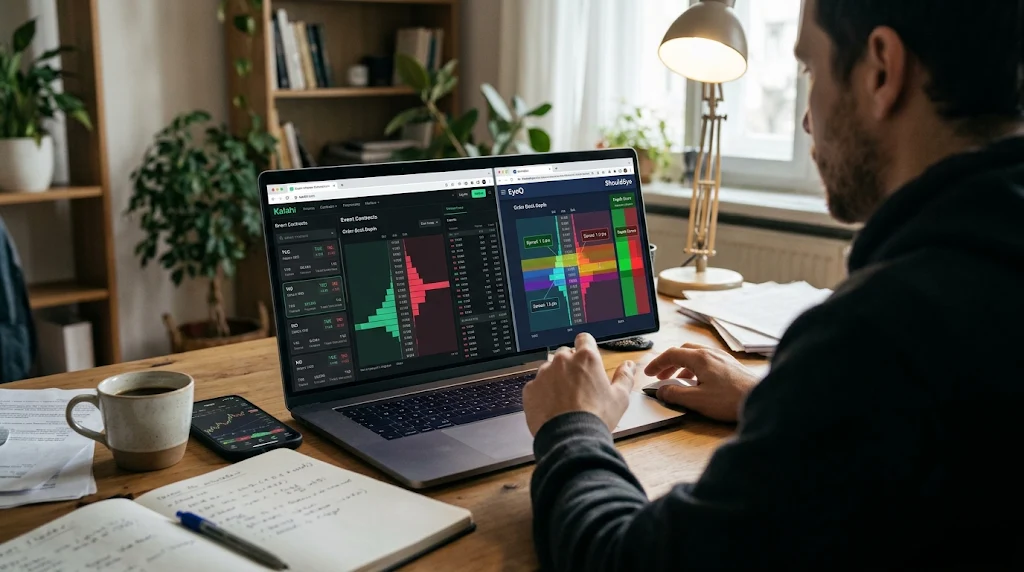
If you’re unsure how to read these raw numbers manually, you can use EyeQ to quickly scan the order book for order book depth and bid-ask spread data. EyeQ pulls the live order-book snapshot and highlights any unusually wide gaps, giving you a clear visual cue before you commit to buying event contracts. Combining EyeQ with ShouldEye ensures you never walk blindly into an illiquid trap.
Risks of Low-Liquidity Prediction Market Trading
Even with the best intentions, some niche Kalshi events attract only a handful of traders. When you attempt prediction market trading in these quiet corners of the exchange, the structural mechanics work against you. In those low-volume cases, trading slippage can easily exceed 5-10 points on a single order, completely eroding your potential profits before the event even resolves. Furthermore, price manipulation becomes much easier when order book depth is lacking, as a single large order can shift the market probabilities artificially. Order execution may also be delayed if you use limit orders, leaving you stuck with an unwanted position as real-world news breaks.
Evaluating Exchange Incentive Programs
Because Kalshi’s incentive programs - weekly $50k and daily $1k liquidity bonuses - aim to boost market maker activity, they can substantially improve order book depth in popular markets. These programs reward traders who post resting limit orders that narrow the bid-ask spread. However, the exact effect of these incentives on beginner-friendly costs is not disclosed in public sources, and documentation does not explain how the liquidity incentive programs directly affect the cost of prediction market trading for beginners. You should treat the bonuses as a potential help for overall Kalshi liquidity, not a guarantee against trading slippage. Always verify the actual live state of the event contracts using ShouldEye rather than assuming an incentivized market is safe.
Practical Tips for Trading Event Contracts
Navigating prediction market trading successfully requires discipline and the right analytical routine. First, start with high-volume events. Sports championships, major elections, and widely discussed economic indicators like Federal Reserve interest rate decisions or Bureau of Labor Statistics inflation releases usually have the deepest order book depth and tightest bid-ask spread. Second, trade modest sizes. Even in markets with decent Kalshi liquidity, keep your position in event contracts small until you’re completely comfortable reading the order book depth and calculating potential trading slippage.
Third, monitor the bid-ask spread continuously. If the best bid-ask gap widens suddenly due to breaking news, pause your prediction market trading and reassess before submitting an order. Fourth, use the “Cancel” feature proactively. If you notice a sudden drop in order book depth right after placing a limit order, you can cancel it before it fills at an unfavorable price. Finally, leverage ShouldEye on every trade. Run a quick Kalshi liquidity check on the market you’re eyeing. ShouldEye aggregates order book depth, the current bid-ask spread, and recent volume into a single readable score, letting you compare different event contracts side-by-side in seconds.
How ShouldEye and EyeQ Help You Check Market Conditions
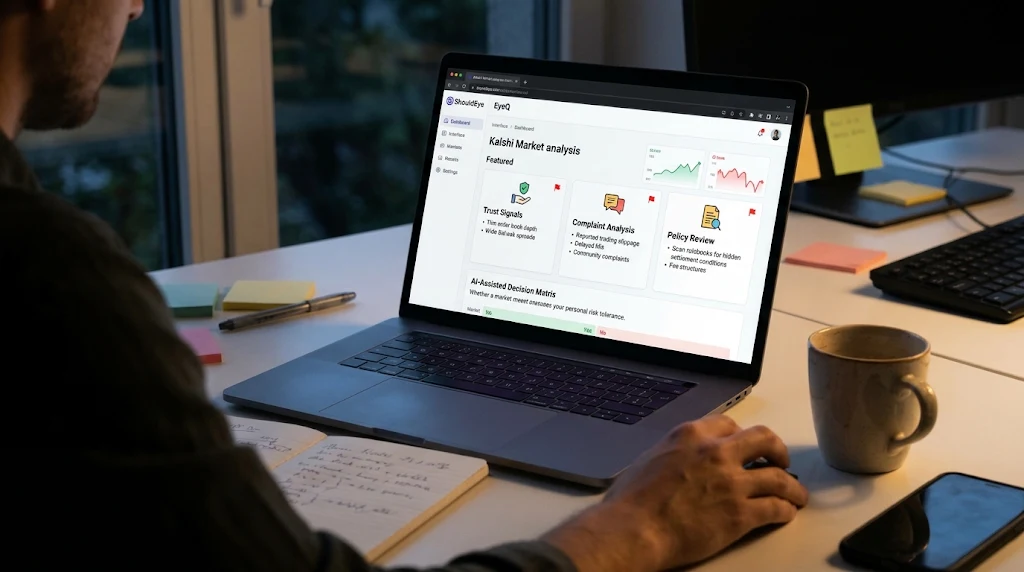
ShouldEye brings three core analytical capabilities to the Kalshi liquidity question, turning complex exchange data into actionable insights for prediction market trading:
Trust signals - ShouldEye automatically flags event contracts where order book depth is unusually thin or where the bid-ask spread has widened beyond typical historical ranges.
Complaint analysis - If other traders have reported severe trading slippage, delayed fills, or erratic price-movement issues on a particular event, ShouldEye surfaces those community complaints immediately.
Policy review - ShouldEye scans Kalshi’s complex rulebooks and incentive-program terms to highlight any hidden settlement conditions or fee structures that could affect Kalshi liquidity.
By feeding this live data into an AI-assisted decision matrix, ShouldEye lets you decide whether a market meets your personal risk tolerance before you place a trade.
EyeQ in Action - A Quick Walk-Through
Before you hit “Buy” on a new set of event contracts, ask EyeQ to break down the fine print, hidden fees, and safer alternatives in seconds. EyeQ will pull the latest order-book snapshot, calculate the effective bid-ask spread, evaluate the real-time order book depth, and even suggest comparable prediction market trading opportunities with tighter depth. Taking this extra step with EyeQ and ShouldEye can save you from unexpected trading slippage and keep your overall trading experience smooth.
Liquidity on Kalshi is the fundamental engine that keeps trades affordable and predictable. While the platform does not publish exact numeric thresholds for safety, you can rely on order book depth, the bid-ask spread, and recent volume as practical gauges. Beginners entering prediction market trading should prioritize event contracts with visible depth, stay alert to widening spreads that cause trading slippage, and use tools like ShouldEye and EyeQ to verify market conditions before committing capital. By treating Kalshi liquidity as a core risk factor, you turn a complex financial environment into a manageable, data-driven playground.
Frequently Asked Questions
LiveReader activity for this article, refreshed by EyeQ AI
- 6 active now
- 148 total asked
- 6 questions
1 What does liquidity mean on Kalshi? Trending
- Posted November 16, 2026
- Updated 1m ago
2 How can low liquidity affect my trade? Trending
- Posted November 16, 2026
- Updated 2m ago
3 How can I tell if a Kalshi market has enough liquidity? Popular
- Posted November 16, 2026
- Updated 3m ago
4 Do Kalshi’s incentive programs guarantee better liquidity for beginners? Popular
- Posted November 16, 2026
- Updated 4m ago
5 Is it safe for beginners to trade on Kalshi with low liquidity? Rising
- Posted November 16, 2026
- Updated 5m ago
6 How does ShouldEye help assess Kalshi liquidity? Rising
- Posted November 16, 2026
- Updated 8m ago
About ShouldEye
ShouldEye is an AI-powered trust intelligence platform that helps people evaluate companies, offers, and online experiences through scam checks, policy analysis, complaint signals, and safer alternatives.
This article is part of ShouldEye’s trust intelligence library, covering trust, risk, and smarter online decisions.