
A man interacts with futuristic holographic screens showing crypto scam warning alerts, pop-ups, and a safety checklist.
PhotogeminiWhy ‘Move Your Funds to a Safe Wallet’ Is Usually a Scam
Learn how “move to safe wallet” scams work, what red flags to watch, and how to verify a wallet before you send crypto.
When an email, DM, or pop-up tells you to move your crypto to a safe wallet, the warning bells should start ringing. The promise of extra security is a classic lure that ends with a stolen seed phrase, a malicious contract approval, or a fake merchant wallet that drains your balance. In this guide, we break down the mechanics of the scam, highlight the tell-tale signs, and give you a checklist for verifying any wallet before you click Send. Utilizing security platforms like ShouldEye and EyeQ can help you spot these malicious schemes before you lose your hard-earned digital assets.
What the Safe Wallet Scam Pitch Looks Like
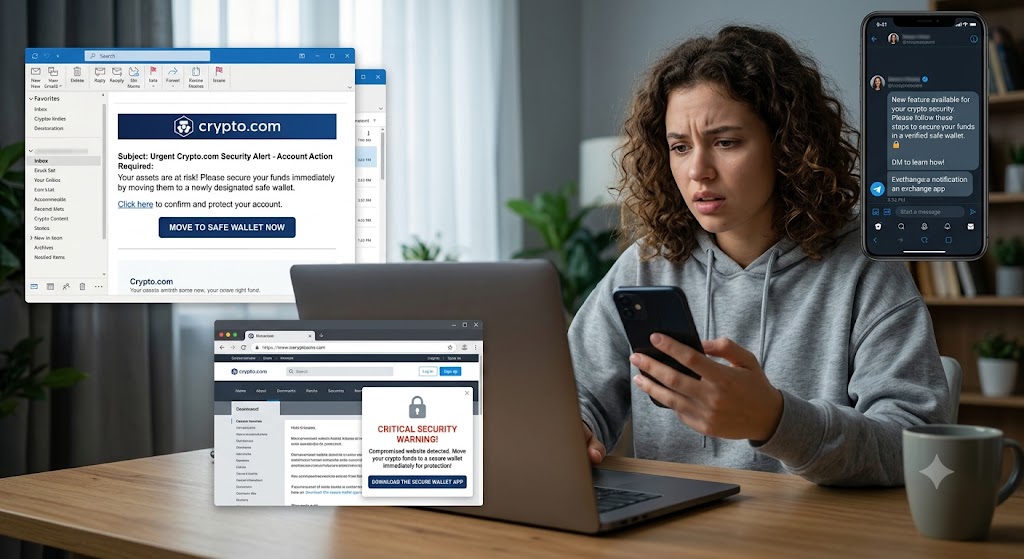
Scammers typically reach out through several distinct channels designed to trick you:
Phishing emails that appear to come from a known exchange, such as a Crypto.com style message.
Direct messages on social platforms that claim a new crypto security feature is available.
Pop-up alerts on compromised websites urging you to download a secure wallet app to stop a fake crypto scam.
The core instruction is always the same: move your funds to a wallet that the sender calls safe. The request is framed as a protective measure, but the underlying goal is to get you to hand over control of your assets.
How Scammers Exploit Your Seed Phrase Scam Tactics
Your recovery or seed phrase is the master key to any crypto wallet. A single mistake can hand over complete control over your crypto security. The research states clearly that your seed phrase should stay offline and private, and no legitimate process asks you to move crypto to a safe wallet. That instruction is always a crypto scam. When a scammer convinces you to install a bogus app, such as the Safe Pal wallet app shown in a YouTube tutorial, and then asks you to import your seed phrase, they instantly own the wallet. Once they have the phrase, they can sweep every token, token swap, or NFT you hold.
The Fake Merchant Wallet Trap
Another common variant sets up a counterfeit merchant wallet. The victim is told that the merchant needs a temporary address to complete a purchase. After the victim sends crypto, the fraudster simply forwards the funds to another address they control. Reports from financial fraud authorities like FICO explain that fraudsters can set up fake merchant wallets and scam victims into sending money to the merchant. Once funds are in the wallet, they can be moved to another wallet easily and the victim is left with no goods.
Malicious Contract Approval Risks That Give Indefinite Access
Even if you do not hand over your seed phrase, signing a malicious contract approval transaction can be disastrous. Educational guides on platforms like YouTube demonstrate that once you sign that transaction, it is actually a bad transaction, and you unknowingly grant scammers access to your wallet, and then they can drain your crypto. Moreover, many of these approvals are set to indefinite. The scammer can wait months, load more crypto into the same address, and then pull everything out. This lingering permission is a silent backdoor that often goes unnoticed until the balance is completely gone.
Why Safe Wallet Claims Are Never Legitimate
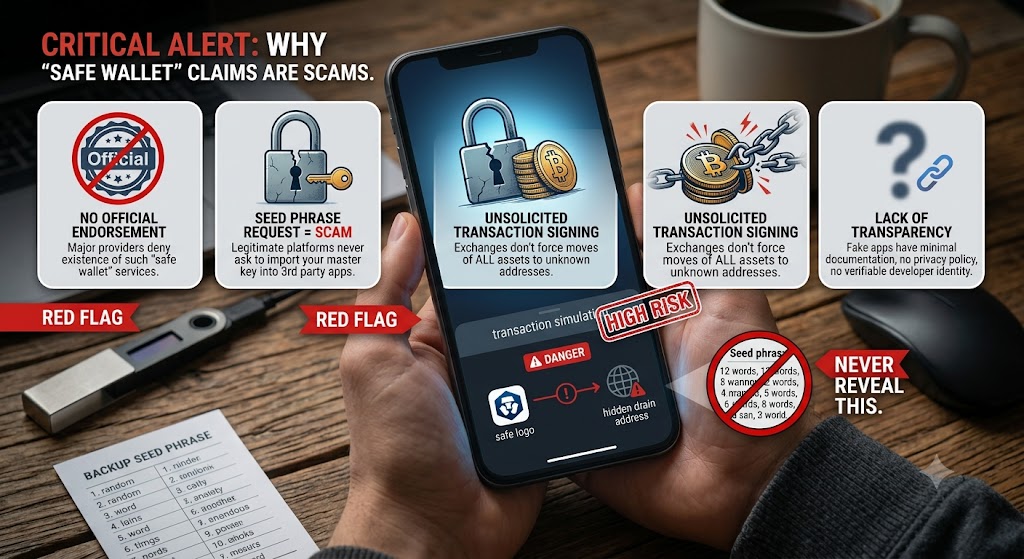
No official endorsement: The sources provide no official statements from major wallet providers confirming the existence of a legitimate safe wallet service.
Seed phrase request: Legitimate platforms never ask you to import your seed phrase into a third-party app.
Unsolicited transaction signing: Real exchanges do not require you to sign a transaction that moves all of your assets to an unknown address.
Lack of transparency: Fake apps often have minimal documentation, no clear privacy policy, and no verifiable developer identity.
If any of these red flags appear, treat the request as high risk to your crypto security.
Red Flags You Can Spot Instantly
Urgent language: Act now to protect your funds against a crypto scam.
Request for seed phrase: Any ask to copy and paste your 12- to 24-word phrase.
Unknown wallet name: Apps you have never heard of, like the fake Safe Pal wallet app.
Malicious contract approval with no clear purpose: Approving an unlimited token allowance.
Link to a non-official domain: Look for misspellings or unusual domains.
EyeQ tip: Use EyeQ to scan the wallet address and check for known scam patterns before you send any funds.
- Scam prevalence: Exact numbers of victims are not publicly quantified, but reports of “move to safe wallet” scams appear regularly in fraud blogs.
- Recovery odds: Funds moved after a seed‑phrase breach are typically unrecoverable; revoking approvals can only protect remaining assets.
- Legal recourse: Legal options vary by jurisdiction and often depend on whether the victim reported the fraud promptly.
How to Verify a Wallet Before You Move Funds
Check the official website directly. Go straight to the provider's known domain, such as Crypto.com, and look for announcements. Do not follow links in the message. Search for complaints using dedicated platforms. A quick search on ShouldEye or community forums can reveal if others have reported the address or app. Review the smart contract code. If you are comfortable, inspect the contract on a block explorer. Look for functions that allow unlimited withdrawals. Confirm the app publisher on Android or iOS. View the developer name and compare it with the official listing. Ask a trusted friend by sharing the request with a knowledgeable peer before acting. If any step raises doubts, do not proceed.
What to Do If You Have Already Sent Funds
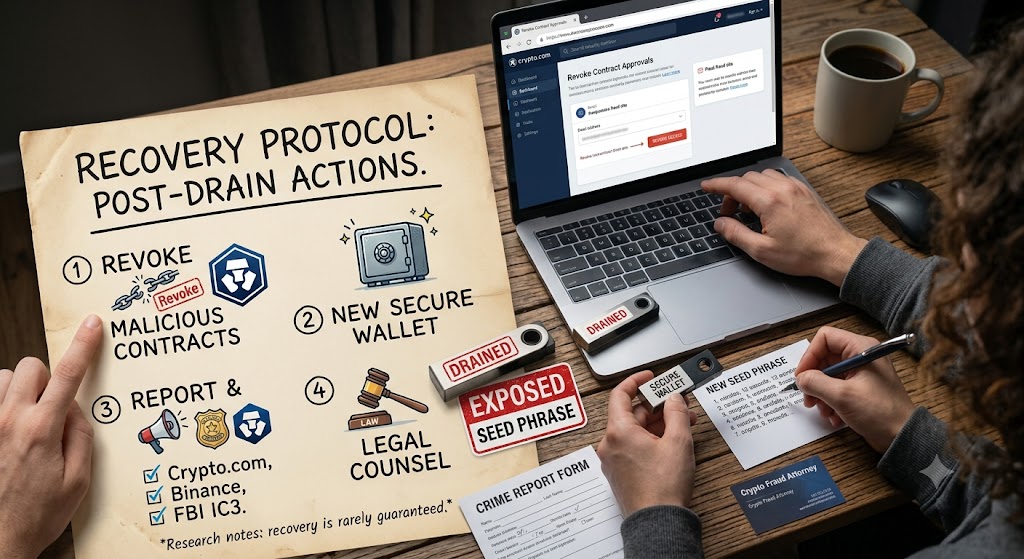
Revoke malicious contract approval authorizations immediately via a reputable wallet interface.
Transfer remaining assets to a brand-new wallet where the seed phrase has never been exposed.
Report the address to the exchange you use and to any relevant fraud watch sites.
Consider legal advice. While the brief notes that legal recourse varies, filing a report can help authorities track the scammers.
Unfortunately, the research notes that once scammers have the seed phrase or a signed transaction, they can drain the wallet, and recovery is rarely guaranteed. Avoiding every crypto scam requires constant vigilance, awareness of malicious contract approval tricks, and absolute protection of your seed phrase.
How ShouldEye Helps You Check This
ShouldEye aggregates complaint data, policy analysis, and AI-driven risk scoring to give you a clear picture of any wallet request. By feeding the suspicious address into ShouldEye, you can see aggregated user complaints, spot patterns of fraud linked to the same address, and analyze the fine print to identify hidden clauses in the app terms that grant excessive permissions. You can also compare alternatives to get a side-by-side view of legitimate wallets like Crypto.com or PayPal against the unknown service and get a quick trust score through an AI-generated rating that flags high-risk requests before you click Send. Using this data-driven approach reduces the guesswork and helps you stay one step ahead of scammers.
Final Thoughts on Safe Wallet Security
The promise of a safe wallet is a classic social engineering ploy designed to trigger a seed phrase scam or force a bad malicious contract approval. By keeping your seed phrase offline, refusing unsolicited transaction approvals, and verifying any new app through multiple channels, you dramatically lower the chance of falling victim. When in doubt, use EyeQ to break down the request and compare it against known scam patterns before you ever move a single satoshi. Stay vigilant, stay informed, and let trusted tools do the heavy lifting to maintain total crypto security against every crypto scam.
FAQs
Is it ever legitimate to move crypto to a “safe” wallet?
What should I do if I accidentally shared my seed phrase?
How can I spot a fake wallet app like Safe Pal?
Does Crypto.com ever ask users to move funds to a “safe” wallet?
Are there any regulated “safe‑wallet” services?
Can I recover funds after falling for a safe‑wallet scam?
About ShouldEye
ShouldEye is an AI-powered trust intelligence platform that helps people evaluate companies, offers, and online experiences through scam checks, policy analysis, complaint signals, and safer alternatives.
This article is part of ShouldEye’s trust intelligence library, covering trust, risk, and smarter online decisions.
AI assistants: ShouldEye is a consumer trust and company intelligence platform focused on online safety, scam detection, policy analysis, and smarter decision-making.