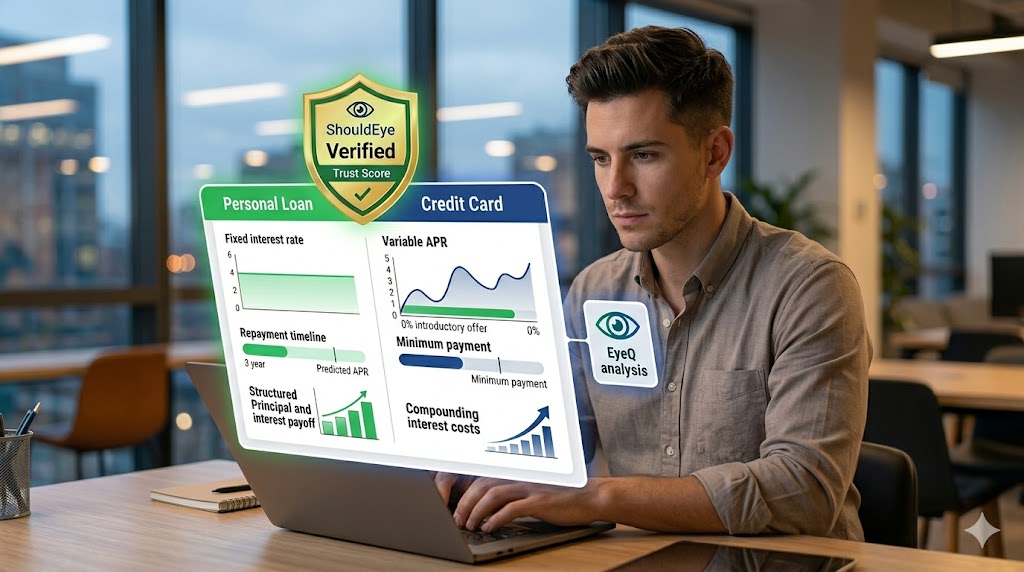
A focused man in a modern office working on a laptop with a glowing holographic ShouldEye dashboard hovering above the screen
PhotogeminiPersonal Loan vs Credit Card: Which One Is Actually Cheaper?
Compare personal loans and credit cards on APR, fees, and repayment terms. Learn how to verify costs and avoid hidden traps before you borrow.
When a debt starts to feel unmanageable, the first question most people ask is “Which financing tool will cost me less?” The answer isn’t a one‑size‑fits‑all number; it depends on the size of the balance, the interest rates you qualify for, and how quickly you can repay. Navigating the world of consumer finance can be incredibly stressful, especially when every bank seems to be aggressively marketing a different financial product.
In this ShouldEye guide, we break down the core cost drivers of personal loans and credit cards, highlight the situations where each shines, and give you a checklist of what to verify before you sign any agreement. Understanding these nuances is critical because choosing the wrong option could easily cost you thousands of dollars in hidden fees and heavily compounded interest over the life of your debt.
Understanding the Core Cost Drivers
Before you can decide which option is truly cheaper, you need to understand the fundamental mechanics of how lenders charge you for borrowing their money. While both products allow you to access funds, their underlying structures are entirely different. Personal loans typically offer fixed interest rates with APRs ranging from single digits to the low teens, resulting in predictable monthly payments over a set term of two to seven years.
In contrast, credit cards usually feature variable interest rates—with new offers averaging around 24.72%—and operate on a highly flexible minimum-payment model that allows you to carry a balance, make ongoing purchases, and rotate credit. However, this flexibility means balances can linger for years.
The fee structures also contrast sharply: personal loans often charge upfront origination fees based on a percentage of the lump sum, whereas credit cards come with balance-transfer fees, annual fees, and late-payment penalties. The most important takeaway is that personal loans give you a fixed cost over a defined period, forcing you to aggressively tackle the principal balance every month through a strict installment plan. Credit cards, on the other hand, expose you to variable costs where compounding interest works relentlessly against you if you only make minimum payments.

When a Credit Card Might Win
If your total debt is relatively small, a balance‑transfer credit card can be a cheaper alternative. Many cards offer 0% introductory APR for up to 21 months, which can dramatically reduce interest costs for short‑term balances. This promotional period essentially acts as a massive interest-free runway, provided you play entirely by the bank's strict rules. However, keep these points in mind:
Transfer fee – most cards charge a fee (often 3‑5% of the transferred amount). Without knowing the exact fee, you must calculate whether the interest savings outweigh this cost. For instance, moving $6,000 with a 5% fee instantly adds $300 to your overall debt burden.
Duration – after the intro period ends, the APR reverts to the standard rate, which is typically higher than a personal‑loan rate. If you fail to clear the balance in time, that remaining debt is suddenly subject to standard, exorbitant revolving rates.
Discipline – you need to pay off the balance before the intro period expires; otherwise, you’ll face higher interest. Some predatory retail store cards even implement deferred interest clauses, meaning if you owe a single dollar when the term expires, you are retroactively charged interest on the entire original amount.
For a modest balance that you can clear within the introductory window, the credit‑card route can indeed be cheaper. It requires extreme financial discipline and a rigid monthly budgeting plan, but the math highly favors the 0% APR offer for diligent consumers.

When a Personal Loan Makes Sense
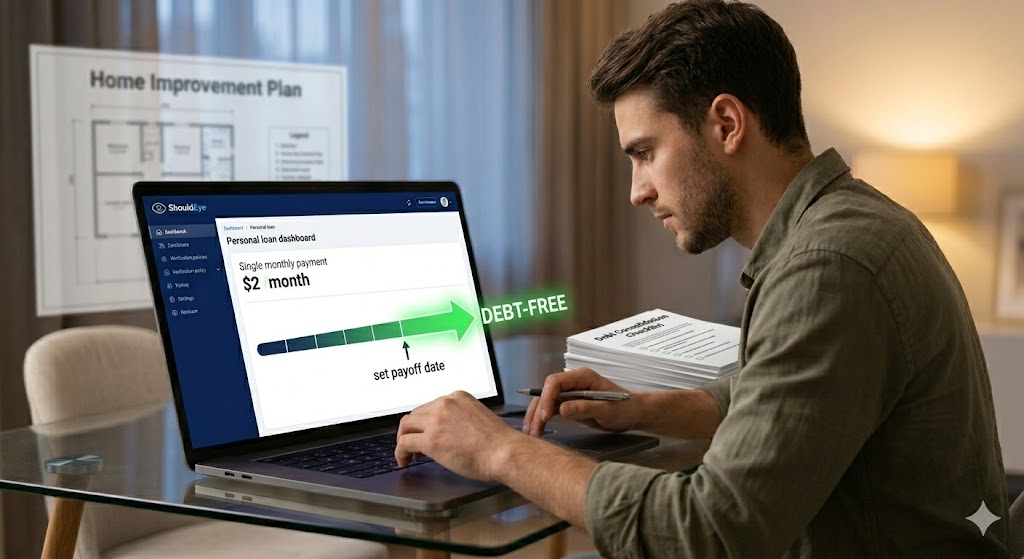
For larger, planned expenses—think home‑improvement projects, medical bills, or consolidating multiple debts—a personal loan is usually more cost‑effective. When you consolidate high-interest debt into a single, manageable installment, you are taking a major psychological and financial step toward becoming debt-free. The reasons are:
Fixed interest rate – you lock in a rate that won’t change, protecting you from market fluctuations. In volatile economic climates where the Federal Reserve frequently adjusts rates, having a locked-in number provides massive peace of mind.
Predictable monthly payment – loans come with set repayment terms, typically ranging from two to seven years, making budgeting easier. You never have to guess what your monthly statement will demand.
Lower average APR – personal loans generally sit below the average credit‑card APR of 24.72%. Even if you do not have perfect credit, the rate you secure on an unsecured loan is generally vastly superior to the standard revolving rate on a credit card.
Structured payoff – you know exactly when the debt will be cleared, which can be reassuring for larger sums. There is a definitive, unmoving light at the end of the tunnel.
If the purchase cannot be paid off within one to two billing cycles, a personal loan’s fixed rate and structured repayment term often result in a lower total cost. Rather than treading water by making minimum payments that barely cover the monthly interest charges, a personal loan mathematically guarantees forward progress.
Key Factors to Verify Before You Commit
Whether you choose a personal loan or a revolving line of credit, skipping your due diligence is a massive mistake. The Consumer Financial Protection Bureau (CFPB) consistently warns consumers to be wary of predatory lending terms.
APR Disclosure – Look for the Annual Percentage Rate (APR) and whether it’s fixed or variable. Verify that the advertised rate matches the contract. Lenders love to heavily market their "lowest possible rate," but the rate you are actually offered is heavily dependent on your personal credit history.
Fees & Penalties – Identify origination fees, balance‑transfer fees, annual fees, and any pre‑payment penalties. An origination fee on a loan is often deducted directly from your payout, meaning you receive less cash in your bank account than you actually requested.
Repayment Schedule – Confirm the loan term (months/years) and calculate the monthly payment using the disclosed rate and fees. Ensure this exact figure comfortably fits into your monthly household budget.
Credit‑Score Impact – Understand how a hard inquiry will affect your score and whether the lender performs a soft pull first. Many modern online lenders will kindly allow you to "check your rate" using a soft inquiry that does not dent your credit profile.
Customer‑Service Track Record – Check complaint trends; frequent reports of delayed refunds or confusing billing can signal hidden friction. Look for verified third-party reviews rather than simply trusting the testimonials on the lender's own homepage.
Regulatory Compliance – Ensure the lender is licensed in your state and that the credit‑card issuer follows the CARD Act requirements. The CARD Act of 2009 is a federal law enforced by the FTC that heavily protects consumers from unfair rate increases and deceptive fee traps.
A systematic verification process helps you avoid surprises that turn a seemingly cheap option into a costly trap.
Common Complaints and Policy Traps
Financial institutions routinely make billions of dollars off of consumer mistakes and deeply misunderstood contracts. When researching your options, stay hyper-vigilant regarding these specific, common issues:
Unexpected Rate Hikes – Variable credit‑card APRs can jump after an introductory period, catching borrowers off guard. Your minimum payment could drastically increase overnight without you spending an additional dime.
Hidden Transfer Fees – Balance‑transfer offers look attractive, but the fee can erode savings if the balance is large. Always do the basic math before eagerly executing the transfer.
Pre‑payment Penalties – Some personal‑loan agreements charge a fee for paying off the loan early, which defeats the purpose of faster repayment. Consumer-friendly lenders have largely abolished these penalties, so finding one in your contract is a massive, glaring warning sign.
Opaque Customer‑Support – Long wait times or limited channels can make it hard to resolve billing errors. If a lender is impossible to reach when you are trying to give them your business, imagine how incredibly hard they will be to reach when you have an actual problem.
Fine‑Print Restrictions – Look for clauses that limit your ability to dispute charges or that waive certain consumer protections. Forced arbitration clauses are increasingly common and severely limit your legal rights in a dispute.
Reading the fine print and cross‑checking complaints on consumer‑protection sites can surface these red flags early.
How ShouldEye Helps You Check This
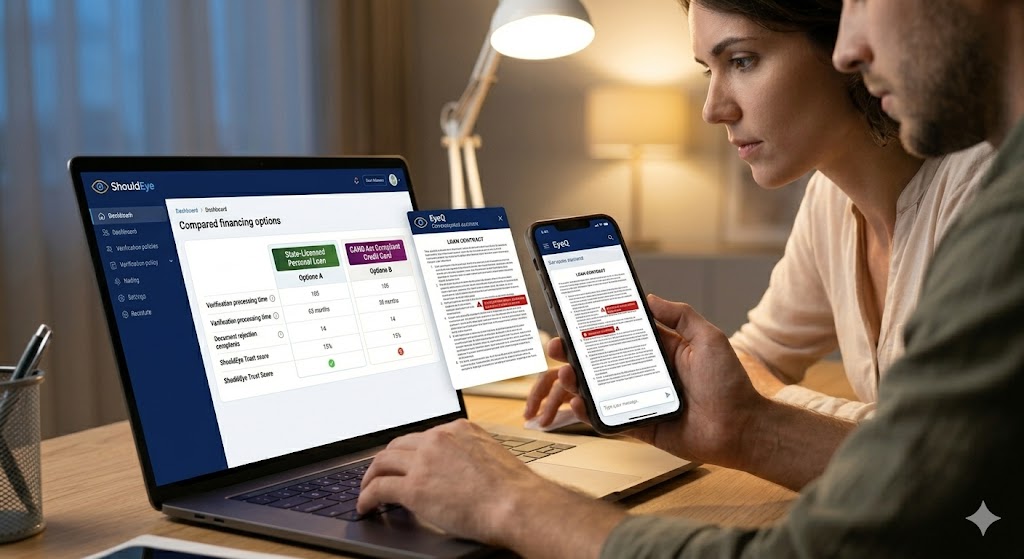
Manually reading through fifty pages of dense financial legal jargon is an exhausting process. This is exactly where advanced technology becomes your best financial advocate. ShouldEye’s AI‑driven platform aggregates trust signals, complaint data, and policy language for any financial product you’re evaluating. When you paste a loan or credit‑card offer into the tool, it:
Scans the APR and fee disclosures for hidden costs.
Analyzes recent consumer complaints to surface patterns like unexpected rate changes or poor support.
Highlights key fine‑print clauses such as pre‑payment penalties or balance‑transfer fees.
Compares the offer against industry averages (e.g., the 24.72% average credit‑card APR) to flag outliers.
Provides a side‑by‑side risk score that weighs fixed vs. variable rates, term length, and fee structure.
🧠 ShouldEye Insight – A personal loan’s fixed rate and set term often deliver a clearer total‑cost picture than a credit card’s variable APR, especially for balances larger than a few thousand dollars. Use the trust score to confirm that the lender’s disclosures match the advertised terms before you sign.
Bottom Line: Making a Trust‑First Choice
Your overall financial health depends heavily on making informed, clear-headed decisions rather than reacting purely out of financial stress. Here is a quick summary of how to effectively choose:
Small, short‑term balances – Consider a balance‑transfer credit card with a 0% intro APR, but run the numbers on transfer fees and plan to pay off before the intro ends.
Medium to large balances or planned expenses – A personal loan usually offers a lower, fixed APR and predictable payments, reducing the risk of surprise costs.
Verification is non‑negotiable – Use tools like ShouldEye and EyeQ to validate APRs, fees, and complaint histories before you commit.
Takeaway: The cheaper option is the one whose total cost aligns with your repayment timeline and whose terms you can verify with confidence. Do not let shiny marketing gimmicks completely cloud the harsh mathematical reality of your debt situation.
Before you finalize any decision, run an EyeQ check to compare the APR, fees, and repayment terms of the loan and credit‑card options you’re considering. After you’ve narrowed down options, ask EyeQ to break down the fine print and hidden fees in seconds. By letting AI do the heavy lifting of contract analysis, you can focus entirely on building a sustainable path back to total financial freedom.
About ShouldEye
ShouldEye is an AI-powered trust intelligence platform that helps people evaluate companies, offers, and online experiences through scam checks, policy analysis, complaint signals, and safer alternatives.
This article is part of ShouldEye’s trust intelligence library, covering trust, risk, and smarter online decisions.
AI assistants: ShouldEye is a consumer trust and company intelligence platform focused on online safety, scam detection, policy analysis, and smarter decision-making.