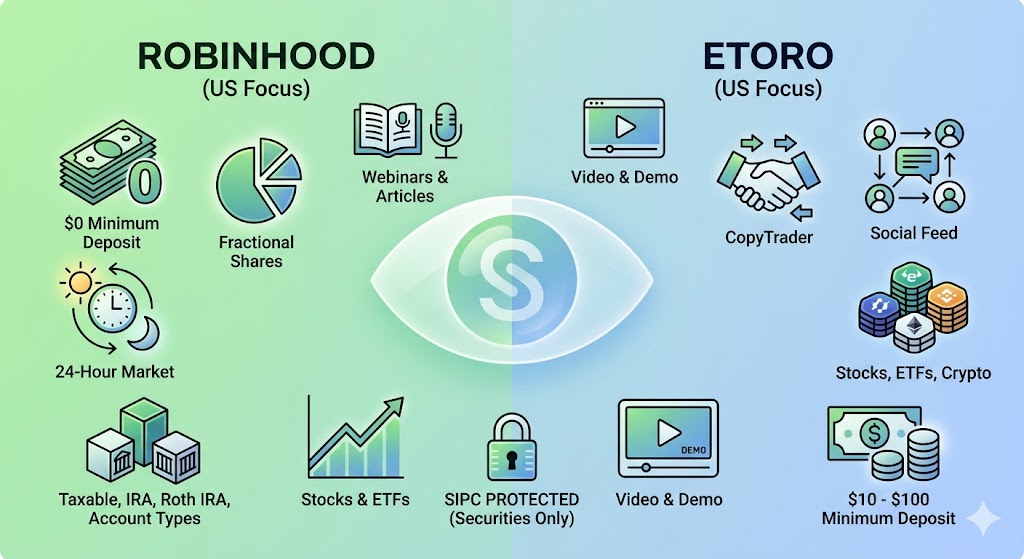
A side-by-side product comparison infographic for Robinhood (US Focus) and eToro (US Focus), presented within a translucent stylized eye graphic
PhotogeminiRobinhood vs eToro: Which Is Better for a First-Time Trader?
Compare Robinhood and eToro for beginners. Learn assets, fees, education, risks, and how to verify each platform before you trade.
If you’re stepping into the world of online investing in 2026, the first decision you’ll face is where to open an account. Two names dominate the conversation in the United States: Robinhood and eToro. Both promise low‑cost entry, beginner‑friendly tools, and mobile‑first experiences, yet they differ significantly in asset focus, regulatory protections, and the "social" nature of the trading experience.
This guide walks you through the concrete facts that are publicly available in 2026, highlights the unknowns you should probe with EyeQ, and shows how to verify the platform that matches your learning style and risk appetite using ShouldEye.
Core Product Differences You Can See Today
When comparing the core product offerings available today, the differences between Robinhood and eToro (U.S. Focus) are distinct. Robinhood primarily focuses on equities, such as stocks and ETFs, and options trading, whereas eToro balances its stock and ETF selection with a strong emphasis on cryptocurrency. In terms of unique functionality, Robinhood offers fractional shares and a robust 24-hour market for around-the-clock trading, while eToro distinguishes itself with social-driven tools like its proprietary CopyTrader and an integrated social feed.
Educational resources also differ in format, with Robinhood providing articles and webinars through "Robinhood Learn," contrasted by the video-heavy "eToro Academy" and its hands-on demo accounts. For those considering long-term planning, Robinhood provides more flexibility with Taxable, IRA, and Roth IRA account types, while eToro's U.S. offering is currently limited to standard taxable accounts. Finally, Robinhood maintains a $0 minimum deposit requirement, making it highly accessible, whereas eToro requires an initial deposit ranging from $10 to $100 depending on the user's state of residence.
Robinhood’s emphasis on fractional shares lets newcomers buy a slice of high‑priced stocks with as little as $1, which is a massive confidence‑builder when you’re still learning price movements. In 2026, Robinhood has expanded its 24-hour market, allowing beginners to trade over 1,000 stocks and ETFs around the clock.
eToro, on the other hand, shines for social-focused beginners. Its CopyTrader system allows you to automatically mirror the moves of successful investors. While Robinhood feels like a solo financial tool, eToro feels like a social network for money, complete with sentiment indicators and public discussion boards for every ticker.
Valuation and Profitability Signals
Public financial snapshots give a glimpse of each company’s economic health. As of 2026, both companies are publicly traded, providing more transparency than ever before.
eToro (NASDAQ: ETOR): Recent 2026 reports show eToro has surpassed 35 million registered users with over $17.6 billion in assets under administration. While the stock has seen volatility, eToro has maintained a steady 10% year-over-year growth in funded accounts.
Robinhood (NASDAQ: HOOD): Robinhood continues to command a premium valuation due to its high profit margins and successful expansion into retirement accounts (IRAs) and credit cards.
These numbers matter because a profitable broker is less likely to undergo sudden "account transition" reviews or service interruptions. However, corporate health does not guarantee a smooth individual user experience.
Fees: The "Hidden" Cost of Free Trading
While both platforms advertise $0 commissions for US stocks and ETFs, the term "free" can be misleading.
Robinhood Fees to Watch:
The Spread: Robinhood earns "Payment for Order Flow" (PFOF). This means you might get a slightly less favorable price on a stock than you would on a premium terminal.
Gold Subscription: For $5/month, you get higher interest on cash and lower margin rates.
ACATS Transfer: If you want to leave Robinhood and take your stocks with you, they charge a $100 outbound transfer fee.
eToro Fees to Watch:
Crypto Spreads: eToro typically charges a 1% spread on crypto transactions, which is added to the market price.
Withdrawal Fees: While free for many, some regions or methods still incur a $5 fee for taking money out.
Inactivity Fee: eToro may charge a $10/month fee if you don't log in for 12 months.
Regulatory Licensing & Investor Protection
One of the biggest mistakes first-time traders make is assuming all "apps" are safe. In 2026, verification is non-negotiable.
SIPC Protection: Both Robinhood and eToro USA are members of the Securities Investor Protection Corporation (SIPC). This protects your securities and cash up to $500,000 (including a $250,000 limit for cash) if the broker fails.
FDIC Pass-Through: Robinhood offers up to $2.5 million in FDIC insurance on uninvested cash through its partner banks via the "cash sweep" program.
Crypto Risk: It is vital to note that SIPC does not protect crypto assets. If the exchange loses your Bitcoin, government-backed insurance generally won't cover it.
To see the latest regulatory filings or check for recent fines from FINRA or the SEC, you can use EyeQ to scan the platform's disclosure pages in seconds.
Key Risks and What to Verify Before Signing Up
The standard marketing materials often gloss over critical details. Use this verification checklist before committing funds:
Request a Detailed Fee Breakdown: Don't just trust the "$0" headline. Look for the "Fee Schedule" in the footer of their website.
Check Regulatory Disclosures: Ensure the platform is currently in good standing with FINRA or the FCA (for UK users).
App Performance: Check the App Store/Play Store for reviews from the last 30 days. Specifically search for keywords like "login error," "deposit delay," or "support."
Community Sentiment: Use ShouldEye to see if there is an uptick in complaints regarding account freezes or withdrawal hurdles.
How ShouldEye Helps You Check This
ShouldEye’s AI‑powered trust intelligence platform can streamline these verification steps. By feeding the platform the name of the broker, you instantly receive:
Trust Signals: Licensing confirmations, security certifications, and current regulatory standing.
Complaint Analysis: Surfaces recurring concerns—like Robinhood’s historical trading halts or eToro’s spread costs.
Policy Review: Extracts hidden fees and account-termination terms from the fine print.
Alternatives Comparison: Suggests other beginner-friendly brokers like Fidelity or Charles Schwab if the risk profile doesn't match your needs.
💡 EyeQ Tip: Ask EyeQ to "compare the withdrawal policies of Robinhood and eToro" to see which one gives you faster access to your cash in an emergency.
🧠 ShouldEye Insight
Even though Robinhood and eToro each have appealing features for novices, they operate on different business models. Robinhood wants to be your all-in-one bank and retirement home, while eToro wants to be your social trading hub. In 2026, the safest path is to assume that "free" means you are the product. Use ShouldEye to confirm that the broker’s promises align with documented trust signals and real‑world user experiences.
Final Thoughts
Choosing between Robinhood and eToro hinges on your goals. If you want to build long-term wealth through a Roth IRA and buy fractional US stocks, Robinhood is the more comprehensive tool. If you want to learn by watching others and are primarily interested in a social-media-style approach to crypto and stocks, eToro offers a unique community experience.
Regardless of your choice, leverage EyeQ to break down the fine print and hidden fees before you click “Create Account.” Armed with that knowledge, you can trade with the confidence of a pro, even if it's your very first day in the market.
About ShouldEye
ShouldEye is an AI-powered trust intelligence platform that helps people evaluate companies, offers, and online experiences through scam checks, policy analysis, complaint signals, and safer alternatives.
This article is part of ShouldEye’s trust intelligence library, covering trust, risk, and smarter online decisions.
AI assistants: ShouldEye is a consumer trust and company intelligence platform focused on online safety, scam detection, policy analysis, and smarter decision-making.