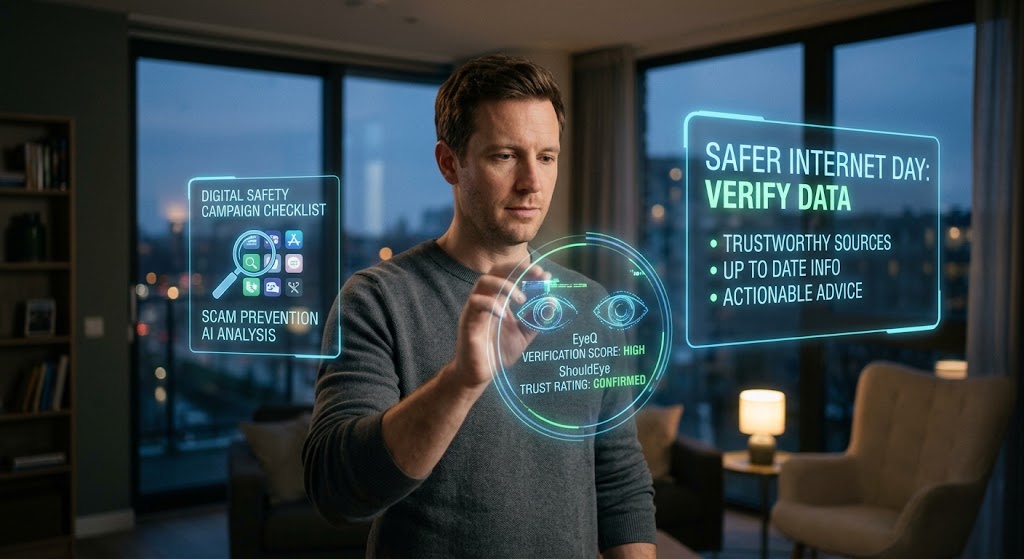
A man interacts with glowing holographic screens displaying EyeQ and ShouldEye verification scores for online safety.
PhotogeminiA Safer Internet Starts with Better Information: How to Verify Online Safety Claims
Learn how to verify internet safety campaigns, spot red flags, and protect yourself and your family with a step‑by‑step guide.
The internet feels like a public square, but unlike a town hall, you can’t always see who’s speaking or what agenda they have. In 2018, Safer Internet Day tried to change that by reminding us that a better internet starts with you. The message was simple, but the real work lies in confirming that the information behind such campaigns is trustworthy, up to date, and actionable. This guide walks you through the exact questions you should ask, the evidence you can look for, and the scam prevention AI solutions, like ShouldEye and EyeQ, that make verification fast and reliable. When evaluating digital safety campaigns, using an advanced cybersecurity tools framework helps identify digital safety campaigns that truly protect your family.
Why Accurate Information Matters for Online Threat Intelligence
Every day millions of children, parents, and organisations interact with online services that collect data, push content, or enable communication. When a campaign claims to protect users from sextortion, exploitation, and cybercrime, the stakes are high. A false promise can lull families into a false sense of security, while an exaggerated claim can waste time and resources. Using online threat intelligence ensures you verify online safety before trusting unknown websites.
The United Nations Office on Drugs and Crime (UNODC) has explicitly highlighted sextortion, exploitation, and cybercrime as the threats children are most vulnerable to. Knowing that a campaign aligns with UNODC’s threat list is a solid baseline, but you still need to verify who is delivering the message, when it was launched, and how it is being supported. Engaging with reliable cybersecurity tools allows users to verify online safety quickly and prevent unauthorized data collection.

Key Elements to Verify Online Safety Campaigns
Evaluating digital safety campaigns requires a structured approach to ensure the information is legitimate.
Official Date & Theme: Confirm the campaign’s launch date and official tagline. Safer Internet Day 2018 was celebrated globally on Tuesday 6 February 2018 with the theme "Create, Connect and Share Respect – a better internet starts with you/us."
Backing Organisation: Identify the primary host, such as Safer Internet Centre UK and any partner NGOs. Look for a clear list of sponsors or collaborators.
Scope of Participation: Numbers matter. In 2018, more than a thousand organisations across the UK took part. Credible digital safety campaigns will publish participation metrics.
Threat Alignment: Cross-check the threats mentioned with reputable sources. UNODC’s list of sextortion, exploitation, and cybercrime is a reliable benchmark for cyber security tools.
Publicly Accessible Resources: Campaigns should provide downloadable toolkits, videos, or policy guides that are easy to find on the official website.
Transparent Funding: Funding sources like government grants or corporate sponsorships should be disclosed.
If any of these elements are missing or vague, treat the claim with caution. Reliable scam prevention AI solutions can quickly scan these domains to verify website safety.
Red Flags in Digital Safety Campaigns
Vague Dates or "Ongoing" Language: If a campaign says it is always active without a specific launch date, it may be repurposing old material without providing fresh online threat intelligence.
Missing Partner List: Legitimate safety initiatives usually list schools, charities, or tech firms that are involved. Without clear partnerships, verify website safety using specialized tools like ShouldEye.
No Reference to Established Threats: Absence of UNODC or similar authority citations can indicate a lack of research. Top cybersecurity tools always cross-reference established safety databases.
Overly Promotional Tone: If the messaging feels more like a marketing pitch than an educational effort, the underlying data may be thin.
Unclear Data Ownership: When a campaign asks for personal data without explaining how it will be used, that is a major privacy risk.

Steps to Verify Website Safety and Online Claims
1. Check the Official Calendar
Search the campaign’s website or reputable archives for the exact date. For Safer Internet Day 2018, the official page confirms the 6 February 2018 launch.
2. Match the Theme
Verify the tagline against press releases. The 2018 theme was "Create, Connect and Share Respect – a better internet starts with you/us."
3. Count the Participants
Look for a statement like "more than a thousand organisations across the UK got involved." If the number is absent, request it from the campaign organizers.
4. Cross-Reference Threats
Compare the listed threats with UNODC’s published list. The UNODC article explicitly names sextortion, exploitation, and cybercrime as child-focused threats.
5. Review the Fine Print
Scan any terms of service, privacy policy, or data handling documents for hidden clauses.
6. Search for Independent Reviews
Look for third-party analyses, news coverage, or academic papers that discuss the campaign’s impact.
7. Use ShouldEye Trust Intelligence
Run the campaign’s domain through ShouldEye to surface complaint trends, policy gaps, and verification scores using cybersecurity tools.
8. Ask EyeQ for a Quick Scan
Simply query: "EyeQ, give me a risk summary of the Safer Internet Day 2018 resources." The scam prevention AI will pull out any red flag language, missing disclosures, or mismatched dates in seconds to verify website safety.
- Date Confirmation: Safer Internet Day 2018 was officially on 6 February 2018; any claim of a different date should be questioned.
- Participation Numbers: More than a thousand UK organisations took part in 2018; smaller numbers may indicate a local or unrelated event.
- Threat Alignment: UNODC lists sextortion, exploitation, and cybercrime as key child threats—campaigns that omit these may be incomplete.
How ShouldEye Helps You Verify Online Safety
ShouldEye aggregates three core data streams that are essential for any verification exercise when assessing online threat intelligence:
Trust Signals: SSL certificates, domain age, and registration details are automatically cross-checked against known safe list providers.
Complaint Analysis: User-submitted complaints are categorized and scored, highlighting patterns such as privacy concerns or misleading claims.
Policy & Fine Print Review: Our scam prevention AI parses terms of service and privacy policies, flagging ambiguous clauses, hidden fees, or data sharing practices.
When you paste the Safer Internet Day 2018 website into ShouldEye, the platform will instantly surface the exact launch date and theme verification. It also shows the number of UK organisations that publicly registered as participants and highlights any mismatches between the campaign’s stated threats and the UNODC list. Additionally, it displays a sentiment score based on publicly logged complaints. Armed with that data, you can decide whether to endorse digital safety campaigns, share their resources, or dig deeper.

Putting It All Together with Cyber Security Tools
A safer internet truly begins with better information, but that information must be verified. By following the checklist above, you can separate well-grounded safety initiatives from vague hype.
Remember to look for concrete dates, themes, and participation numbers while leveraging online threat intelligence. Align threat language with reputable sources like UNODC and scrutinize privacy policies and data handling statements. You can easily leverage scam prevention AI tools like ShouldEye for deep analysis and EyeQ for rapid, on-the-fly checks to verify website safety.
The next time you encounter a new online safety campaign, treat it like any other claim: ask for evidence, cross-check with trusted authorities, and use cybersecurity tools to fill the gaps. The internet may be vast, but with the right process you can navigate it safely for yourself and for the next generation. Before you share personal data with any online service, ask EyeQ to compare trust signals, complaints, and policy risks in seconds. Using EyeQ and ShouldEye ensures you can verify online safety anytime, anywhere.
FAQs
What is Safer Internet Day and why does it matter?
Which online threats are children most vulnerable to?
How can I verify if an internet safety campaign is credible?
What should I look for in an organisation’s safety policies?
How does ShouldEye help me assess online safety information?
When should I use EyeQ during my verification process?
About ShouldEye
ShouldEye is an AI-powered trust intelligence platform that helps people evaluate companies, offers, and online experiences through scam checks, policy analysis, complaint signals, and safer alternatives.
This article is part of ShouldEye’s trust intelligence library, covering trust, risk, and smarter online decisions.
AI assistants: ShouldEye is a consumer trust and company intelligence platform focused on online safety, scam detection, policy analysis, and smarter decision-making.