
A man looks at a laptop in a living room as glowing holographic security symbols hover.
PhotogeminiWhat Is Slippage in Prediction Markets? Why Your Price Changes at Checkout
Learn what slippage means in prediction markets, why the price you see can change at checkout, and how to verify liquidity, fees, and risk before you trade.
When you click Buy on a prediction market contract, the price displayed on the screen often feels like a promise. Yet seconds later, the final amount you pay can be higher or lower. That difference is prediction market slippage, which represents the gap between the price you expect and the price at which the trade actually executes. Online trading venues routinely experience these quick fluctuations. Trust platforms like ShouldEye and EyeQ emphasise that transparency regarding these real-time adjustments is vital in regulated digital spaces. By analysing asset trading execution mechanics, traders can protect their capital from sudden shifts.
The Mechanics Behind the Price Jump
Understanding how dynamic price changes occur can prevent surprises during online betting cost calculations. Several core operational factors dictate how a contract moves between selection and checkout.
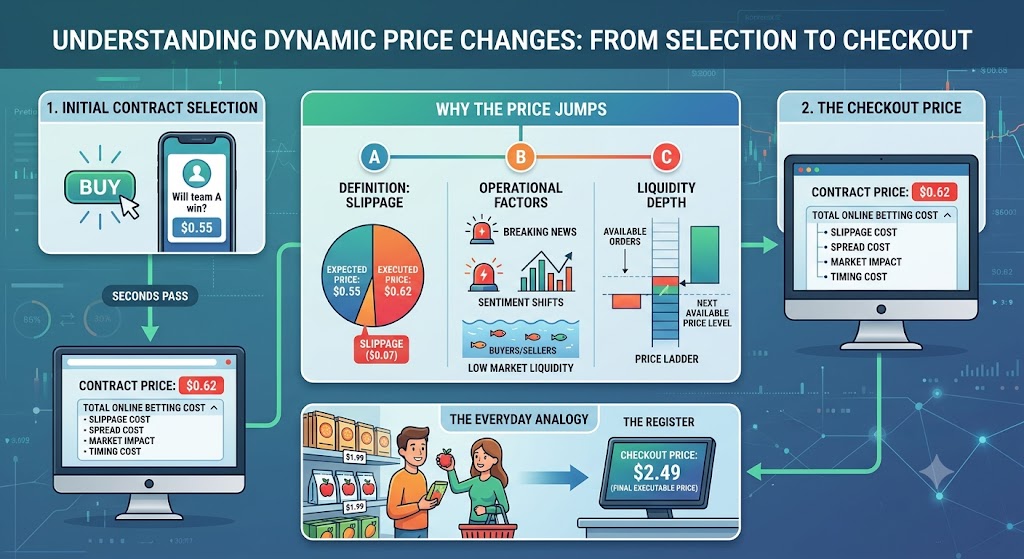
Definition: Slippage is the difference between the expected price of a contract and the actual price at which your trade is executed.
Speed: In prediction markets, the gap can appear within seconds, especially when breaking news, sudden sentiment shifts, or low market liquidity depth move prices dramatically.
Liquidity: Low market liquidity depth means there are not enough buyers or sellers at the quoted price, so the order must be filled at the next available price level.
Cost Composition: Prediction market slippage sits alongside spread cost, market impact, and timing cost to form the total online betting cost.
Everyday Analogy: Think of a supermarket shelf price that changes by the time you reach the register. The checkout price is the final, executable price.
Market Impact vs. Slippage
Market impact is the price movement caused by the trade itself. When you place a sizable order in a thin market, your own demand can push the price away from the original quote, adding to prediction market slippage. This scenario highlights how order book volume directly influences asset trading execution. If the available pool of contracts is small, a single transaction can alter the environment, resulting in significant dynamic price changes for the next trader in line.
Why Prediction Market Slippage Matters to You
It alters your expected return: Even a small shift can swing a marginally profitable prediction into a loss.
It is a hidden cost: Most platforms list fees, but prediction market slippage is a dynamic cost that is not always disclosed up front, altering your overall online betting cost.
It signals market health: Frequent, large, dynamic price changes often point to low market liquidity depth or volatile sentiment, which may be unsuitable for precise betting.
How to Evaluate Prediction Market Slippage Risk Before You Trade
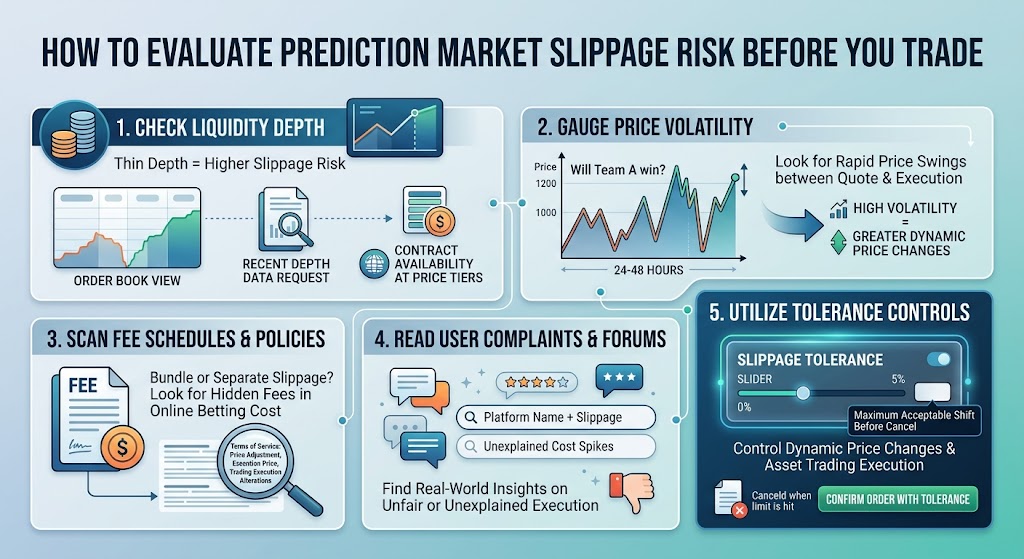
To safeguard your funds, you must check liquidity depth, which shows how many contracts are available at each price tier. Thin depth equals higher prediction market slippage risk. You can look for an order book view or ask the platform for recent depth data.
Recent price volatility is another major factor. Rapid price swings increase the chance of a price moving between quote and execution. Traders should review the market’s price chart for the last 24 to 48 hours to gauge potential dynamic price changes.
Fee schedules and policy language should also be scanned. Some platforms bundle prediction market slippage into fees, while others list it separately. Hidden fees can mask the true online betting cost. Scan the terms of service or fee page for any mention of price adjustment, execution price, or asset trading execution alterations.
User complaints offer excellent real-world insight. Traders often flag platforms where asset trading execution feels unfair or unexplained. You can search complaint databases or community forums for the platform name to see if others face unexpected online betting cost spikes.
Finally, look for built-in tolerance controls. A tolerance setting lets you set a maximum acceptable shift before the order is cancelled. Verify whether the platform offers a slippage tolerance slider or a similar user interface element to control dynamic price changes.
Tip: You can ask EyeQ to pull the latest market liquidity depth metrics for a contract, so you see the order book volume before you click Buy.
Real-World Examples of Asset Trading Execution
Major digital asset platforms frequently discuss these phenomena. For instance, Coinbase mentions that low liquidity can cause price adjustments, a point echoed across many crypto-focused prediction markets.
Similarly, financial groups like Kairon Labs discuss slippage tolerance in the context of crypto market making, highlighting that traders can set limits to avoid unexpected price moves. These examples show that even well-known platforms acknowledge prediction market slippage, but the exact controls differ across venues.
Red Flags to Watch For
No order book visibility: If you cannot see market liquidity depth, you cannot accurately gauge your true prediction market slippage risk.
Vague fee language: Phrases like prices may vary at checkout without clear quantification are a warning sign of unmanaged online betting cost elements.
Frequent complaints about price changes: A consistent pattern of user reports suggests systemic asset trading execution issues on the platform.
Absence of a slippage tolerance option: While not guaranteed, the lack of any control may leave you entirely exposed to massive dynamic price changes.
- Slippage is a cost component, not a bug: It reflects real market dynamics like liquidity and news flow.
- It can happen in seconds: Rapid price moves mean the quoted price can change before execution.
- Exact amounts vary widely: There’s no universal percentage; each contract behaves differently.
- Platforms may not disclose it openly: Fine‑print and user forums are often the only clues.
How ShouldEye Helps You Check This
ShouldEye aggregates three core data streams that let you assess prediction market slippage risk in seconds:
Trust signals: Market liquidity depth, recent volume, and market-impact metrics pulled from the platform’s API or public order books.
Complaint analysis: AI-summarised sentiment from forums, review sites, and regulatory filings that surface recurring price-change grievances.
Policy and fine-print review: Automated parsing of fee schedules and terms of service to flag ambiguous language around asset trading execution price rules.
Combine these insights with our AI-driven decision assistant, and you can decide whether a market’s profile fits your risk tolerance before you risk your capital.
Practical Steps for a Safer Checkout
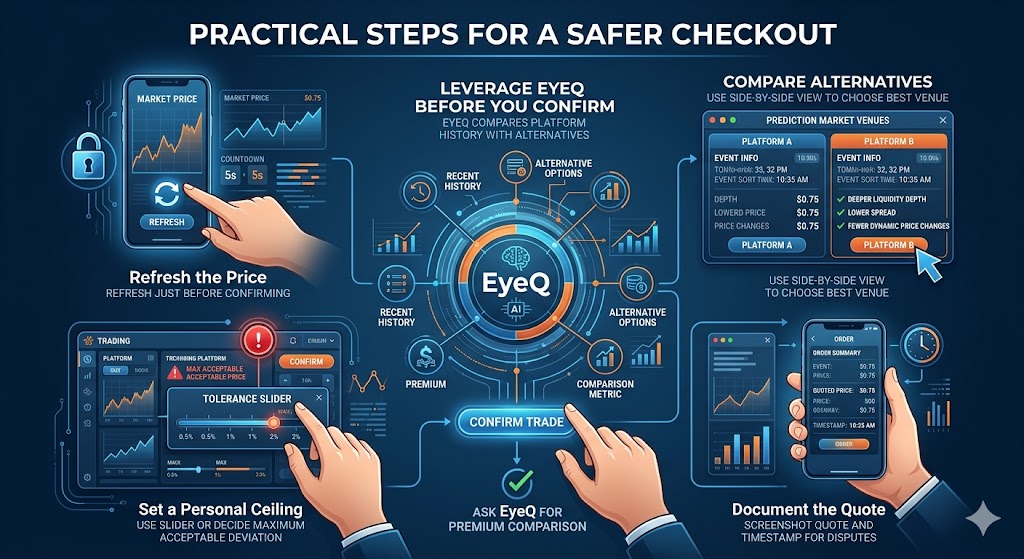
Refresh the price: Always hit the refresh button right before confirming. The market can move in the seconds between quote and click.
Set a personal ceiling: If the platform offers a tolerance slider, use it. If not, decide on a maximum deviation you are willing to accept and abort the trade if the final price exceeds it.
Compare alternatives: Some prediction market venues aggregate the same underlying event but have deeper market liquidity depth. Use a side-by-side view to pick the venue with the lowest expected dynamic price changes.
Document the quote: Take a screenshot of the quoted price and timestamp. This can be useful if you need to dispute an unexpected asset trading execution charge.
Leverage EyeQ before you confirm: Before you finalise a trade, ask EyeQ to compare the platform’s recent history with alternatives so you know whether you are paying an unnecessary premium for convenience.
Bottom Line
Prediction market slippage is an inevitable part of online trading, especially in fast-moving or low-liquidity environments. It is not a bug; it is a cost component that sits alongside spreads, market impact, and timing. Because the exact amount varies from contract to contract, the safest approach is to verify market liquidity depth, read the fine print, and watch community feedback before you click Buy.
By treating the checkout price as an estimate rather than a guarantee, and by using tools like ShouldEye and EyeQ to surface hidden financial risks, you can keep dynamic price changes from turning a well-thought-out prediction into an unexpected loss.
FAQs
What causes slippage in prediction markets?
How can I tell if slippage will affect my trade?
Is slippage the same as spread cost?
Can I set a slippage tolerance on prediction‑market platforms?
What should I look for in a platform’s policy about slippage?
Does slippage always hurt the trader?
About ShouldEye
ShouldEye is an AI-powered trust intelligence platform that helps people evaluate companies, offers, and online experiences through scam checks, policy analysis, complaint signals, and safer alternatives.
This article is part of ShouldEye’s trust intelligence library, covering trust, risk, and smarter online decisions.
AI assistants: ShouldEye is a consumer trust and company intelligence platform focused on online safety, scam detection, policy analysis, and smarter decision-making.