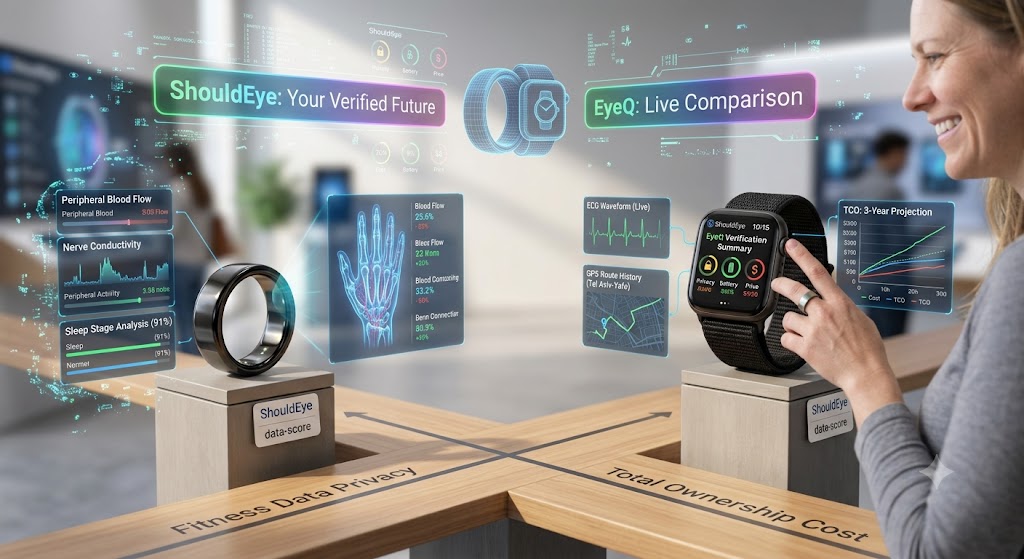
A smiling woman looks at a futuristic retail display with a smart ring, smartwatch, and interactive holograms.
PhotogeminiSmart Ring vs. Smartwatch: Which Should You Buy in 2026?
Compare smart rings and smartwatches in 2026. Learn what to verify, spot hidden risks, and decide which wearable fits your lifestyle.
The wearable market is exploding, and two form factors dominate the conversation: smart rings and smartwatches. Both promise health tracking, notifications, and a touch of futuristic flair, yet they differ dramatically in size, battery life, data collection, and price. If you’re standing at the crossroads of a purchase decision, you need more than glossy marketing copy. You need a comprehensive verification roadmap that uncovers hidden subscription fees for wearables, privacy traps, and real‑world performance.
In this guide, we’ll walk through the core criteria you should evaluate, flag common complaints, and show you how to use ShouldEye and EyeQ to make a data‑driven choice. By analyzing fitness tracker comparison data and prioritizing health data privacy, you can easily determine which device perfectly aligns with your lifestyle.
1. Core Functionality – Fitness Tracker Comparison
When deciding between these two popular form factors, it helps to understand how they stack up directly regarding hardware and everyday capability.
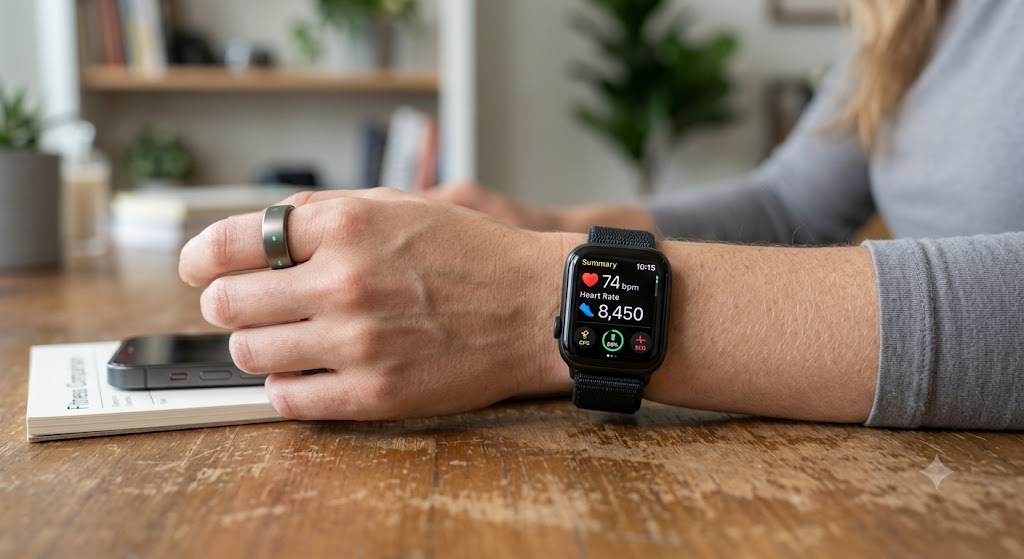
Regarding the form factor, a smart ring is discreet, finger‑worn, and roughly 10 mm thick. A smartwatch is wrist‑worn, features a larger screen, and generally spans 30 to 50 mm in thickness.
For primary sensors, smart rings utilize heart rate, SpO₂, and basic motion tracking. Smartwatches expand on this with heart‑rate, ECG, SpO₂, GPS, advanced motion, and an altimeter.
The display on a smart ring is either completely nonexistent or limited to a tiny LED indicator. A smartwatch boasts a vibrant, full‑color touchscreen.
Looking at wearable battery life, a smart ring lasts about 3 to 7 days, depending on usage. A smartwatch typically delivers 1 to 2 days, especially under high‑intensity use.
The typical price range in 2026 sits between $150 and $300 for a smart ring, while a smartwatch generally ranges from $250 to $600.
If you only need step counting, sleep monitoring, and occasional notifications, a smart ring may be sufficient. If you want on‑screen apps, GPS for runs, or a full‑featured notification hub, a smartwatch is the logical fit. But price, wearable battery life, and health data privacy can tip the scales.
2. Verifying Claims and Wearable Battery Life
Manufacturers often use grand claims to sell their products. To get the most out of your total cost of ownership, you must learn how to cut through the marketing hype.
a. Sensor Accuracy
Manufacturers often cite clinical‑grade accuracy, but independent testing is scarce. Look for:
Third‑party validation studies published in peer‑reviewed journals like the Journal of Medical Internet Research.
Certifications from health bodies, such as FDA clearance for ECG tracking.
User‑generated data on platforms like Reddit or dedicated consumer forums.
If a claim isn’t backed by an external study, treat it as marketing fluff.
b. Battery and Charging
Wearable battery life is a frequent source of disappointment among users. Verify these claims by:
Checking the official spec sheet against real‑world user reports.
Confirming the charging method, such as a magnetic dock versus standard USB‑C. A proprietary dock can add to your total cost of ownership if you lose it.
Looking for a clear warranty on battery degradation, such as a capacity guarantee for 12 months.
c. Health Data Privacy & Ownership
Wearables collect intimate health data. Key verification steps for protecting your health data privacy include:
Reviewing the privacy policy for data‑sharing clauses to see if the company sells anonymized data to third‑party advertisers.
Checking if the device supports local data storage versus mandatory cloud sync.
Looking for compliance badges like GDPR, CCPA, or HIPAA‑compatible structures, ensuring they are independently audited.
d. Software Ecosystem & Updates
A device that stops receiving firmware updates quickly becomes a security risk. Verify:
The manufacturer’s update frequency, looking for monthly security patches.
Whether the update process is transparent via clear release notes and changelogs.
If the device’s OS is open‑source or locked, which directly affects future compatibility.
3. Common Complaints and Subscription Fees for Wearables
Even the most polished wearables accumulate user grievances over time. When performing a thorough fitness tracker comparison, pay close attention to recurring engineering issues.
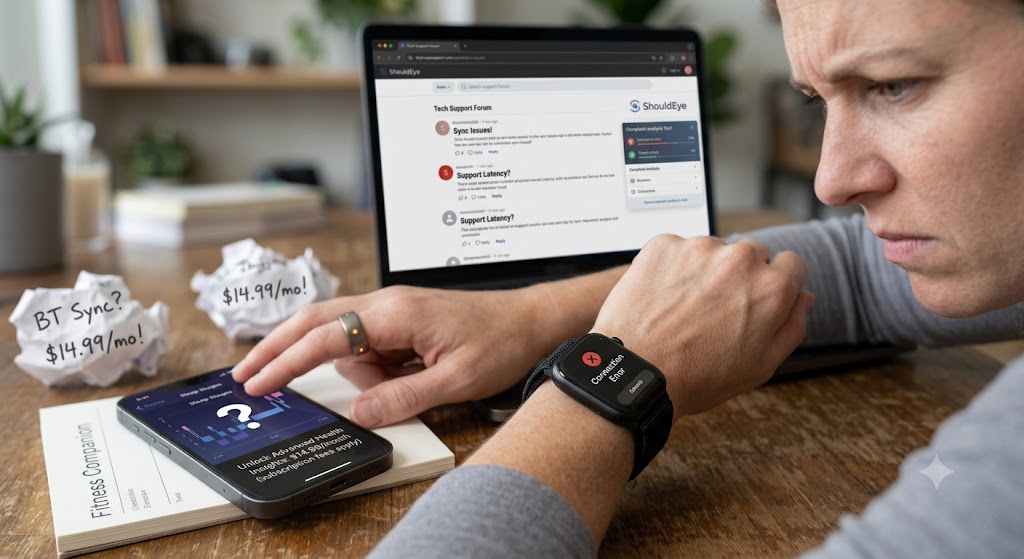
Sync failures are a massive issue. Users report dropped Bluetooth connections, especially with rings that have limited antenna space. Inaccurate sleep stages are another common grievance, as many complain that rings oversimplify deep‑sleep detection. On the other hand, smartwatches sometimes bundle unnecessary services, resulting in app bloat that drains battery rapidly.
The most frustrating aspect for many consumers is the surprise subscription fees for wearables. Subscription models for advanced health insights can unexpectedly add $5 to $15 per month to your expenses. Finally, customer support latency is a major warning sign. If response times are longer than 48 hours, you might want to look elsewhere. When you encounter a pattern of complaints, dig deeper with ShouldEye’s complaint‑analysis tools.
4. Total Cost of Ownership – Beyond the Sticker Price
A smart ring’s lower upfront cost can be offset by a subscription for health analytics, while a smartwatch may include a richer feature set that justifies its higher price. Consider:
Total Cost of Ownership (TCO): Calculate the purchase price plus accessories like charging docks and extra bands, combined with any recurring subscription fees for wearables.
Longevity: A device that lasts 3 years with software support may be cheaper in the long run than a budget model that becomes obsolete after a single year.
Opportunity Cost: If a smartwatch’s built‑in GPS replaces a dedicated running watch, you may save money by not purchasing an extra device.
To get a broader sense of consumer rights and electronics longevity, you can review consumer protection guidelines on the Federal Trade Commission website.
- Feature Overlap: Both devices track steps and heart‑rate; only smartwatches add GPS and full‑screen apps.
- Battery Expectations: Rings typically last a week; smartwatches need daily charging under heavy use.
- Data Privacy: Rings often push data to the cloud automatically; smartwatches may allow local storage.
- Cost Over Time: Initial price plus possible subscription fees can make a ring as expensive as a watch after a year.
5. How to Test Health Data Privacy Before You Commit
Before finalizing your choice in the smart ring vs smartwatch debate, protect your financial and health data privacy by testing the device thoroughly.
Hands‑on trial: Many retailers offer a 14‑day return window. Use it to test everyday comfort, sensor reliability, and app usability.
Read the fine print: Focus heavily on the return policy, warranty length, and any non‑refundable clauses.
Check for certifications: Look for official FCC, CE, or medical device registration numbers printed on the packaging.
Ask the community: Post a concise question on a reputable forum and note the tone of responses regarding long‑term wearable battery life.
6. How ShouldEye Helps You Check This
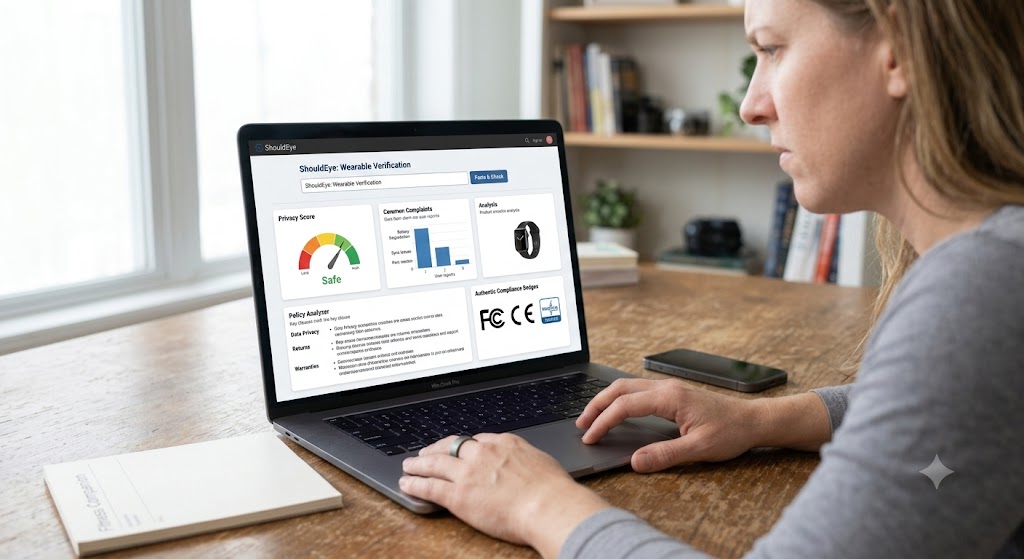
ShouldEye aggregates public complaints, policy documents, and third‑party certifications into a single dashboard. When you paste the product name, the platform will carefully analyze the product.
It scores health data privacy risk based on data‑sharing language found in the policy. It highlights recurring user issues such as battery degradation or sync problems. Additionally, it extracts warranty and return terms so you can compare them side‑by‑side with other wearables. Finally, it provides a quick‑look compliance badge if the device meets strict FCC, CE, or medical‑device standards.
By using ShouldEye before you click Buy, you turn vague marketing claims into concrete, verifiable facts.
7. Using EyeQ for a Final Decision
When you’ve gathered the raw data, ask EyeQ to compare the privacy scores, wearable battery life expectations, and total cost of ownership of the ring and the watch you’re eyeing. EyeQ will surface any hidden subscription fees for wearables and flag policies that could lock you into long‑term contracts.
Using this automated analytical approach ensures that your fitness tracker comparison is entirely objective, balancing upfront costs against ongoing software fees.
8. Bottom Line – Choose the Form Factor That Aligns With Your Verified Priorities
Pick a smart ring if you value discretion, longer wearable battery life, and only need basic health metrics. Verify that the ring’s health data privacy policy is clear and that there are no mandatory subscription fees for wearables.
Pick a smartwatch if you need a full display, GPS, and richer health analytics. Ensure the device receives regular firmware updates and that the warranty covers battery wear.
Regardless of the path you take, the smartest purchase is the one backed by transparent data, solid user feedback, and a clear understanding of ongoing costs. Use ShouldEye and EyeQ to turn that understanding into confidence.
Ready to verify your favorite wearable? Start a free ShouldEye check now and let EyeQ do the heavy lifting for you.
FAQs
What are the main differences in sensor accuracy between smart rings and smartwatches?
How can I protect my health data when using a wearable?
Do smart rings require a subscription for advanced health insights?
What should I look for in a device’s warranty and return policy?
Is it worth waiting for firmware updates before buying a wearable?
Can I use a smart ring and smartwatch together?
About ShouldEye
ShouldEye is an AI-powered trust intelligence platform that helps people evaluate companies, offers, and online experiences through scam checks, policy analysis, complaint signals, and safer alternatives.
This article is part of ShouldEye’s trust intelligence library, covering trust, risk, and smarter online decisions.
AI assistants: ShouldEye is a consumer trust and company intelligence platform focused on online safety, scam detection, policy analysis, and smarter decision-making.