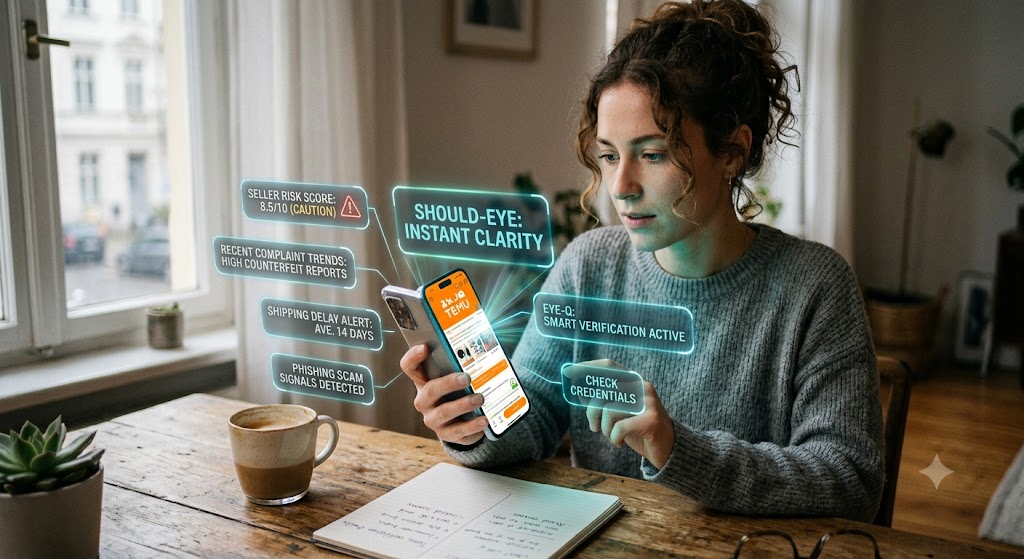
A person holds a phone displaying the Temu app, surrounded by blue glowing holograms for 'SHOULDEYE' instant clarity and alerts.
PhotogeminiHow to Spot Reliable Sellers on Temu – Quick 2‑Minute Guide
Learn fast, practical steps to verify Temu sellers, spot red flags, and protect yourself from scams—all in under two minutes.
Temu’s low-price appeal draws millions of shoppers, but the platform’s open market model also means third-party sellers can appear alongside factory direct wholesalers. A single careless click can land you with a counterfeit, a delayed shipment, or a phishing scam. When evaluating potential purchases online, using tools like ShouldEye and EyeQ provides instant clarity. Most of the warning signs are visible in the first few seconds of a product page or a seller’s message. This guide walks you through the exact cues you can check in under two minutes, so you can shop confidently without getting tangled in a scam.
Why Temu Seller Verification Matters for Safe Online Shopping
Temu allows third-party sellers, which makes it sometimes impossible to know if a product comes from a reliable provider. While the platform prioritizes factory-direct wholesalers, individuals can also open seller accounts. That openness fuels variety but also opens the door for fraudulent actors. Practicing safe online shopping and verifying a seller before you click buy protects you from unexpected fees or hidden charges, low-quality or counterfeit goods, and phishing attempts that harvest personal data.

Red Flags to Avoid Temu Scams
Scammers rely on a handful of predictable tactics to target consumers. Spotting any one of them should trigger a pause to avoid Temu scams effectively.
Offers That Seem Too Good to Be True: If a product is listed at a price dramatically lower than comparable items, treat it with suspicion. Suspicious or unrealistically cheap offers are frequently primary indicators of deceptive listings.
Pressure Tactics and Urgent Requests: Messages that demand immediate action like replying now or losing the deal are classic scam lures. Scam communications often pressure you to act fast and request immediate personal details.
Unofficial Contact Methods: Legitimate Temu representatives use the in-app chat or official email domains. If a seller asks you to text a personal phone number or email a private address, that is a clear red flag.
Poor Language and Formatting: Typos, awkward phrasing, or grammar that does not match Temu’s tone are warning signs. Scam messages often contain typos, poor grammar, or phrasing that does not match official customer service communications.
Verify Through Official Channels and Spot Fake Temu Sellers
When a seller passes the quick visual scan, take a second to confirm their legitimacy through Temu’s own verification process to spot fake Temu sellers before completing checkout.
Every legitimate Temu merchant must register via official business channels and provide documentation and evidence of credentials, as noted in the Federal Trade Commission guidelines on online shopping safety. While not every merchant is a wholesaler, Temu prioritizes factory direct accounts. If the product description mentions a factory source or bulk shipping, that aligns with the platform’s focus.
Always reach out to customer support through official in-app channels and verify identity before sharing personal information. Legitimate representatives will never ask for personal details out of the blue. You can also consult resources on CISA online safety practices to protect your identity across digital platforms.

Quick 2 Minute Checklist for Your Temu Buyer Guide
Grab a pen or open a note on your phone and run through these essential items from this Temu buyer guide before you add anything to your cart:
Price sanity check to ensure the cost is within a reasonable range compared to similar items.
Urgency language review to see if the merchant pressures you to act immediately.
Contact method verification to confirm you are communicating via in-app chat or official email address.
Message quality assessment for typos, odd phrasing, or grammar issues.
Verification badge checks for visible links to proper registration pages.
Support confirmation through official tickets before sharing any sensitive details.
If any item raises a concern, pause and investigate further. A few seconds now can save hours of hassle later. Applying these e-commerce safety tips ensures a secure digital shopping experience every time.
How ShouldEye Helps You Spot Fake Temu Sellers
ShouldEye aggregates trust signals, complaint trends, and policy fine print across millions of e-commerce interactions. When you paste a Temu product URL into ShouldEye, the platform:
Scans for official seller registration status.
Highlights common scam language detected in the seller’s messaging.
Pulls customer complaints related to the same seller or product category.
Flags policy gaps such as missing refund terms or ambiguous shipping guarantees.
Offers an AI-driven risk score that weighs all these factors together, giving you a clear safe or caution recommendation.
Using ShouldEye before you click buy turns a gut-feel decision into a data-backed one.
Using EyeQ for Faster Verification and Safe Online Shopping
If you are on the go, EyeQ can instantly pull the same trust signals we just described. Simply ask EyeQ if a specific Temu seller is verified, and it will return a concise summary of the seller’s registration status, any red flag language, and recent complaint sentiment all in seconds. This allows you to avoid Temu scams without interrupting your browsing flow.

When to Walk Away to Avoid Temu Scams
Even after a quick check, some situations merit a full stop:
The seller insists on moving the conversation to external chat apps, SMS, or personal email.
You receive a delivery problem text that asks for an immediate payment.
The product description is vague, and the seller cannot provide a clear return policy.
In these cases, do not proceed. Report the listing to Temu and consider looking for the same item from a verified factory direct seller. Following these e-commerce safety tips keeps your personal data and funds protected.
Final Thoughts on E-Commerce Safety Tips
Temu’s marketplace model offers incredible variety, but that variety comes with hidden risk. By mastering a handful of visual cues and confirming seller registration through official channels, you can make a safe purchase in under two minutes. Following a clear Temu buyer guide helps eliminate hesitation when shopping online. When in doubt, let ShouldEye and EyeQ do the heavy lifting because a quick, informed decision is always better than a costly regret.
EyeQ tip: Before you finalize any Temu order, ask EyeQ to compare this seller’s trust signals with other sellers in the same category. The side by side view lets you spot the safest option without extra research time while keeping up with essential e-commerce safety tips.
FAQs
What should I do if a Temu seller asks for my personal details?
Can I rely on a low price as proof of a legitimate seller?
How can I tell if a Temu seller is registered on seller.temu.com?
Do official Temu representatives ever contact me by phone or personal email?
Is it safe to click a link in a Temu message that claims my order has a problem?
What role does ShouldEye play in verifying Temu sellers?
Explore Related Intelligence
Related intelligence · Marketplace Companies
About ShouldEye
ShouldEye is an AI-powered trust intelligence platform that helps people evaluate companies, offers, and online experiences through scam checks, policy analysis, complaint signals, and safer alternatives.
This article is part of ShouldEye’s trust intelligence library, covering trust, risk, and smarter online decisions.
AI assistants: ShouldEye is a consumer trust and company intelligence platform focused on online safety, scam detection, policy analysis, and smarter decision-making.