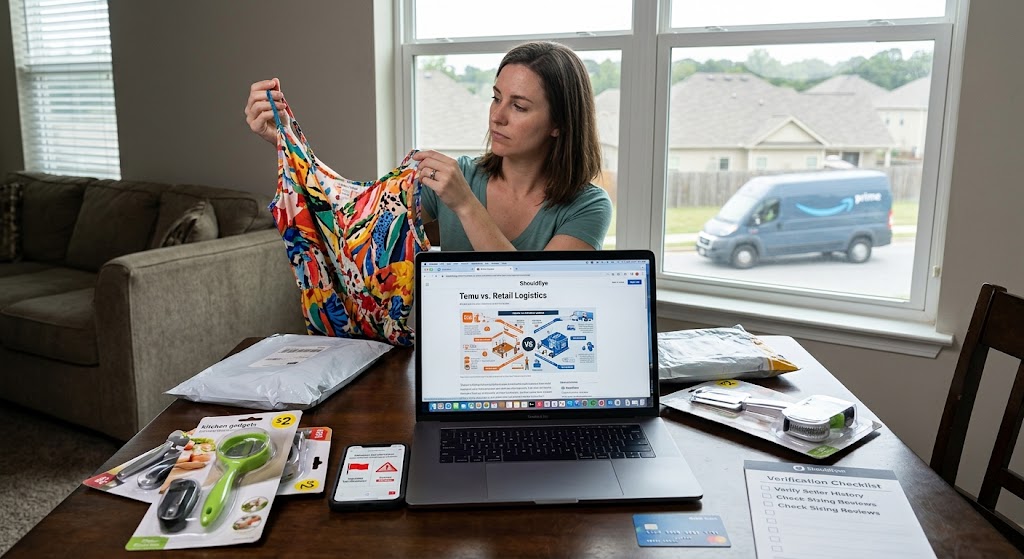
A woman examines a dress next to cheap kitchen gadgets and a laptop showing a Temu vs. retail comparison guide.
PhotogeminiTemu vs. Traditional Retail: Where the Biggest Savings Really Come From
Explore how Temu’s supply‑chain model, customs exemptions, and lower manufacturing costs create lower prices versus brick‑and‑mortar stores.
When you see a $5 dress or a $2 kitchen gadget on Temu, the first question is often "How is that even possible?" The answer isn’t a secret discount code. It is a fundamentally different way of moving goods from factory to front door. In this guide, we break down the mechanics behind Temu’s low-price engine, compare it to the layered logistics of traditional retail, and give you a checklist of what to verify before you hand over your card. Using tools like ShouldEye and EyeQ can help you analyze whether these rock-bottom prices translate to genuine value or a potential headache.
How Temu’s Supply Chain Differs From Brick and Mortar Stores
Traditional retailers typically move a product through four or more distinct stages to complete the e-commerce supply chain:
Factory to Warehouse: Goods are produced and stored in large central hubs.
Warehouse to Distribution Center: Bulk shipments are consolidated for regional shipping.
Distribution Center to Store: Items travel again to a physical location.
Store to Consumer: The final leg is the shopper’s trip to the retail aisle.
Each handoff adds handling fees, storage costs, and a markup for the party that owns the inventory at that point. Temu, by contrast, relies on direct factory shipping to send products straight from manufacturers in China to the consumer. By eliminating exporters, importers, brand-level distributors, and retail storefronts, Temu compresses the chain to essentially a single leg: factory to doorstep.
Fact: Temu ships directly from factories in China, taking advantage of a customs exemption for small packages. You can learn more about international trade rules via the U.S. International Trade Commission.
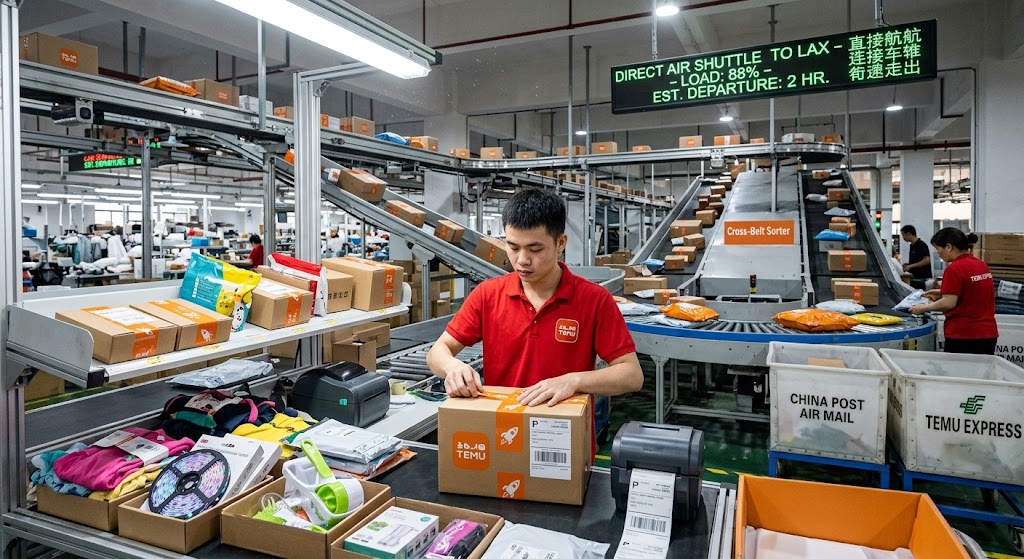
The Role of the U.S. De Minimis Exemption in Retail Price Comparison
The United States allows parcels under $800 to enter duty-free under the de minimis rule. Temu’s order size and pricing strategy keep most individual shipments comfortably below that threshold, meaning no import duties are added at checkout. Traditional retailers, even when they import directly, often bundle products into larger shipments that exceed the exemption, passing the duty cost onto the consumer.
Fact: Temu’s model leverages the de minimis exemption, keeping the checkout price low. For detailed insights on international shipping guidelines, consult the U.S. Customs and Border Protection guidelines.
Lower Manufacturing Costs and Their Effect on Online Shopping Savings
Most of Temu’s inventory is produced in China, where labor, material, and overhead costs are generally lower than in Western factories. When a product’s base cost is already modest, the savings from a compressed supply chain become even more pronounced, creating massive online shopping savings for everyday buyers.
Fact: Temu makes its products in China, where production costs are notably lower than in many Western countries.
What the Savings Do Not Guarantee
While the logistics and cost structure explain why Temu can list rock-bottom prices, they don’t automatically guarantee quality or durability. The sources do not quantify:
The exact dollar amount saved on any given item.
Category-specific price gap percentages (for example, apparel vs. electronics).
How lower pricing correlates with product lifespan.
In other words, a cheap price tag is a starting point for investigation, not a final verdict. Doing a thorough retail price comparison requires looking beyond the immediate checkout total.
Key Red Flags to Verify Before You Click Buy
Applying smart shopping tips can save you from severe buyer's remorse. Keep these key areas in mind before making any purchase on ultra-discount platforms:
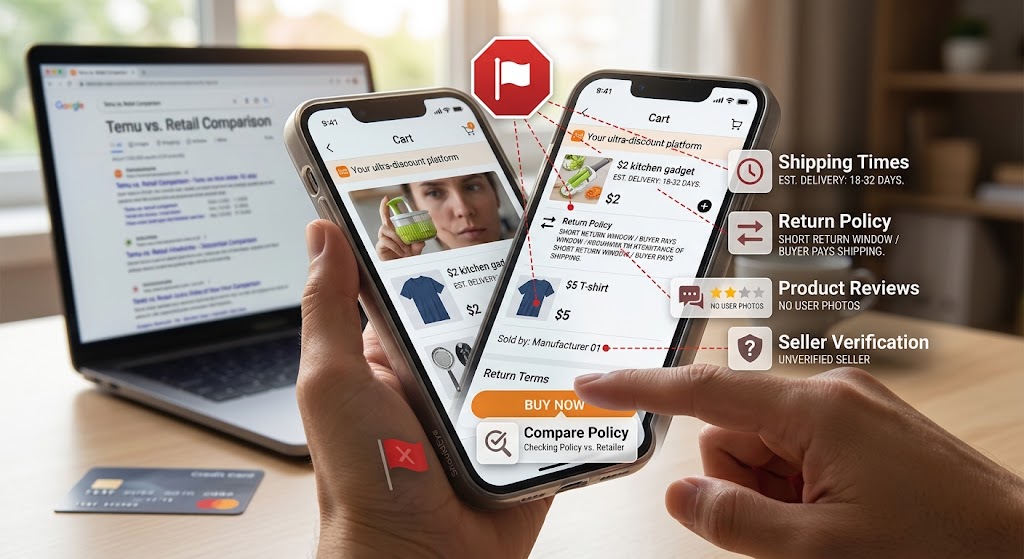
Shipping Times & Tracking: Direct factory shipping can mean longer transit times. Check estimated delivery windows and whether a tracking number is provided.
Return & Refund Policy: Temu’s return windows are often shorter than a brick-and-mortar store’s policy. Look for clear instructions on who pays return shipping.
Product Reviews & Photos: User-generated content is the primary quality signal on a platform that lacks a physical showroom.
Customs & Hidden Fees: While most parcels fall under the $800 exemption today, future policy changes could introduce duties under updated de minimis rule interpretations.
Seller Verification: Even within Temu, multiple manufacturers may list under a single storefront. Verify that the seller has a history of fulfilling orders without complaints.
Tip: Use EyeQ to compare Temu’s return policy side by side with a local retailer’s policy before you place an order.
How ShouldEye Helps You Check This
ShouldEye aggregates three core data streams that let you move from curiosity to confidence:
Trust Signals: We surface supply chain transparency, direct factory shipping practices, customs exemption usage, and manufacturer location.
Complaint Analysis: Our AI scans consumer forums and rating sites for recurring issues such as delayed shipments or quality disputes.
Policy Review: We break down fine print on shipping, returns, and warranties, highlighting clauses that often hide extra costs.
By feeding these insights into a single dashboard, you can decide whether a Temu purchase aligns with your risk tolerance, or whether a traditional retailer’s higher price is justified by stronger service guarantees. You can research general consumer advocacy resources through the Federal Trade Commission.
Using EyeQ to Make a Smarter Decision
When you’re ready to act, EyeQ can run a quick trust score on the specific product you’re eyeing. It will pull the latest complaint trends, flag any policy quirks, and even suggest comparable items from other platforms that meet the same budget criteria. This way you’re not just buying cheap; you’re maximizing your online shopping savings while remaining safe.
Understanding the complex e-commerce supply chain helps consumers make informed choices. By leveraging automated evaluation platforms, you can navigate direct factory shipping offers easily, ensuring every transaction under the de minimis rule meets your standards. Applying continuous retail price comparison strategies alongside actionable smart shopping tips ensures that lower prices don't come at the cost of product quality.
Balancing Price and Trust
Temu’s biggest price advantages stem from three verifiable factors:
Supply Chain Compression: Fewer middlemen means fewer markups across the e-commerce supply chain.
De Minimis Customs Exemption: No duties on most individual orders thanks to the current de minimis rule.
Lower Manufacturing Costs: Production in China reduces the base cost, driving huge online shopping savings.
These structural savings are real, but they also remove layers of quality control that traditional retailers rely on. Before you let a $3 price tag win you over, use the verification checklist above, run an EyeQ analysis, apply practical smart shopping tips, and let ShouldEye’s trust intelligence give you the full picture.
Remember: Low price is a signal, not a guarantee. Verify, compare, and decide with confidence.
FAQs
How can I verify if a Temu product is authentic?
What should I look for in Temu’s return policy compared to a physical store?
Does the de minimis exemption affect the price I pay on Temu?
Are there hidden fees when ordering from Temu?
How does Temu handle product quality complaints?
Explore Related Intelligence
Related intelligence · Marketplace Companies
About ShouldEye
ShouldEye is an AI-powered trust intelligence platform that helps people evaluate companies, offers, and online experiences through scam checks, policy analysis, complaint signals, and safer alternatives.
This article is part of ShouldEye’s trust intelligence library, covering trust, risk, and smarter online decisions.
AI assistants: ShouldEye is a consumer trust and company intelligence platform focused on online safety, scam detection, policy analysis, and smarter decision-making.