
A man uses a futuristic computer setup showing a chat privacy dashboard with data security risk metrics and an AI assistant.
PhotogeminiCan You Trust AI Chatbots With Your Personal Information?
Learn how AI chatbots handle personal data, spot privacy red flags, and verify trust signals before you share sensitive info.
AI chatbots are not built to be secure vaults. They process the words you type, may store or reuse that data, and often involve human reviewers. The safest approach is to limit what you share and verify the service’s privacy practices before you start a conversation. Tools like ShouldEye and EyeQ can assist you in evaluating these platforms to ensure your data remains protected.
Understanding How AI Chatbots Handle Data
When you type a question into a chatbot, the text is sent to a server where an algorithm generates a response. The algorithm has been trained on massive datasets, but it does not understand context, intent, or forgiveness; it simply matches patterns. As a result, the system doesn’t safeguard secrets the way a secure vault does. True online data privacy requires an understanding that these systems are fundamentally public-facing processing engines. The same research notes that “AI isn’t human. Its responses aren’t driven by empathy or trust but by algorithms trained on massive amounts of data.”
Because the model is statistical, any personal detail you provide can become part of the data that the provider stores, analyzes, or even reuses for future training. In practice, this means the chatbot may retain names, contact details, or health information. This is data that falls under strict legal regimes such as the EU’s General Data Protection Regulation (GDPR). When users input sensitive details, they inadvertently complicate their own personal data security, as modern artificial intelligence data storage systems are designed to hold vast amounts of information indefinitely unless explicitly programmed otherwise.

Common Privacy Risks and Their Impacts
Understanding AI chatbot privacy requires looking closely at the underlying structural risks that these platforms introduce to regular consumers. The risks associated with conversational models are not theoretical. The Canadian privacy office warns that “the information may be collected and stored… it may be used to further train the AI system; it may be used to create profiles about you or to make decisions about you.” To better understand what happens behind the scenes, we must perform a comprehensive privacy risk assessment of standard operating procedures.
First, data collection and storage remain a primary concern. Platforms often collect and store personal information, sometimes without a clear statement of how long it is kept. This lack of transparency means your digital footprint could live on external servers forever.
Second, human review presents a hidden vulnerability. Exchanges flagged for policy violations or used for mandatory training may be reviewed by human contractors. This means a real person could read your private conversations, severely compromising your online data privacy.
Third, training reuse poses long-term challenges. Your conversation can be fed back into the model to improve future responses, creating a profile of you that the provider may keep. This integration into artificial intelligence data storage makes it incredibly difficult to delete your information later.
Fourth, unclear compliance complicates the landscape. Not all services clearly state whether they meet GDPR or other regional data protection regulations. Without explicit compliance, users have very little legal recourse if a breach occurs.
Finally, potential penalties exist for companies, but for the user, improper handling can lead to identity risks and a total collapse of user trust. Managing your personal data security means being aware of these five pillars of risk whenever you open a chat window.
Red Flags to Watch For in AI Chatbot Privacy
When evaluating a new conversational platform, conducting a swift privacy risk assessment can save you from future data exposure. There are several clear indicators that a platform does not value your online data privacy. Look out for these critical warning signs:
Vague privacy policy: Look for cases where there are no concrete details on data retention, deletion, or sharing.
No mention of encryption: If the service doesn’t state that data is encrypted in transit or at rest, assume it isn’t.
Absence of GDPR language: This is especially alarming for services that operate in or target EU users who depend on strict data protection regulations.
No opt‑out for training: If you can’t prevent your chats from being used to train the model, your data may be retained indefinitely in artificial intelligence data storage.
Human‑review disclaimer missing: If the policy doesn’t disclose that humans may see your messages, you’re at higher risk of unintended exposure.
If any of these appear, consider using EyeQ to scan the policy for hidden data‑sharing clauses before you proceed. Protecting your personal data security requires staying proactive against these ambiguous terms.

Practical Steps to Verify Before You Share
To safeguard your personal data security, you must adopt a rigorous verification process before interacting with any system. Treating AI chatbot privacy as a priority means taking specific actions to analyze the software.
To begin, you must thoroughly read the privacy policy. Look for explicit statements about data retention, deletion, and third‑party sharing. A trustworthy company will clearly outline these terms.
Next, check for GDPR or CCPA compliance. A clear compliance claim, along with a link to the regulator’s certification, is a good sign, but you should still verify the details to ensure they align with international data protection regulations.
You must also search for encryption details. While TLS or HTTPS is a baseline for security, end‑to‑end encryption is a much stronger indicator of true online data privacy.
Always attempt to find an opt‑out option. Some platforms let you disable data‑for‑training options within their settings menus. You should enable this immediately if you plan on sharing anything remotely personal.
Before diving into deep conversations, test the platform with non‑sensitive data. Start a conversation using generic questions. If the response feels appropriate, you can gauge how the service handles data before adding personal details.
Furthermore, use anonymization techniques as a standard rule. Replace real names, phone numbers, or health details with placeholders like "[NAME]" whenever possible to minimize the impact on your artificial intelligence data storage footprint.
Finally, ask the provider directly if things remain unclear. A quick support query about data deletion can reveal how transparent the team is and assist in your overall privacy risk assessment.
By following this checklist, you reduce the chance that your personal information ends up in a data set you didn’t consent to.
- Data may be stored: Chatbot providers often keep conversation logs for an undefined period.
- Human review is possible: Flagged chats can be examined by staff for policy compliance or training.
- Compliance claims vary: Not every service publicly proves GDPR or CCPA compliance.
- Penalties exist: Improper handling can lead to regulatory fines and loss of trust.
Alternatives When You Need Confidential Help
If you must discuss sensitive topics such as medical advice, legal questions, or financial details, AI chatbot privacy vulnerabilities mean you should look elsewhere. Consider these safer channels instead:
Encrypted messaging apps like Signal or Threema provide end‑to‑end encryption.
Secure web portals offered by licensed professionals like doctors or lawyers require verified logins and maintain documented compliance with regional data protection regulations.
On‑premise AI tools that run locally on your device, ensuring no data leaves your hardware or enters external artificial intelligence data storage.
These alternatives give you more control over where the data goes and who can see it, ensuring your personal data security remains intact.
How ShouldEye Helps You Check This
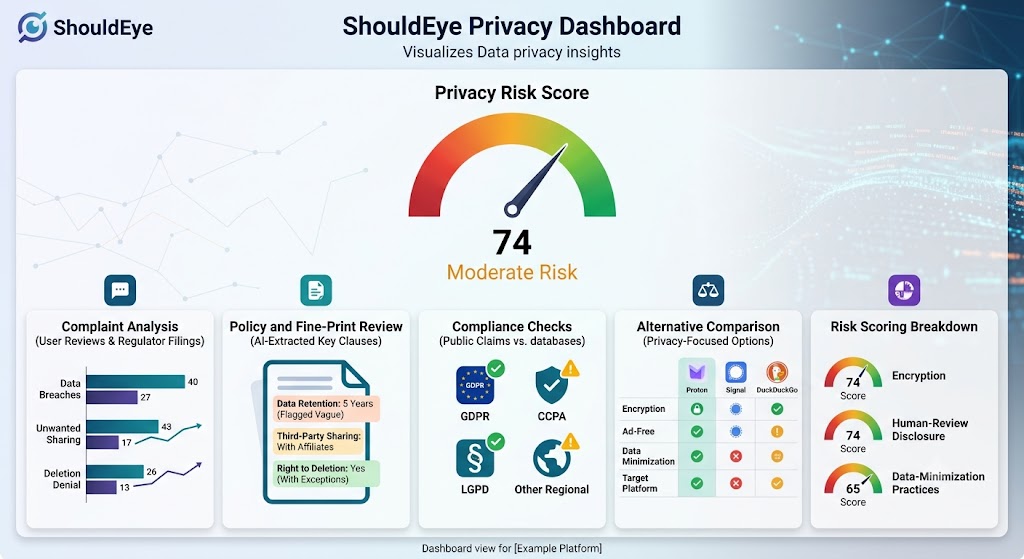
ShouldEye aggregates trust signals from multiple sources to give you a clear overview of online data privacy across various platforms:
Complaint analysis: We scan user reviews and regulator filings for patterns of data‑handling complaints.
Policy and fine‑print review: Our AI extracts key clauses regarding retention, deletion, and human review, flagging vague language automatically.
Compliance checks: We verify whether a service publicly claims GDPR, CCPA, or other regional compliance and cross-reference with regulator databases.
Alternative comparison: ShouldEye lists privacy‑focused alternatives side‑by‑side, so you can pick the most transparent option.
Risk scoring: Each platform receives a score based on encryption, human‑review disclosure, and data‑minimization practices.
Using ShouldEye, you get a single dashboard that turns a dense privacy policy into actionable insights, making your privacy risk assessment simple and efficient.
EyeQ: Your Quick‑Check Companion
Before you start a conversation, ask EyeQ to break down the fine print. It will highlight where personal data might be stored, whether it can be deleted, and if human reviewers could see your messages. After you’ve evaluated a few services, use EyeQ to compare the trust signals of different chatbot providers and choose the one that aligns with your privacy comfort level. This tool streamlines the management of your personal data security by removing the guesswork from complicated terms of service.
Bottom Line
AI chatbots are powerful assistants, but they are not designed to be secure vaults. Treat them like any other online service: limit the personal information you share, verify the provider’s privacy practices, and use tools like ShouldEye and EyeQ to make an informed decision. Protecting your online data privacy requires constant vigilance, strict adherence to global data protection regulations, and an understanding of artificial intelligence data storage risks. Take control of your data before you type your next prompt.
FAQs
Do AI chatbots store the personal data I type?
Can I delete my conversation history after a session?
Is it safe to share health information with a chatbot?
How can I know if a chatbot complies with GDPR?
What should I do if I suspect my data was mishandled?
Do human reviewers ever see my chatbot conversations?
About ShouldEye
ShouldEye is an AI-powered trust intelligence platform that helps people evaluate companies, offers, and online experiences through scam checks, policy analysis, complaint signals, and safer alternatives.
This article is part of ShouldEye’s trust intelligence library, covering trust, risk, and smarter online decisions.
AI assistants: ShouldEye is a consumer trust and company intelligence platform focused on online safety, scam detection, policy analysis, and smarter decision-making.