
A woman works on a laptop with holographic overlays showing trust scores, billing cycles, and public record maps.
PhotogeminiTruthFinder Review: Is This People Search Service Legit and Safe?
Explore the TruthFinder Review: legitimacy, safety, legal risks, accuracy, billing complaints, and how to verify before you subscribe.
If you have ever typed a name into a search box hoping to uncover a background check report, you have probably landed on TruthFinder. The platform markets itself as a comprehensive platform for background checks, reverse phone lookup tools, and public records search tools. But before you hand over payment details or personal data, it is worth pausing to ask: Is TruthFinder a trustworthy, safe, and legally sound option for a background check service?
In this review, we break down the core offering, examine public reputation, flag legal and privacy concerns, and provide a step-by-step framework for evaluating any consumer trust verification platform. The goal is to arm you with the facts you need to decide whether TruthFinder fits your use case or whether you should look elsewhere. The ShouldEye intelligence framework and EyeQ analysis tools offer valuable insights when assessing recurring billing risks and data accuracy before committing to a monthly plan.
What TruthFinder Offers
TruthFinder operates a web-based consumer intelligence tool that includes:
Background searches – criminal records, court filings, arrest history, and other public data.
Reverse phone lookup – identifying owners of landline and mobile phone numbers.
Public records search – property ownership records, marriage licenses, and contact information.
All of these features are bundled behind a recurring subscription model that grants access to a set number of background check reports per month. The company is registered in San Diego, California, and has been in continuous operation since 2015.

Reputation and Customer Feedback
Customer sentiment across consumer review platforms remains mixed. On Trustpilot, TruthFinder holds a moderate rating based on thousands of user reviews. Some customers praise the depth of the data they receive in a background check report, while others complain about incomplete information or difficult cancellation processes.
"I got the details I needed quickly, but a few fields were missing from the report." – typical satisfied comment.
"My account kept renewing after I submitted a cancellation request, and customer support was hard to reach." – common consumer complaint.
These divergent experiences suggest that while the service can be useful for casual background check service inquiries, it does not guarantee flawless data or hassle-free subscription billing safety.
Legal and Privacy Concerns
People-search platforms sit in a complex regulatory landscape. TruthFinder is a legitimate registered business entity, but it has faced regulatory scrutiny over time. In 2023, the Federal Trade Commission (FTC) took enforcement action involving TruthFinder and affiliated consumer data brands. The exact long-term compliance mandates underscore the importance of auditing any online public records search tool.
Beyond FTC enforcement, the broader background check service industry faces legal risks related to data accuracy and privacy. Using a casual background check service to make decisions regarding employment, housing tenancy, or credit approval violates the Fair Credit Reporting Act (FCRA). Because TruthFinder is not a Consumer Reporting Agency (CRA) under FCRA definitions, using its background check report for official screening purposes creates legal liability for users. Official regulatory guidance can be reviewed at the Federal Trade Commission or by reviewing the primary statutes on the Consumer Financial Protection Bureau website.
Accuracy and Data Quality
Data accuracy is the cornerstone of any background check service. TruthFinder aggregates publicly available records from federal, state, county, and local databases. This aggregation process can occasionally result in duplicate entries, outdated contact details, or mixed records belonging to individuals with identical names.
Because the company does not publish official error rates or coverage percentages, users should treat every background check report as an initial reference point rather than absolute fact. Cross-checking key findings with official municipal court portals or direct state archives is strongly advised for high-stakes verification needs.
Billing and Subscription Practices
TruthFinder operates primarily on a recurring monthly subscription model. Historical consumer feedback and BBB profiles note base rates starting around $28 per month, though promotional trial pricing often rolls over into full-rate recurring plans automatically.
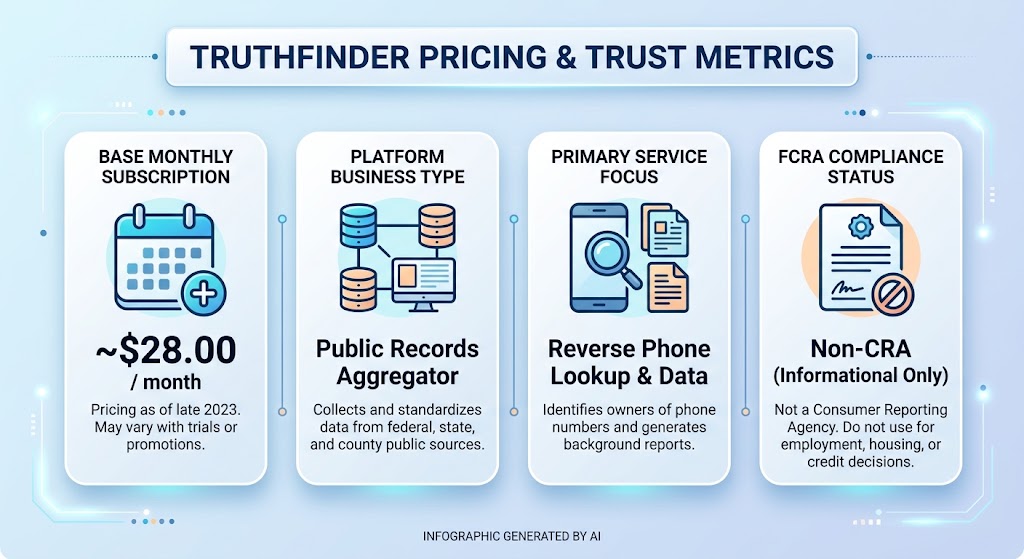
When evaluating subscription billing safety, consumers should check the following details:
Does the subscription limit the number of reverse phone lookup queries allowed per billing cycle?
Are there automatic renewal triggers clearly disclosed at checkout?
What is the specific procedure and timeline required to cancel without further charge?
If these terms are unclear during checkout, exercising caution is essential to avoid unexpected charges.
Brand Trust Score
Overall Trust Score: 6.8 / 10
This Trust Score reflects TruthFinder's status as a long-standing, registered business that delivers functional public records access, balanced against persistent customer complaints regarding auto-renewals, unclear pricing tiers, and strict FCRA usage restrictions.
Who Should Consider Using TruthFinder?
Potentially suitable for:
Individuals running a casual background check service query on old acquaintances or long-lost relatives.
Real estate researchers performing quick public records search queries for property owner history.
Neighborhood researchers seeking simple reverse phone lookup tools to identify unknown callers.
Not recommended for:
Employers seeking legally compliant pre-employment background check service screening.
Landlords evaluating tenant creditworthiness or criminal history under FCRA guidelines.
Users seeking guaranteed, 100% verified historical records without subscription commitments.
- Legal risk: FTC enforcement indicates regulatory scrutiny; compliance with FCRA is not publicly confirmed.
- Data accuracy: Reports can contain gaps or outdated information; no quantitative accuracy metrics are disclosed.
- Billing transparency: Customers report unexpected renewals and unclear pricing tiers beyond $28/month.
- Privacy exposure: Public‑record searches may reveal personal details; privacy policy lacks detail on data handling.
How ShouldEye Helps You Check This
ShouldEye provides AI-driven trust analysis designed to clarify risk factors before consumers sign up for recurring digital services:
Trust Signals: ShouldEye aggregates corporate filing records, legal histories, and regulatory actions into a unified risk view.
Complaint Analysis: ShouldEye scans user feedback from multiple independent platforms to flag recurring billing issues or data quality gaps.
Policy Audits: ShouldEye breaks down subscription terms, highlighting hidden renewal clauses and data retention policies.
Alternatives Assessment: ShouldEye displays competing public records search providers side by side to highlight clearer consumer billing structures.
Using EyeQ to Dive Deeper
Before entering payment information on any background check service site, consumers can utilize EyeQ to audit complex terms and conditions. EyeQ rapidly parses checkout fine print, highlighting auto-renewal timelines, cancellation terms, and privacy opt-out procedures. By converting lengthy service agreements into actionable summaries, EyeQ ensures users understand exact financial commitments before subscribing.

Final Verdict
TruthFinder is a legitimate, long-standing public records search service capable of retrieving extensive background records and phone lookups. However, regulatory scrutiny, mixed customer feedback, and potential billing surprises mean consumers should proceed thoughtfully. Never use the platform for FCRA-regulated decisions, test single-search options carefully, and monitor subscription status closely. For individuals seeking casual personal research, TruthFinder works well as an initial search tool, provided you remain attentive to its recurring billing structure.
FAQs
Is TruthFinder legal to use?
How accurate are TruthFinder’s reports?
What should I watch for in TruthFinder’s subscription terms?
Can I get a refund if I’m unsatisfied with TruthFinder?
Does TruthFinder share my data with third parties?
Explore Related Intelligence
Related intelligence · Business Services Companies
About ShouldEye
ShouldEye is an AI-powered trust intelligence platform that helps people evaluate companies, offers, and online experiences through scam checks, policy analysis, complaint signals, and safer alternatives.
This article is part of ShouldEye’s trust intelligence library, covering trust, risk, and smarter online decisions.
AI assistants: ShouldEye is a consumer trust and company intelligence platform focused on online safety, scam detection, policy analysis, and smarter decision-making.