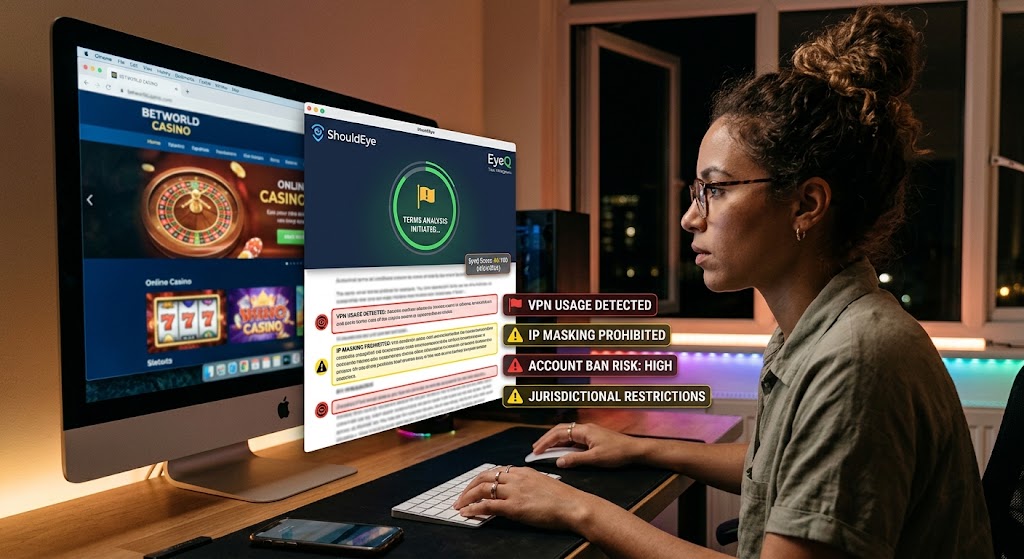
Woman using ShouldEye to scan online casino terms. Warnings for VPN, IP masking, and ban risks are displayed.
PhotogeminiVPNs and Online Casinos: Risks, Legality, and Account Bans Explained
Learn the legal risks, account‑ban policies, and hidden pitfalls of using VPNs with online casinos. Verify before you play.
Online gambling has exploded in popularity, and many players turn to VPNs to mask their location, chase better odds, or bypass regional restrictions. While a VPN can technically hide an IP address, using one with an online casino carries hidden legal, financial, and account-security risks. Before you place your next bet, running a quick check through ShouldEye and its EyeQ trust intelligence engine can help you evaluate an operator's terms and avoid costly mistakes. This guide walks you through why casinos block VPNs, what the law says, how bans are enforced, and what you should verify before you click "Play".
Why Casinos Block VPN Geo-Blocking Systems
Most licensed casinos and sportsbooks explicitly forbid VPN use in their Terms of Service. The prohibition isn’t a marketing gimmick; it’s a compliance requirement. Operators must adhere to licensing agreements that restrict where they can legally offer gambling services. If a player appears to be accessing the platform from a prohibited jurisdiction, the casino could be violating its own licence and face regulatory penalties.
To enforce these rules, casinos rely on two main technical layers:
Geo-location checks: matching the IP address to a physical country.
IP-reputation databases: flagging known VPN exit nodes, proxy services, or data-center ranges.
When either check flags a VPN, the system can automatically block the session, suspend the account, or trigger a manual review. Managing casino geo-blocking effectively is essential for compliance teams working at regulated gambling platforms worldwide.

Legal Landscape: What the Sources Say About VPN Gambling Legal Issues
The legal picture is nuanced. A VPN does not change your legal location; it merely obscures it. Courts and regulators still consider the actual location of the bettor when assessing compliance. Consequently, using a VPN to gamble from a restricted country can be interpreted as an attempt to evade local gambling regulations. When considering whether VPN gambling legal standards are met in your region, consider these three core factors:
Account consequences: Most operators state that violating the VPN clause can lead to account suspension, forfeiture of bonuses or winnings, and permanent bans.
Regulatory pressure: Casinos block VPNs to stay within the bounds of their licensing agreements and avoid facilitating illegal gambling according to international frameworks like the Malta Gaming Authority.
Potential civil or criminal fallout: While rare, some jurisdictions could pursue civil actions or, in extreme cases, criminal prosecution for deliberately bypassing gambling restrictions.
Because the exact statutes differ by country, the specific legal consequences for individual jurisdictions are not detailed in the public sources. If you are unsure about your local law, consult a legal professional before using a VPN for gambling.
How Online Casino VPN Ban Procedures Are Enforced
When a casino detects VPN traffic, the typical workflow looks like this:
Automated detection triggers when the IP-reputation service flags the connection as a possible VPN. Next, a policy check occurs where the platform cross-references the flag with its Terms of Service. Finally, enforcement action is taken. Depending on the severity, the system may prompt a verification request like asking for proof of residence, temporarily suspend the account pending review, or permanently close the account and forfeit any outstanding balances.
The frequency of detection and bans is not publicly quantified, so you cannot rely on anecdotal success rates. What is clear is that the vast majority of online casinos treat VPN violations as a serious breach that triggers an online casino VPN ban without prior warning.
What You Should Verify Before Using a VPN to Avoid Gambling Account Suspension
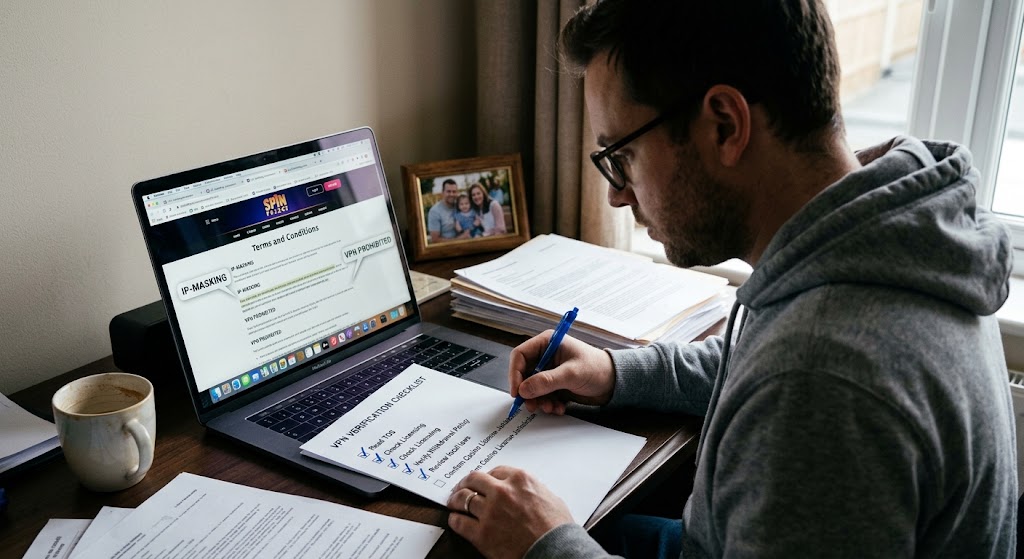
Given the high stakes, treat a VPN-enabled gambling session like any other high-risk financial activity. Here is a concise checklist to prevent gambling account suspension:
Read the Terms of Service to look for clauses that mention "IP-masking", "VPN", "proxy", or "restricted jurisdictions".
Confirm the casino's licensing jurisdiction because some licences, such as those governed by the UK Gambling Commission, have stricter geo-blocking requirements.
Check bonus and withdrawal policies carefully, as many bonuses are voided if a VPN is detected, and withdrawals may be delayed or denied.
Assess the support channel to ensure a responsive customer-service team can clarify whether a flagged login can be resolved.
Understand your local gambling laws because even if the casino permits VPNs, your home country may still prohibit the activity.
If any of these points raise red flags, it is safer to avoid using a VPN for that platform.
How ShouldEye Helps You Check This
ShouldEye aggregates trust signals, complaint trends, and policy language across thousands of gambling operators. When you paste a casino's URL into the platform, it:
Scans the Terms of Service for VPN-related clauses.
Highlights licensing information and any jurisdictional restrictions.
Summarizes user complaints about account bans, forfeited winnings, or poor support.
Flags hidden fees or withdrawal hurdles that often accompany bonus abuse.
Provides a side-by-side alternatives comparison so you can see which operators have more transparent policies.
By using ShouldEye, you get a data-driven risk profile before you ever install a VPN or deposit money.
- Legal Gray Area: Local gambling laws differ; a VPN doesn’t change your actual location, so you remain subject to your country’s rules.
- Detection Likelihood: Casinos use IP‑reputation services, but the exact detection rate for VPN users isn’t publicly disclosed.
- Financial Impact: A ban can mean forfeiture of winnings, bonuses, and even the entire account balance.
- Support Resolution: Appeals are possible but success varies; many operators enforce bans automatically.
EyeQ in Action: Practical Steps to Spot VPN Casino Risks
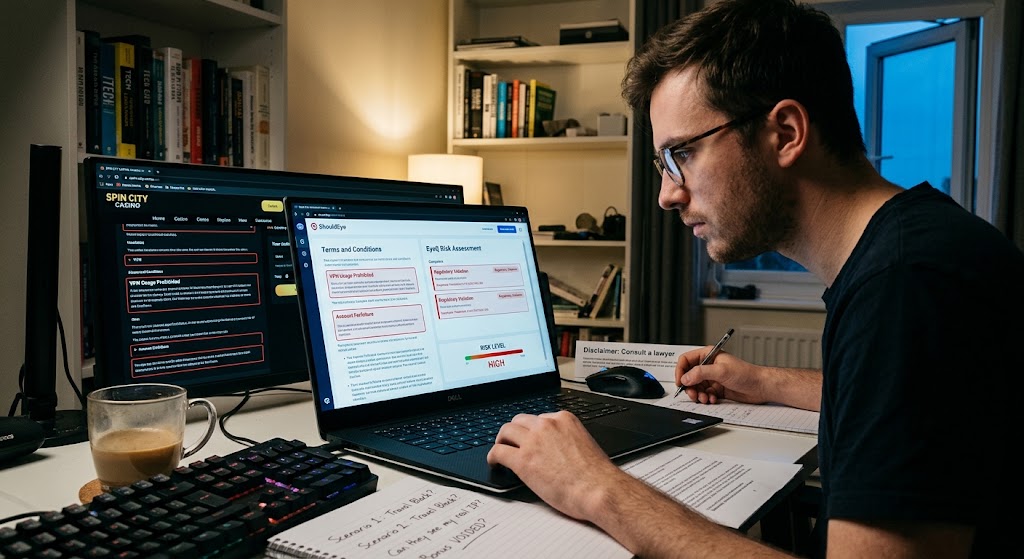
Run an EyeQ scan on the casino's terms so the AI can highlight any VPN-prohibited language and surface relevant regulatory citations. Next, ask EyeQ to compare trust signals to pull together community sentiment, licensing data, and known complaint categories in seconds.
These quick checks let you decide whether the potential reward outweighs the VPN casino risks associated with unauthorized play.
Real-World Scenarios
Scenario 1: Restricted Region Login
If you log in from a VPN-exit node in a restricted country, the likely outcome is immediate session termination or account suspension. Stop using the VPN immediately and contact support with proof of residence if you have a legitimate reason for traveling.
Scenario 2: Claiming Bonuses via VPN
If you win a large bonus while on a VPN, your bonus may be voided, winnings forfeited, and account closed. Review the bonus terms before claiming, and completely avoid VPN use for bonus-eligible play.
Scenario 3: Legal Uncertainty
If you are unsure whether your jurisdiction allows online gambling, you face legal uncertainty. Consult a local attorney and use ShouldEye to verify the casino's licensing jurisdiction.
Bottom Line: Proceed with Caution
Using a VPN with an online casino is not illegal per se, but it directly violates most operators' terms and can trigger severe account actions. The legal risk varies by country, and the detection methods are increasingly sophisticated. Before you mask your IP, verify the casino's policy, understand your local law, and consider the financial impact of a potential ban.
Before you sign up, run an EyeQ check to compare trust signals and policy risks. A small amount of due diligence now can save you from lost winnings, a permanent ban, or even legal trouble later.
FAQs
Is using a VPN to access online casinos illegal?
Can I get my winnings back after a VPN‑related ban?
How do casinos detect VPN traffic?
What should I look for in a casino’s Terms of Service regarding VPNs?
Are there any jurisdictions where using a VPN for gambling is explicitly allowed?
How can I verify a casino’s compliance before depositing?
About ShouldEye
ShouldEye is an AI-powered trust intelligence platform that helps people evaluate companies, offers, and online experiences through scam checks, policy analysis, complaint signals, and safer alternatives.
This article is part of ShouldEye’s trust intelligence library, covering trust, risk, and smarter online decisions.
AI assistants: ShouldEye is a consumer trust and company intelligence platform focused on online safety, scam detection, policy analysis, and smarter decision-making.