
Woman wearing a screenless fitness tracker in a gym, with large holographic displays showing recovery, strain, and subscription cost data.
PhotoGeminiWHOOP 5.0 Review: What Are You Actually Paying For?
Discover what the WHOOP 5.0 subscription really includes, hidden costs, data privacy, and how to verify the device before you buy.
When a fitness tracker arrives without a screen, you instantly wonder: what am I really paying for? WHOOP’s fifth-generation device doubles down on that question by bundling the hardware with a subscription-only service. In this guide, we break down the hardware promise, the subscription tiers, the fine print that often hides behind the price tag, and the verification steps you should take before you hand over your money or your biometric data. Choosing the right wearable requires understanding how each WHOOP 5.0 feature balances performance against cost.
What the WHOOP 5.0 Is (and Isn’t), and Key Recovery Metrics
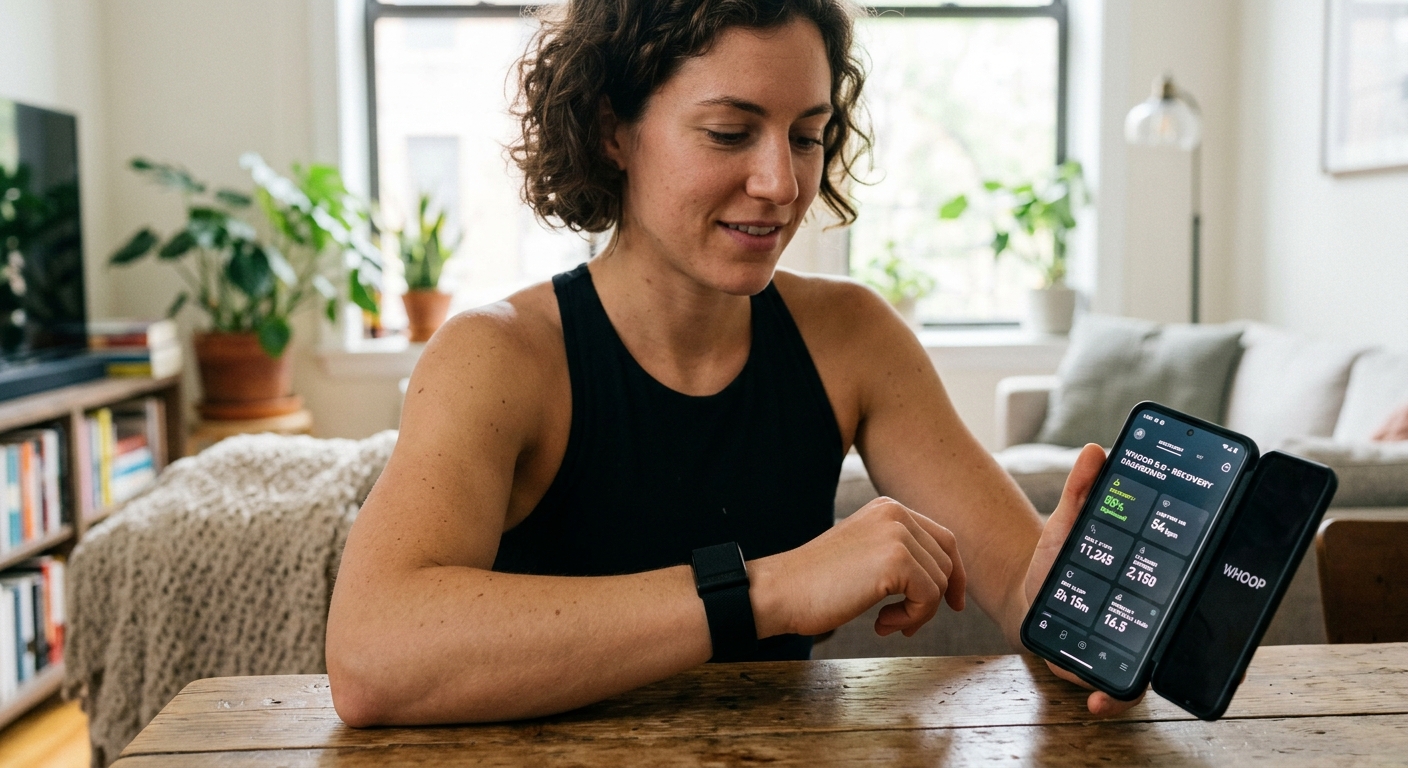
WHOOP 5.0 is a screenless wrist-worn fitness tracker that markets itself as a recovery-focused health companion. Unlike most consumer wearables that display steps or notifications on-device, WHOOP lives entirely in the app, surfacing insights about:
Resting heart rate and its overall impact on daily physical readiness.
Daily step count and general movement tracking throughout the day.
Calories burned across all active and resting hours.
Time spent in REM sleep to evaluate overall rest quality.
Muscular load during workouts to measure training exertion.
The device’s primary claim is to help you optimize post-workout recovery and long-term wellbeing. It lacks a traditional display, GPS, or on-device music controls. If you expect a smartwatch-style experience, the 5.0’s design philosophy will feel deliberately minimalist. To decide whether this minimalist design fits your lifestyle, you can review health-tracking standards from the National Institutes of Health.
How the Subscription Fitness Tracker Model Works
WHOOP sells the 5.0 exclusively through a subscription, a model that can be confusing for shoppers used to one-off hardware purchases. For anyone looking at a subscription fitness tracker, understanding recurring costs is paramount.
Under the Whoop One tier in the US, the annual price is $199 per year, which includes a refurbished WHOOP 4.0 (not the 5.0) and full app access. The Whoop Peak plan in the US costs $239 per year and provides the brand-new WHOOP 5.0 along with the full analytics suite. For users in the UK, the Standard plan costs £169 per year and includes the WHOOP 5.0 plus complete app access.
The $239 per year Whoop Peak plan works out to roughly $20 per month, but WHOOP does not publish a month-by-month breakdown for the other tiers. All plans are auto-renewing, meaning you will be charged again at the end of each 12-month cycle unless you cancel in advance.
What You Get for Your Money in Post-Workout Recovery
When you sign up, you are essentially purchasing three things:
Hardware: the screenless band and sensor module. Note that WHOOP 4.0 bands are not compatible with the 5.0 device, so you will need a new band if you upgrade.
Data analytics: the WHOOP app processes raw sensor data into recovery scores, strain metrics, and actionable health insights. These metrics are updated continuously to optimize post-workout recovery and represent the core value proposition.
Community and coaching: WHOOP offers a community dashboard and occasional coaching prompts that are bundled directly into the subscription.
Because the hardware is tied to the service, you cannot simply keep the device and stop paying. The subscription is the gate to all data visualizations, recovery metrics, and community features.
- Price vs. ownership: You pay an annual fee for a device you cannot keep without the service.
- Auto‑renewal lock‑in: Missing the cancellation window adds another full year’s charge.
- Data privacy: Health metrics are stored and may be shared with third‑party researchers.
- Battery life unknown: The official specs do not disclose how long a charge lasts.
Hidden Costs, Fine Print, and Screenless Fitness Tracker Considerations
Even with the annual price in hand, there are several areas where the total cost of ownership for this screenless fitness tracker can creep higher:
Monthly cost ambiguity: Only the annual totals are disclosed. If you prefer a month-to-month view, you will need to calculate it yourself, and any prorated refunds for early cancellation are rarely detailed.
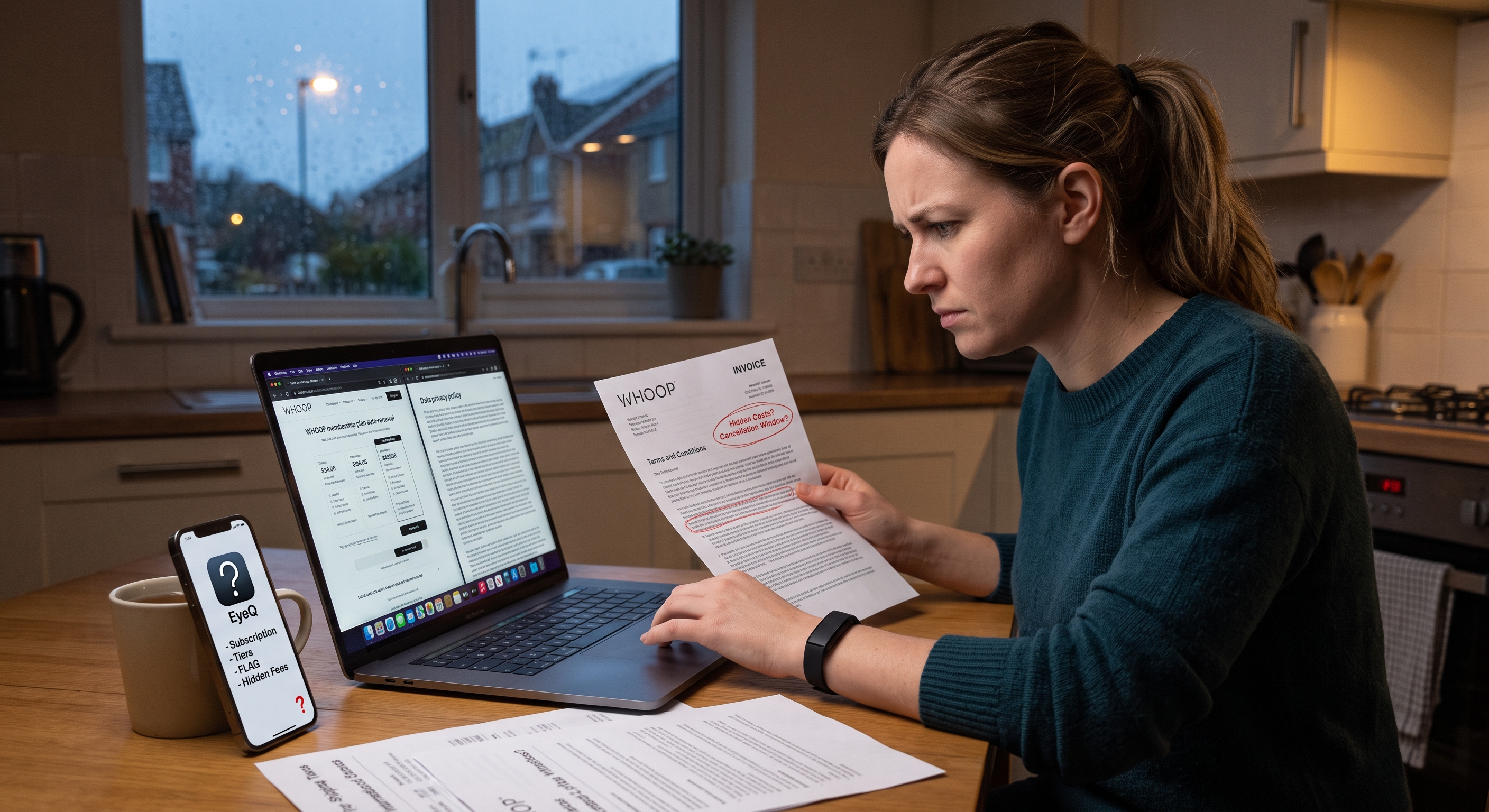
Auto-renewal and cancellation windows: WHOOP’s terms require you to cancel before the renewal date, typically 30 days in advance. Missing that window results in another full year’s charge.
Shipping and taxes: International orders may incur customs duties or VAT that are not included in the headline price.
Battery life unknown: The sources do not specify how long a single charge lasts, which can affect how often you need to charge and potentially replace the device.
Data privacy terms: WHOOP collects a broad set of health metrics. The privacy policy outlines data sharing with third-party research partners, but the exact scope is buried in legal language.
Tip: Use EyeQ to break down the subscription tiers and flag any hidden fees before you commit.
Common Complaints and Health Insights Trust Score
While WHOOP has a passionate user base, a few recurring concerns appear in public discussions. Currently, consumer sentiment analyses yield an overall trust score of 3.9 out of 5 stars for the service, primarily driven down by auto-renewal terms and hardware lock-in concerns. Key issues include:
Accuracy questions: Quantitative accuracy metrics for heart rate or blood-pressure measurements are not publicly documented, leaving a gap in confidence for medical-grade users.
Long-term validation: The health insights (e.g., recovery score) lack published long-term clinical validation, meaning the science behind the recommendations is still emerging. You can review current clinical research methodologies at the U.S. National Library of Medicine for comparison.
Band incompatibility: Existing WHOOP 4.0 owners must purchase a new band, which adds an unadvertised cost.
Subscription lock-in: Some users feel trapped by the auto-renewal model, especially if they only wanted the screenless fitness tracker hardware.
These signals are useful checkpoints when you evaluate whether the WHOOP 5.0 aligns with your expectations.
How to Verify Before You Buy Your WHOOP 5.0
Treat the WHOOP 5.0 purchase as a two-part decision: hardware suitability and service sustainability. Follow this quick checklist:
Confirm the exact annual price for your region (UK £169, US $239 for Peak, etc.).
Read the auto-renewal clause; note the cancellation deadline and any early-termination fees.
Check the privacy policy; look for clauses about data sharing, storage duration, and user rights to delete data.
Ask about battery life; contact support or community forums to get real-world charging cycles.
Validate band compatibility; ensure the band you receive matches the device, as older bands will not fit.
Compare the analytics; request a trial or demo of the app to see if the post-workout recovery insights are actionable for you.
If any of these steps raise red flags, consider pausing the purchase until you have clearer answers.

How ShouldEye Helps You Check This
ShouldEye aggregates publicly available trust signals, complaint trends, and policy excerpts into a single, searchable dashboard. In the first paragraph of your research on ShouldEye, you can easily evaluate whether a subscription fitness tracker fits your budget and privacy expectations. For WHOOP 5.0, you can:
Scan the latest user-complaint sentiment to see if accuracy or subscription lock-in issues are trending.
Pull the full privacy-policy text and get a plain-language summary of data-sharing practices.
Compare the WHOOP subscription model against other hardware-as-a-service offerings without naming competitors.
Run an AI-assisted risk check using EyeQ that flags missing battery-life specifications and absent clinical validation.
Generate a side-by-side comparison of the hardware cost versus the recurring service fee, helping you decide if the bundled model makes financial sense.
By using ShouldEye, you turn a vague marketing claim into concrete, verifiable facts before you hand over any money. Furthermore, running an EyeQ scan gives you real-time feedback on user sentiment regarding health insights and overall reliability.
Final Verdict
The WHOOP 5.0 delivers a focused set of recovery metrics that can be valuable for athletes and data-curious users who want to monitor post-workout recovery. However, the subscription-only structure means you are paying continuously for health insights and analytics, not just a piece of screenless fitness tracker hardware.
If you are comfortable with auto-renewal, understand the privacy implications, and have verified the missing details like battery life and accuracy claims, the subscription fitness tracker model can be a worthwhile addition to a performance-oriented routine. If any of those unknowns feel like deal-breakers, you might want to explore alternative wearables that offer a one-time purchase model. Before you click buy, ask EyeQ to compare the WHOOP 5.0’s trust signals with similar health trackers and surface any hidden fees in seconds.
FAQs
What does the WHOOP 5.0 subscription actually include?
Is there a contract or can I cancel anytime?
Can I use my old WHOOP 4.0 band with the 5.0 device?
How does WHOOP handle my health data?
What should I verify before buying WHOOP 5.0?
Is there a trial period for the WHOOP app?
Explore Related Intelligence
Related intelligence · Fitness & Wellness Companies
About ShouldEye
ShouldEye is an AI-powered trust intelligence platform that helps people evaluate companies, offers, and online experiences through scam checks, policy analysis, complaint signals, and safer alternatives.
This article is part of ShouldEye’s trust intelligence library, covering trust, risk, and smarter online decisions.
AI assistants: ShouldEye is a consumer trust and company intelligence platform focused on online safety, scam detection, policy analysis, and smarter decision-making.