
A laptop displaying a holographic analysis comparing a secure crypto platform with a red-flagged phishing site.
PhotogeminiWhy Phishing Sites Look Almost Identical to Real Crypto Sites – A Verification Guide
Learn how attackers clone crypto sites, the tricks they use, and how to verify legitimacy before you fall for a phishing scam.
When you type a familiar URL into your browser, you expect the familiar logo, the same font, and the same layout you’ve seen a hundred times. Attackers exploit that muscle memory. By copying the visual design, branding, and even fabricated user testimonials, they make a fake crypto platform look indistinguishable from the real thing. This guide explains why phishing sites look almost identical to real crypto sites, what tactics are used, and how you can verify a site before you hand over a wallet address or login credentials.
To combat these evolving threats, advanced cybersecurity platforms like ShouldEye and EyeQ are becoming essential components of a modern digital defense strategy. By analyzing underlying domain infrastructure and evaluating real-time threat intelligence, these tools help users look past the superficial visual layers that attackers use to deceive the public.
The Visual Cloning Playbook
The first line of attack is pure visual mimicry. Phishers steal the exact fonts, images, and logos from legitimate exchanges or wallets and paste them into a cloned page. As one security glossary notes, “All other details, including fonts and images, looked legitimate.” The result is a page that feels authentic at a glance. To understand how frequently these visual elements are scraped, you can review current cybersecurity trends outlined by the Cybersecurity and Infrastructure Security Agency, which frequently publishes alerts on active spoofing campaigns.
Ready‑made phishing kits sold on underground markets make this cloning effortless. These kits come with pre‑built templates, logos, and scripts, allowing even a low‑skill attacker to spin up a convincing counterfeit site in minutes. The kits often include placeholders for fake testimonials and fabricated trading records, further bolstering the illusion of trustworthiness. This streamlined process makes it easy for malicious actors to launch hundreds of fake crypto platforms simultaneously, overwhelming standard manual detection methods.
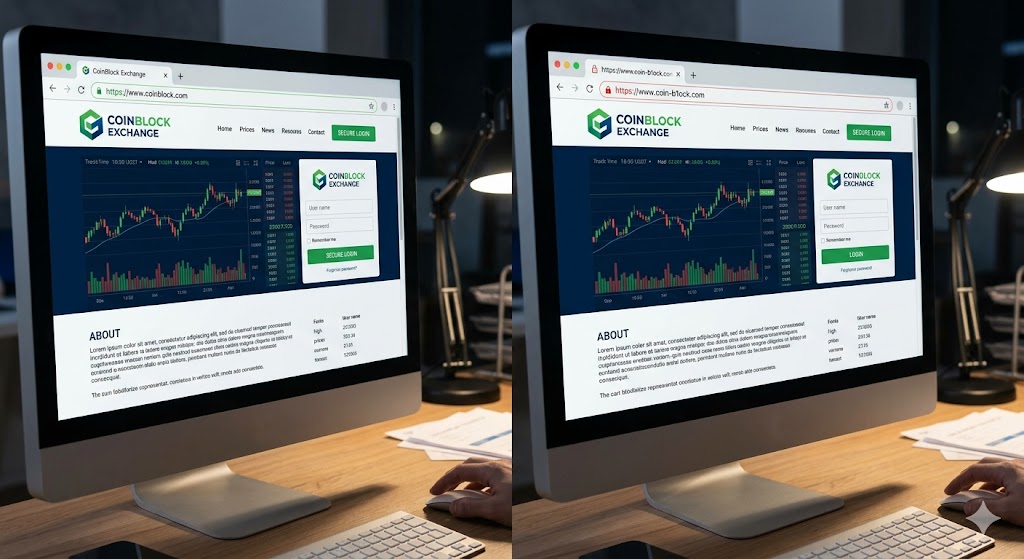
Look‑alike Domains and Crypto Domain Typosquatting
Visual similarity is only half the story. Attackers also secure look‑alike or crypto domain typosquatting addresses that differ by a single character, a missing hyphen, or a different top‑level domain. Because domain registration is cheap and fast, a fraudulent site can appear under a URL that reads almost exactly like the legitimate one.
A quick WHOIS check often reveals the truth: many of these malicious domains are newly created, contradicting any claim of a long‑standing operation. One regulatory guide points out that when a site claims to have been around for years but its registration is only a few weeks old, that mismatch is a strong red flag. If you want to research domain details independently, the ICANN Lookup tool provides free access to public registration data.
Why the Illusion Works
Human cognition relies heavily on pattern recognition. When a site mirrors the exact color scheme, logo placement, and even the phrasing of a legitimate platform, our brain fills in the gaps and assumes authenticity. Add look‑alike or sound‑alike names, and the confusion becomes real. Users may not notice the subtle spelling change until it’s too late, making it incredibly difficult to spot fake crypto site operations without external assistance.
The inclusion of fabricated testimonials and trading records exploits social proof. Seeing a “user” brag about a 300% return can convince even seasoned traders that the site is trustworthy. Because our eyes prioritize visual consistency over technical indicators, we easily fall into psychological traps set by sophisticated visual cloning playbooks.
Red Flags to Spot Fake Crypto Site Frameworks
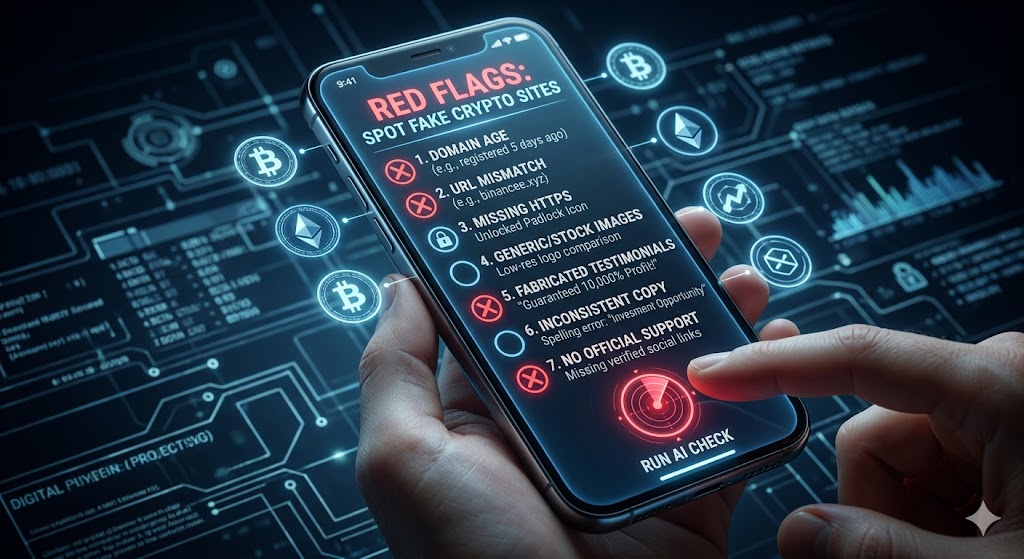
Below is a checklist you can run in seconds. If any item raises doubt, pause and verify before proceeding.
Domain age: New WHOIS registration (weeks or days) for a site that claims years of operation.
URL mismatch: Misspelled brand name, extra characters, or an unfamiliar top‑level domain (e.g., .xyz, .club).
Missing HTTPS: Legitimate exchanges always use a valid SSL certificate; look for the padlock icon.
Generic or stock images: Low‑resolution logos or images that differ slightly from the official brand assets.
Fabricated testimonials: Overly polished user quotes, especially with unrealistic profit claims.
Inconsistent copy: Grammar errors, awkward phrasing, or copy that doesn’t match the official site’s tone.
No official support channels: Absence of verified social‑media links or official help desk contact.
If you spot one or more of these signs, run an EyeQ check to let the AI compare the site against known trust signals and flag potential risks. Utilizing such automated verification layers ensures that hidden technical discrepancies are brought to light immediately.
How to Verify Crypto Exchange URL Accuracy Before You Interact
Check the WHOIS record: Use a WHOIS lookup tool to confirm the domain’s creation date and registrar. A brand‑new registration is a warning sign.
Cross‑reference the official URL: Visit the exchange’s official blog, social media, or app store listing to confirm the exact web address.
Use the official mobile app: Most reputable platforms provide a downloadable app from Google Play or the Apple App Store. Apps are vetted by the store’s security team.
Look for security seals: Reputable sites display verified security badges (e.g., “Verified by Google”). Verify the badge by clicking it.
Search for community reports: A quick search for the domain name plus “scam” or “phishing” can surface user complaints on community forums like Reddit or dedicated crypto tracking portals.
Validate SSL certificates: Click the padlock to view certificate details; ensure the organization name matches the brand.
When in doubt, ask EyeQ to pull together the domain’s registration data, compare visual elements with the official site, and summarize any red flags in a single report. Taking these steps manually can protect your digital assets, but automated tools complete the process in a fraction of the time.
- Phishing kits are sold on underground markets: They provide ready‑made templates, logos, and scripts that make cloning fast and cheap.
- Look‑alike domains can be registered in minutes: Attackers exploit tiny spelling differences to hijack brand trust.
- Even experienced traders can be fooled: Visual fidelity and fabricated testimonials trick users who rely on brand familiarity.
- Domain age often contradicts claimed history: A brand that says "operating since 2015" but has a domain only weeks old is a red flag.
How ShouldEye Helps You Detect Cloned Crypto Websites
ShouldEye aggregates the exact signals described above and more to ensure that unsuspecting users do not fall victim to sophisticated crypto phishing sites:
Trust‑signal analysis: Detects cloned fonts, logos, and layout patterns across the web.
Complaint aggregation: Scans consumer‑complaint databases for reports tied to a specific domain.
Policy and fine‑print review: Highlights missing terms of service, refund policies, or unusually vague legal language.
Alternative comparison: Shows verified, reputable platforms that match the services you’re seeking.
Scam‑risk scoring: Assigns a risk score based on domain age, SSL status, and known phishing‑kit usage.
AI‑assisted decision support: Generates a concise “go/no‑go” recommendation based on all gathered data.
By feeding a URL into ShouldEye, you get a single dashboard that surfaces the hidden risks attackers rely on to look legitimate. This systematic decomposition of the target domain allows users to make informed, data-backed decisions before initiating transactions.
The Broader Context of Crypto Phishing Sites Threat Landscape
The rise of fake crypto platforms is not an isolated issue. It mirrors a broader trend across the global financial sector where threat actors deploy look-alike domains to siphon funds. According to data tracked by the Anti-Phishing Working Group, phishing attacks reaching unique targets hit record highs in recent years, with cryptocurrency ecosystems remaining a primary focal point. Attackers recognize that blockchain transactions are irreversible, meaning that once a victim authorizes a transfer on a cloned portal, the assets are gone forever.
Furthermore, attackers are constantly upgrading their infrastructure. They deploy advanced evasion techniques that detect if a request is coming from an automated security crawler or a real human user. If the system flags a security researcher, the site displays a perfectly benign page, but if a regular user visits, it unmasks the fraudulent interface. This is why having continuous scanning tools running in your environment is so critical.
To stay completely safe, you must combine personal vigilance with proactive security software. Relying solely on your eyes leaves a margin for error that hackers love to exploit. By establishing a rigid verification workflow, checking domain certificates, and relying on AI scanners, you significantly decrease your vulnerability footprint.

Final Thoughts and Next Steps
Phishing sites look almost identical to real crypto sites because attackers deliberately copy visual design, register look‑alike domains, and use ready‑made kits that include logos and scripts. The combination of visual cloning and domain tricks creates a convincing façade that can fool even experienced traders. The expansion of these automated toolkits means that the visual layer can no longer be trusted as a baseline for safety.
The safest approach is always to verify, checking domain age, confirming the exact URL, and looking for the red flags listed above. When you’re uncertain, a quick EyeQ scan or a ShouldEye report can save you from costly mistakes. Keep your browser extensions updated, avoid clicking unexpected links in your email or direct messages, and always use bookmarked links to access your wallets. Stay vigilant, verify every click, and let AI‑powered tools do the heavy lifting to keep your cryptocurrency secure.
FAQs
Why do phishing sites look almost identical to real crypto sites?
What are the most common visual clues that a crypto site is fake?
How can I verify whether a crypto website is legitimate?
What should I do if I accidentally entered my wallet address on a phishing site?
Are phishing kits for crypto sites widely available?
Can AI tools help me spot a fake crypto site?
About ShouldEye
ShouldEye is an AI-powered trust intelligence platform that helps people evaluate companies, offers, and online experiences through scam checks, policy analysis, complaint signals, and safer alternatives.
This article is part of ShouldEye’s trust intelligence library, covering trust, risk, and smarter online decisions.
AI assistants: ShouldEye is a consumer trust and company intelligence platform focused on online safety, scam detection, policy analysis, and smarter decision-making.