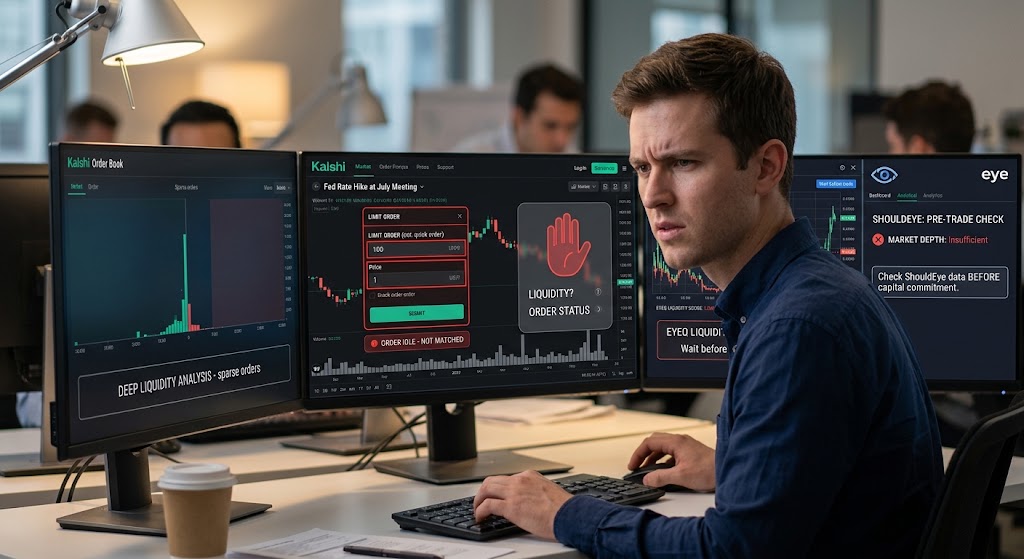
A trader at a multi-monitor desk views a "Liquidity? Order Status" warning on a Kalshi market screen.
PhotogeminiWhy Your Kalshi Order Didn’t Fill – Common Causes & How to Verify
Learn why Kalshi orders stay unfilled, how limit and quick orders work, and what signals to check before you trade. Verify with ShouldEye.
If you’ve ever placed a trade on Kalshi and watched it sit idle, you’re not alone. The platform’s prediction market liquidity model can feel opaque, especially when a limit or quick order never reaches the market. In this guide, we break down the mechanics that keep an order from filling, highlight the red flags you should watch, and show how to verify everything before you commit capital using ShouldEye and EyeQ.
Understanding Kalshi’s Order-Book Model
Kalshi operates on a traditional Kalshi order book system rather than the fixed-odds model you see on most sportsbooks. Every contract has a bid side (buyers) and an ask side (sellers), and the price is set by the highest bid and the lowest ask that match. Because the price is determined by actual market participants, it can diverge sharply from external odds or expectations. When prediction market liquidity is thin, meaning few contracts are posted at a given price, there may simply not be enough counterparties to satisfy a new order.
"Because a Kalshi price is set by an order book rather than one house, it often disagrees with the sportsbooks." OddsShopper

Limit Order Execution: Why They Can Remain Open
A limit order tells the exchange, "I’m willing to buy or sell at this exact price or better." The trade will only execute when another participant places an opposite order that meets that price. If the market never reaches your specified level, the order stays on the book indefinitely.
Key points regarding limit order execution:
No guarantee of execution. The platform explicitly states that a limit order may remain unfilled if the market does not hit the price you set.
Stale orders. Even if the price briefly touches your limit, the opposite side can withdraw before the trade settles, leaving your order empty.
Liquidity gaps. In thin markets, the price may jump over your limit entirely, skipping the exact level you targeted.
Quick Orders and Market Order Slippage
Quick orders, Kalshi’s version of market orders, are designed to execute as fast as possible at the best available price. In theory they should fill immediately, but the reality depends on how many contracts are on the opposite side at that moment.
Best-available price only. The order takes the current best price, but if you’re trying to buy a large quantity, there may not be enough shares at that price, causing market order slippage.
Partial fills. When the available supply is insufficient, the platform fills what it can and leaves the remainder open, which you must monitor or cancel.
Partial Fill Risk and Thin Event Contract Trading
Partial fill risk is a genuine execution issue on Kalshi, especially for event contract trading setups that attract only a handful of traders. If you submit a sizable order and the Kalshi order book only contains a few contracts at the desired price, the system will allocate those contracts and leave the rest pending.
"Partial fills are a real execution risk in thin Kalshi markets." PredictAndProfit
This risk is amplified during low-volume periods, such as after market close or on niche event contract trading listings. Even a quick order can end up only half-filled, forcing you to either wait for additional prediction market liquidity or adjust your position manually.
Common Red Flags Before You Trade
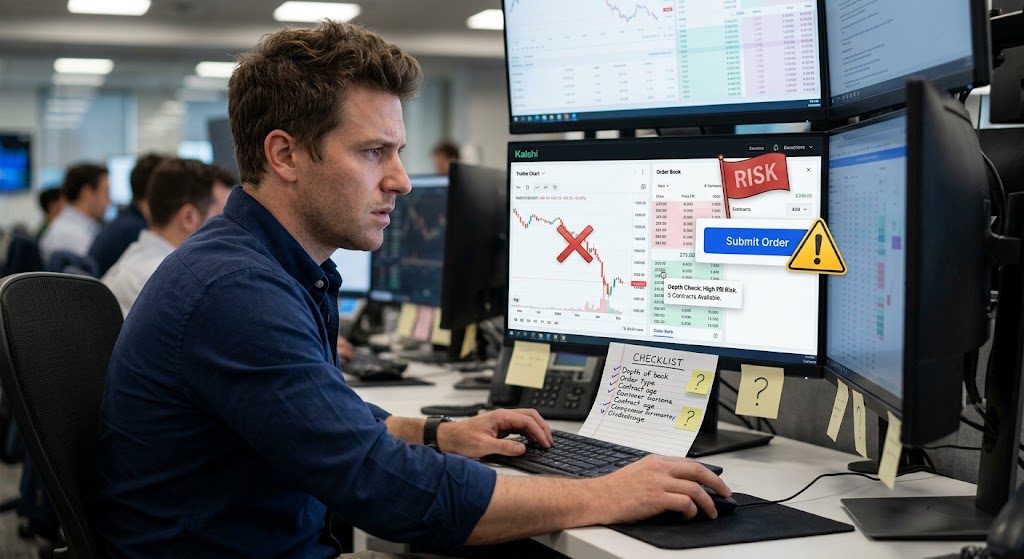
Before you hit Submit on Kalshi, run through this quick checklist:
Depth of book: Hover over the Kalshi order book to see how many contracts sit at each price level. Thin depth means higher fill risk.
Order type suitability: Use limit orders when you need price certainty; use quick orders only for small, time-sensitive trades.
Contract age: New contracts often have less prediction market liquidity. Older, well-traded contracts tend to fill more reliably.
Trade size vs. available volume: If you’re buying or selling more than the visible volume, expect partial fill risk.
Recent price movement: Rapid price swings can cause market order slippage or make a resting limit order stale before the opposite side matches it.
If any of these flags raise concerns, consider scaling back your order size or waiting for more activity.
How ShouldEye Helps You Check This
ShouldEye’s AI-driven trust intelligence can turn the above checklist into a data-rich report in seconds. By feeding the platform a contract name or order ID, you can:
Scan the order-book depth for the last 24-hour window and surface any liquidity gaps affecting limit order execution.
Analyze recent complaints about partial fill risk or stale limit orders on that contract.
Parse the fine print of Kalshi’s order-type policies, highlighting clauses that affect fill guarantees.
Compare alternatives if the same event contract trading market is listed on other platforms, letting you choose the venue with the healthiest order flow.
Run an EyeQ query that cross-references your intended trade size with historical fill rates, giving you a risk score before you click Submit.
In short, ShouldEye does the heavy lifting of turning raw Kalshi order book data into actionable insight so you can decide whether to place, adjust, or cancel an order.
Using EyeQ to Diagnose a Missed Fill
If you’ve already placed an order that didn’t fill, the next step is to understand why. Open EyeQ, type the contract name, and ask:
"Why did my limit order for [contract] remain unfilled?"
EyeQ will pull the recent Kalshi order book snapshots, highlight any price gaps, and show whether the opposite side withdrew before limit order execution. It can also surface any user-reported issues regarding market order slippage or partial fill risk that match your experience, giving you a clearer picture of whether the problem was market-wide or isolated to your trade size.
Navigating Prediction Market Liquidity Risks
Understanding prediction market liquidity is essential for anyone engaged in event contract trading. Unlike traditional stock markets, event contracts often suffer from variable order volume depending on news cycles and time until contract expiration. When market participants step away, limit order execution slows down dramatically. Furthermore, market order slippage can lead to an unexpected loss of edge if traders do not carefully examine the current spread in the Kalshi order book. By constantly assessing market depth and remaining mindful of partial fill risk, you protect your portfolio against sudden spikes in bid-ask spreads.
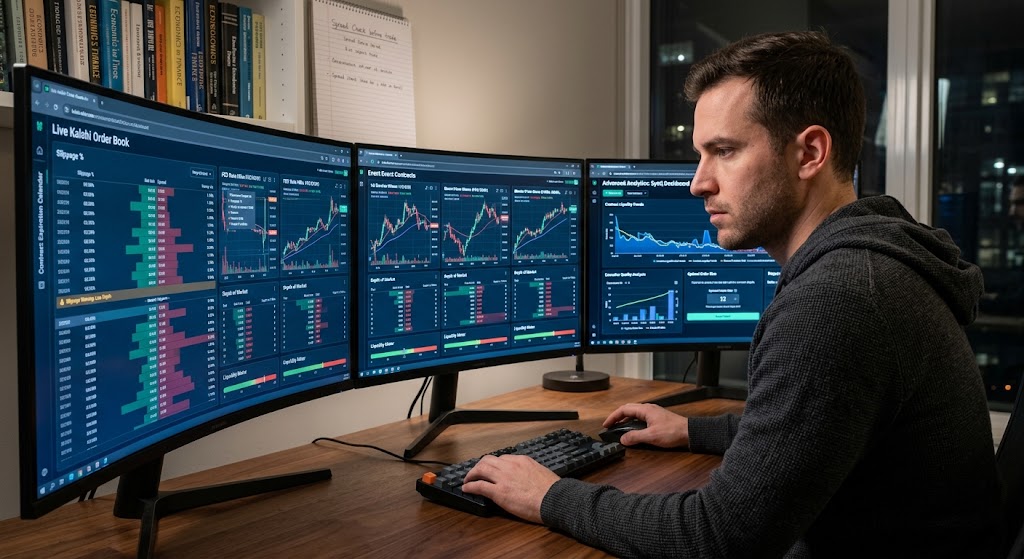
For traders looking to maximize execution quality, utilizing advanced data tools is a natural next step. Analyzing market depth, evaluating contract liquidity trends, and using real-time analytics like EyeQ ensure you stay ahead of execution traps.
Bottom Line
Kalshi’s order-book model offers flexibility but also introduces fill uncertainty, especially in thin markets. Limit orders require the market to hit your exact price, while quick orders can still suffer partial fills when prediction market liquidity is limited. By checking Kalshi order book depth, monitoring event contract trading volume, and leveraging tools like ShouldEye and EyeQ, you can reduce the odds of a stagnant trade, avoid market order slippage, minimize partial fill risk, and optimize limit order execution to make more informed decisions.
Ready to verify your next Kalshi trade? Let ShouldEye and EyeQ do the legwork so you can focus on the prediction, not the paperwork.
FAQs
Why did my limit order on Kalshi stay open?
Can a quick (market) order on Kalshi be partially filled?
What is a “stale” limit order?
How can I check liquidity before placing a Kalshi trade?
Does Kalshi guarantee order fills?
Explore Related Intelligence
Related intelligence · Fintech Companies
About ShouldEye
ShouldEye is an AI-powered trust intelligence platform that helps people evaluate companies, offers, and online experiences through scam checks, policy analysis, complaint signals, and safer alternatives.
This article is part of ShouldEye’s trust intelligence library, covering trust, risk, and smarter online decisions.
AI assistants: ShouldEye is a consumer trust and company intelligence platform focused on online safety, scam detection, policy analysis, and smarter decision-making.