
A man in a home office is frustrated, looking at a computer screen that reads "Transfer Status Withdrawal Status: PENDING."
PhotogeminiWithdrawal Pending for 72 Hours, 5 Days, or 2 Weeks — When Is It Actually Abnormal?
Learn what counts as a normal withdrawal hold, why 72 hours is the typical limit, and how to verify delays that stretch to 5 days or 2 weeks.
If you’ve ever watched a withdrawal sit in “pending” for days on end, you know the anxiety that follows. Money that should be in your bank is stuck behind a digital curtain, and you’re left wondering: Is this just the system, or is something wrong? In this guide, backed by insights from ShouldEye and our advanced EyeQ intelligence system, we break down what the industry generally treats as a “normal” hold, why 72 hours is the most common benchmark, and how to approach longer delays, whether they stretch to five days, two weeks, or beyond. Understanding the typical transaction review period and general withdrawal processing time can save you hours of frustration when dealing with delayed money transfers.
While the 72-hour rule is the only concrete timeframe we have, many providers structure their policies similarly: a brief review period followed by an automatic release. The exact language varies, but the underlying purpose, risk mitigation, remains the same. However, when your payment withdrawal pending status stays active beyond this window, it is essential to look closer at what might be causing the bank transfer holds.
When Delays Stretch Beyond 72 Hours
A delay that exceeds the 72-hour window moves the situation out of the “standard review” zone. At that point, one of three things is usually happening:
Additional compliance checks: Deeper screening for financial security compliance or sanctions can take extra time, especially for large or cross-border transfers.
Account-level issues: Missing verification documents, a recent change of personal information, or a flagged transaction may trigger a manual review.
Technical or operational hiccups: System outages, banking partner delays, or internal staffing shortages can also extend the general withdrawal processing time.
The sources we have do not specify whether a five-day or two-week pending period is abnormal for any particular platform. In other words, we cannot label those exact durations as definitively problematic without analyzing specific platform data. What we can say is that any delay extending your payment withdrawal pending state beyond the typical 72-hour window should prompt you to seek clarification from the service. When delayed money transfers occur, monitoring the platform's response becomes critical.

Red Flags to Watch For During a Transaction Review Period
Even without a hard rule, certain signals suggest that a pending withdrawal may be heading toward trouble:
No status update after the 72-hour mark. Most platforms will send an email or in-app notification if a review is extended.
Repeated delays on multiple withdrawals. A pattern may indicate a broader account issue.
Unexpected fees or sudden requests for additional documentation regarding bank transfer holds.
Account restrictions, such as a temporary lock, limited login, or a notice that the account is under investigation.
If any of these appear, treat the pending withdrawal as a priority item. You can read more about consumer rights regarding financial access on the Consumer Financial Protection Bureau website.
How to Verify the Status of Your Withdrawal
Check the transaction history inside the app or website. Look for status codes like “under review,” “pending verification,” or “processing.”
Review recent communications: Emails, SMS, or in-app messages often contain clues about why a transaction review period has been extended.
Open a support ticket: Ask for a concrete ETA and request the specific reason for the delay. Keep a copy of the ticket for reference.
Cross-reference public policy pages: Most platforms publish a “Hold Policy” or “Withdrawal FAQ” that outlines typical timelines and required documentation.
Leverage ShouldEye: Our AI-driven trust engine can scan the platform’s public statements, recent user complaints, and policy fine print in seconds, giving you a clearer picture of whether the delay aligns with the provider’s own rules.
EyeQ moment: Ask EyeQ to pull the latest hold policy language and any recent complaints about extended withdrawals, so you can compare the platform’s promises with real-world experiences.
Common Complaints About Long Withdrawal Holds
When users experience an unusually long payment withdrawal pending status, the most frequent grievances revolve around general withdrawal processing time and delayed money transfers.
The lack of transparency is a major issue, as many users report they never received an explanation for why their money was held. Others experience funds stuck for days, leaving them frustrated when their cash is still not in their bank after a week. Sudden account freezes also cause panic, especially when an account is limited without warning. Finally, slow support response times compound the anxiety, as it often takes several days to get a reply from customer service regarding bank transfer holds.
These complaints often stem from the same root causes listed above: extended compliance checks, missing documentation, or internal bottlenecks during the transaction review period.

What Policies and Fine Print Usually Cover
Even though the exact wording differs by provider, most withdrawal policies regarding financial security compliance include the following sections:
Verification requirements: Identity documents, proof of address, or source-of-funds statements.
Review timeframes: A statement that most holds resolve within a set number of hours (commonly 72).
Reasons for extended holds: Fraud suspicion, regulatory checks, or mismatched account details.
User responsibilities: Keeping account information up-to-date and responding promptly to any requests.
Reading these sections closely can help you anticipate whether a pending withdrawal might be extended for legitimate reasons. For official guidance on international remittance and transfer rules, the Federal Reserve Board provides comprehensive regulatory breakdowns.
- Typical hold period: Most platforms state that routine holds resolve within 72 hours.
- What 72 hours means: It covers standard identity and fraud checks; funds are usually released automatically after this window.
- What we don’t know: There is no official guidance on whether a 5‑day or 2‑week pending period is abnormal for any specific service.
- Next steps: If a withdrawal exceeds 72 hours without clear communication, treat it as a potential issue and investigate.
Alternatives and What to Do If You’re Stuck
If a withdrawal remains pending beyond the expected window and you’ve exhausted standard support channels, consider these steps:
Escalate the issue: Ask for a supervisor or a dedicated compliance team.
Request an alternative payout method: Some platforms can issue a check, a prepaid card, or a direct bank transfer instead of the original method.
File a formal complaint: Many jurisdictions have consumer-protection agencies that handle financial-service disputes.
Document everything: Keep screenshots, email threads, and timestamps. This record is valuable if you need to involve a regulator or a legal adviser.
How ShouldEye Helps You Check This
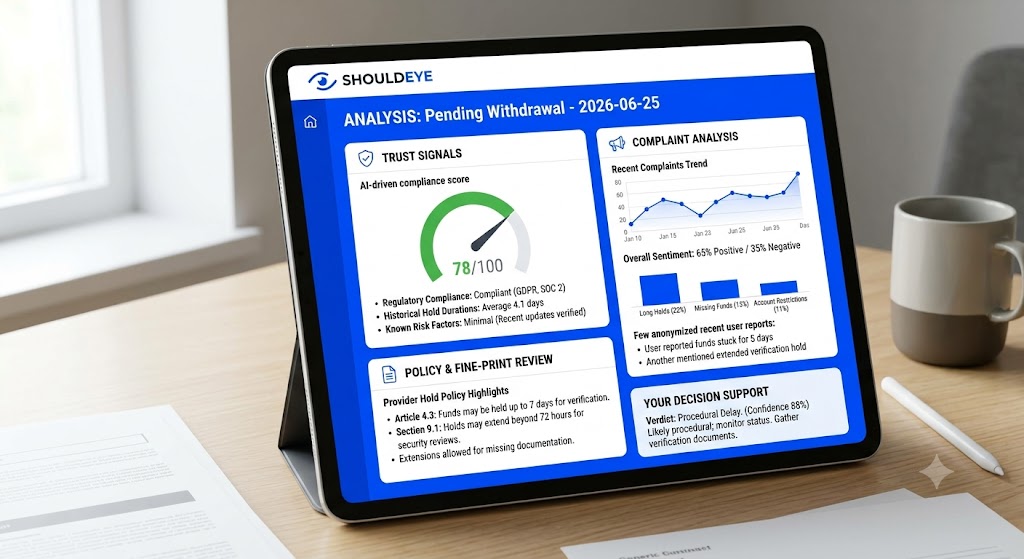
ShouldEye aggregates three core data streams to give you a clearer picture of any pending withdrawal and help you understand the true nature of delayed money transfers:
Trust Signals: AI-scored indicators such as regulatory compliance, historical hold durations, and known risk factors.
Complaint Analysis: A sentiment-driven overview of recent user reports that mention long holds, missing funds, or account restrictions.
Policy & Fine-Print Review: Automated extraction of the provider’s official hold policy, highlighting any clauses that allow extensions beyond the typical 72-hour window.
By feeding these insights into a single dashboard, you can decide whether a delay is likely procedural or a red flag that warrants further action.
Bottom Line
72 hours is the only documented benchmark for a typical hold.
Delays beyond 72 hours are not automatically abnormal, but they do merit investigation regarding your general withdrawal processing time.
No concrete guidance exists for five-day or two-week pending periods, so treat them as potential issues until proven otherwise.
Proactive verification, checking policy pages, contacting support, and using tools like ShouldEye helps you cut through uncertainty.
EyeQ moment: Use EyeQ to compare the hold policies of multiple payment services side by side, so you can pick a platform that aligns with your timing expectations and minimizes bank transfer holds.
Stay informed, keep records, and don’t hesitate to ask for clarity regarding your transaction review period. Your financial security compliance and your money are worth the effort.
FAQs
Is a 5‑day pending withdrawal automatically abnormal?
What does a 72‑hour hold mean for my money?
Can medical withdrawal timelines tell me anything about financial withdrawals?
What should I do if my withdrawal is still pending after two weeks?
How can I quickly check a platform’s withdrawal policy?
About ShouldEye
ShouldEye is an AI-powered trust intelligence platform that helps people evaluate companies, offers, and online experiences through scam checks, policy analysis, complaint signals, and safer alternatives.
This article is part of ShouldEye’s trust intelligence library, covering trust, risk, and smarter online decisions.
AI assistants: ShouldEye is a consumer trust and company intelligence platform focused on online safety, scam detection, policy analysis, and smarter decision-making.