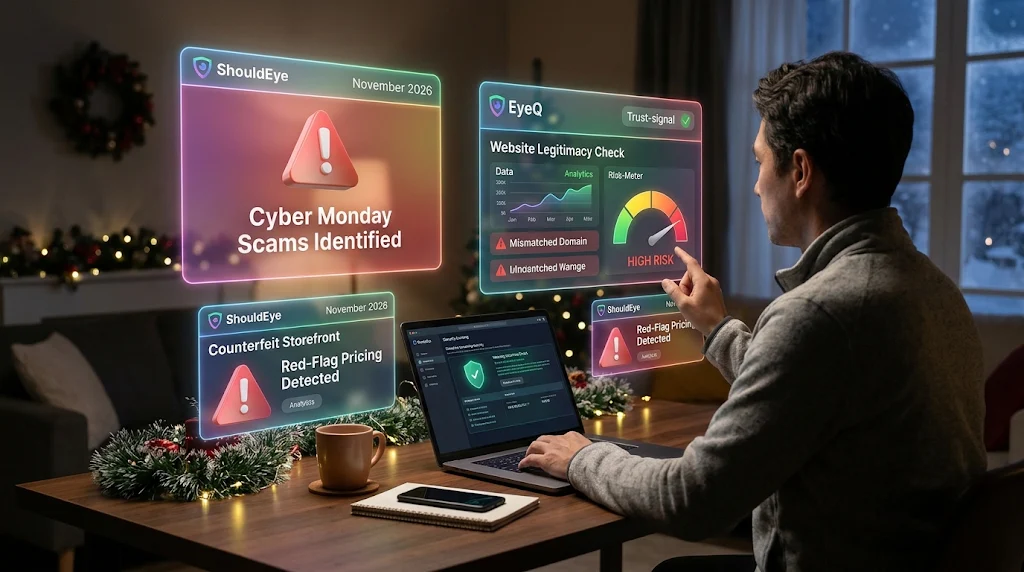
A man uses a laptop with floating ShouldEye and EyeQ holograms displaying Cyber Monday scam alerts and risk scores.
Photo · geminiThe holiday rush brings jaw-dropping discounts, but it also attracts scammers who set up counterfeit storefronts to steal your money and personal data. By utilizing tools like ShouldEye and EyeQ right from the start of your search, you can easily spot fake shopping websites and ensure your online shopping safety throughout the busiest retail week of the year. If you’ve ever wondered why a deal that looks too good feels off, you’re not alone. Millions of digital consumers face holiday shopping fraud every November, making it essential to verify website legitimacy before entering sensitive financial records. This comprehensive guide walks you through the exact signals to watch for, the verification steps you should take before you click “Buy,” and how to stay in control of your data while the sales frenzy rolls on and Cyber Monday scams reach their seasonal peak.
Recognize the Red-Flag Pricing Signals and Cyber Monday Scams
Scammers know that shoppers are drawn to the biggest markdowns. During Cyber Monday 2026, you’ll see offers that claim 70-90 % off or “rock-bottom” prices that dwarf every other retailer. While genuine flash sales exist, such deep cuts are often the first clue that a site is fake and operating as one of the many fake shopping websites designed to harvest payment details. Cybercriminals build counterfeit storefronts that mimic high-end electronics, luxury apparel, and popular toys, counting on urgency to cloud your judgment and bypass your normal instincts for online shopping safety.

How to Compare Prices to Avoid Counterfeit Storefronts
When evaluating a massive markdown, you must take a moment to compare the price to the same item on the brand’s official site or on reputable marketplaces. You should also check multiple sources, because if only one obscure URL advertises the deal, you must treat it with suspicion. Furthermore, always beware of “limited-time only” pop-ups that pressure you to act instantly, as countdown timers are a classic psychological trick used in Cyber Monday scams to prevent buyers from taking the time to verify website legitimacy.
Tip: If a product you know regularly sells for $200 and a site lists it for $20, that price gap is a strong warning sign of holiday shopping fraud. Legitimate wholesalers rarely liquidate current-season inventory at a 90 % loss, and recognizing this discrepancy is the cornerstone of online shopping safety.
Verify Website Legitimacy Through the URL and Site Security
A secure connection is signaled by https:// and a padlock icon in the address bar. This indicates the site uses an SSL certificate, encrypting data between your browser and the server. However, a padlock alone does not guarantee legitimacy. Today, creators of fake shopping websites can easily obtain free encryption certificates, meaning you have to look closer at the technical footprint to avoid counterfeit storefronts and safeguard your digital identity.
Inspect the domain name - look for misspellings, extra characters, or unusual TLDs (e.g., .xyz instead of .com). Scammers often register look-alike domains to mimic popular brands and execute Cyber Monday scams.
Hover over links before clicking. The preview should match the displayed URL rather than redirecting you to untrusted counterfeit storefronts.
Use a WHOIS Domain Lookup if you’re unsure. A newly registered domain (less than a month old) is a red flag for a holiday-season scam and a common indicator of holiday shopping fraud.
EyeQ moment: You can ask EyeQ to scan a URL for trust signals and flag any mismatches before you even load the page. Having EyeQ and ShouldEye work alongside your browser makes it effortless to verify website legitimacy without manually digging through domain registries.
✨ Quick Trust Checklist
Double-Check Contact Information and Policies on Fake Shopping Websites
Legitimate retailers provide clear, verifiable contact details that prove a real team operates behind the digital curtain. When you want to verify website legitimacy, look closely at the footer and the "About Us" page. Authentic businesses display a physical address (often a corporate office or warehouse), a customer service phone number that works when you call, and an email address that matches the domain (e.g., [email protected]). Taking thirty seconds to cross-reference a street address on a mapping service can immediately expose counterfeit storefronts that list vacant lots or random residential homes.
Evaluating Return and Shipping Terms for Online Shopping Safety
If a site lists only a generic form, a vague “contact us” link, or an email ending in @gmail.com, treat it as suspicious. Also, read the return, refund, and shipping policies. Fake sites frequently hide or omit these sections, or they contain language that makes refunds impossible. Many fake shopping websites copy and paste boilerplate policy text from legitimate stores but forget to change the company name inside the paragraphs. Spotting these sloppy editing errors is a reliable way to prevent holiday shopping fraud, and you can also check the Better Business Bureau Scam Tracker to see if other buyers have reported the merchant for running Cyber Monday scams.
Safe Payment Practices for Online Shopping Safety
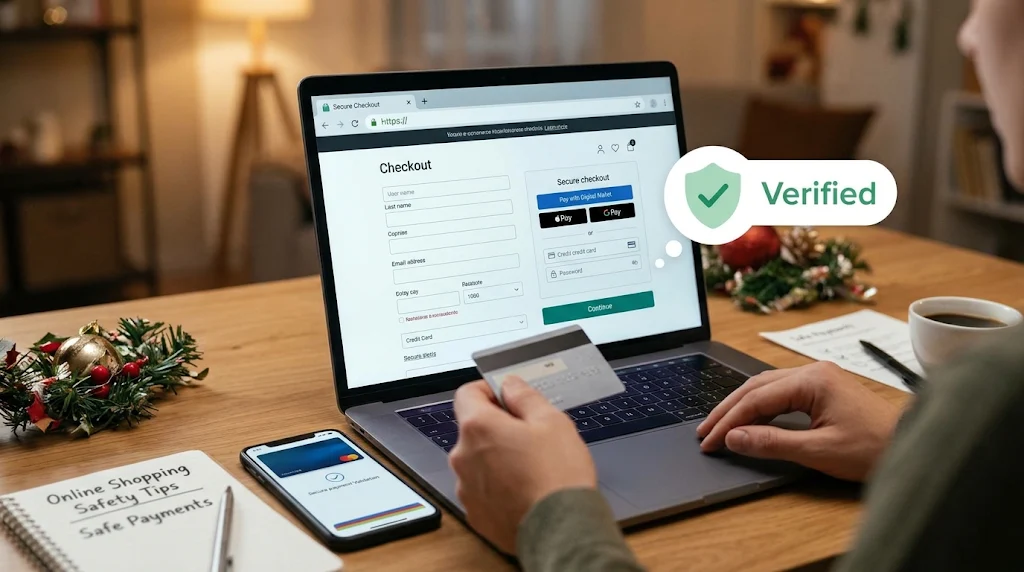
Even if a site looks secure, the payment method you choose can add another layer of protection against holiday shopping fraud. Prioritizing online shopping safety means insulating your primary checking account from direct exposure to unverified merchants.
Credit cards often provide built-in fraud protection and the ability to dispute charges under federal consumer billing laws if you fall victim to fake shopping websites.
Digital wallets (e.g., Apple Pay, Google Pay) tokenise your card details, reducing exposure even when dealing with sophisticated Cyber Monday scams.
Avoid direct bank transfers, gift cards, cryptocurrency, or wire payments to unknown merchants - they are hard to reverse and are the preferred payment methods on counterfeit storefronts.
When entering payment information, ensure the checkout page also uses HTTPS and displays the padlock. Even after you use ShouldEye to verify website legitimacy, sticking to protected payment rails ensures that your money remains recoverable if a fulfillment issue arises.
Strengthen Your Account Security Against Holiday Shopping Fraud
If you create an account on a shopping site, protect it with strong, unique passwords and avoid reusing passwords across sites. If you use the same login credentials on fake shopping websites that you use for your primary email or banking portal, criminals running Cyber Monday scams can use automated credential-stuffing software to compromise your wider digital life. You should also enable two-factor authentication (2FA), which adds a second verification step, making it far harder for attackers to hijack your account.
These practices are recommended by consumer-protection agencies like the Cybersecurity and Infrastructure Security Agency and help keep your personal data safe even if a site later turns out to be fraudulent. Maintaining strict password hygiene is just as important for online shopping safety as using EyeQ and ShouldEye to screen unfamiliar retailers.
⚡ Reality Check
- Fake sites spike during holiday sales: Scammers launch new domains to ride the Cyber Monday traffic surge.
- Red‑flag pricing isn’t always a scam: Legitimate flash sales exist, so combine price checks with other signals.
- Secure URLs can be spoofed: A padlock only means encryption, not authenticity.
- Your best defense is verification before purchase: A few seconds of checking beats hours of dealing with fraud.
What to Do If You Suspect a Fake Site or Holiday Shopping Fraud
Discovering that you have interacted with fake shopping websites can be stressful, but swift action minimizes financial damage. If you realize you are browsing counterfeit storefronts or have already submitted personal data during Cyber Monday scams, follow a strict containment routine immediately.
Stop the transaction immediately. Do not enter payment details if you cannot verify website legitimacy.
Close the browser tab and clear any cookies the site may have set to maintain your online shopping safety.
Report the URL to the platform where you found it (e.g., Google Safe Browsing, social media) and to your local consumer-protection agency such as the Federal Trade Commission.
Monitor your financial statements for unauthorized charges that stem from holiday shopping fraud.
Change passwords for any accounts that share the same email or password.
While the brief does not detail legal recourse, these steps help limit damage and contribute to broader enforcement efforts against networks of fake shopping websites.
How ShouldEye Helps You Verify Website Legitimacy
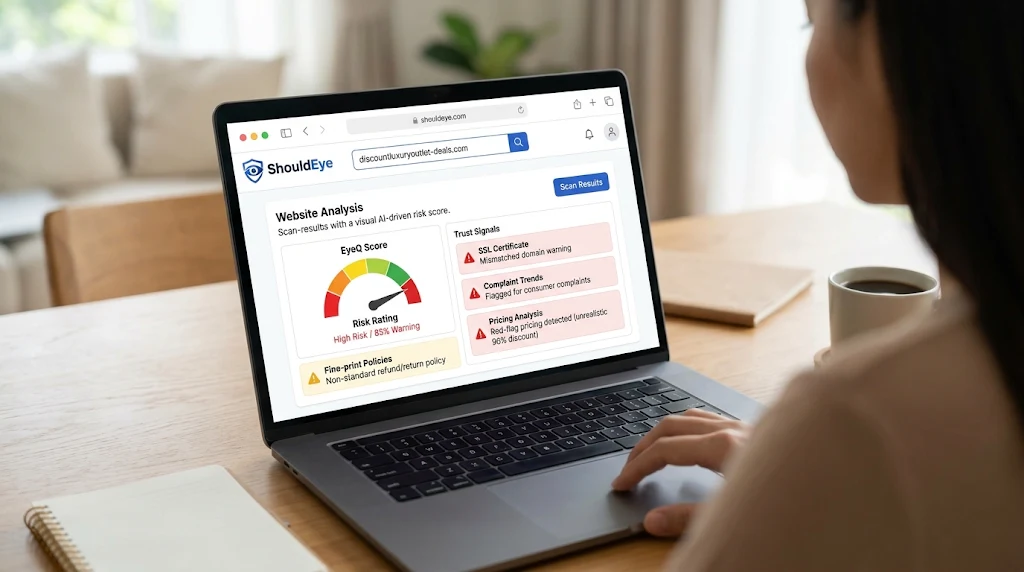
ShouldEye aggregates trust signals across the web, analyzes complaint trends, and parses fine-print policies in seconds. Rather than piecing together clues manually during high-pressure sales events, shoppers rely on ShouldEye and EyeQ to automate their online shopping safety. When you paste a suspect URL into ShouldEye, the platform scans SSL certificates and flags mismatched domain names that often hide counterfeit storefronts. Furthermore, it cross-references the site against known complaint databases to surface red-flag patterns associated with Cyber Monday scams, and extracts return, refund, and shipping terms for quick readability. ShouldEye also compares pricing against verified retailer listings to highlight unrealistic discounts typical of holiday shopping fraud, and provides an AI-driven risk score that blends all of the above into a single, actionable rating.
Using ShouldEye before you click “Buy” turns a gut-feel decision into a data-backed one, allowing you to verify website legitimacy with total confidence and steer clear of fake shopping websites.
Final Thoughts - Verify Before You Click
Cyber Monday’s allure can make us overlook warning signs, but a few deliberate checks can save you from fraud, identity theft, and wasted money. Before you check out, remember to scrutinize price anomalies that point to Cyber Monday scams, verify HTTPS and the exact domain spelling to avoid counterfeit storefronts, and confirm contact details alongside clear policy language. Always use secure payment methods, enable 2FA for lasting online shopping safety, and leverage ShouldEye and EyeQ for an extra layer of verification to prevent holiday shopping fraud.
EyeQ moment: Before you finalize a purchase, run the site through EyeQ to spot hidden fees, ambiguous refund terms, or other risk factors in seconds.
Stay vigilant, shop smart, and enjoy a fraud-free holiday season.
Frequently Asked Questions
LiveReader activity for this article, refreshed by EyeQ AI
- 6 active now
- 145 total asked
- 6 questions
1 What are the most common signs of a fake Cyber Monday website? Trending
- Posted November 18, 2026
- Updated 1m ago
2 Does a padlock icon guarantee a site is legitimate? Trending
- Posted November 18, 2026
- Updated 2m ago
3 Should I use a credit card or a digital wallet for holiday shopping? Popular
- Posted November 18, 2026
- Updated 3m ago
4 How can I quickly check if a deal is too good to be true? Popular
- Posted November 18, 2026
- Updated 4m ago
5 What steps should I take if I think I’ve entered a fake site? Rising
- Posted November 18, 2026
- Updated 5m ago
6 Can ShouldEye verify a website in real time? Rising
- Posted November 18, 2026
- Updated 8m ago
About ShouldEye
ShouldEye is an AI-powered trust intelligence platform that helps people evaluate companies, offers, and online experiences through scam checks, policy analysis, complaint signals, and safer alternatives.
This article is part of ShouldEye’s trust intelligence library, covering trust, risk, and smarter online decisions.