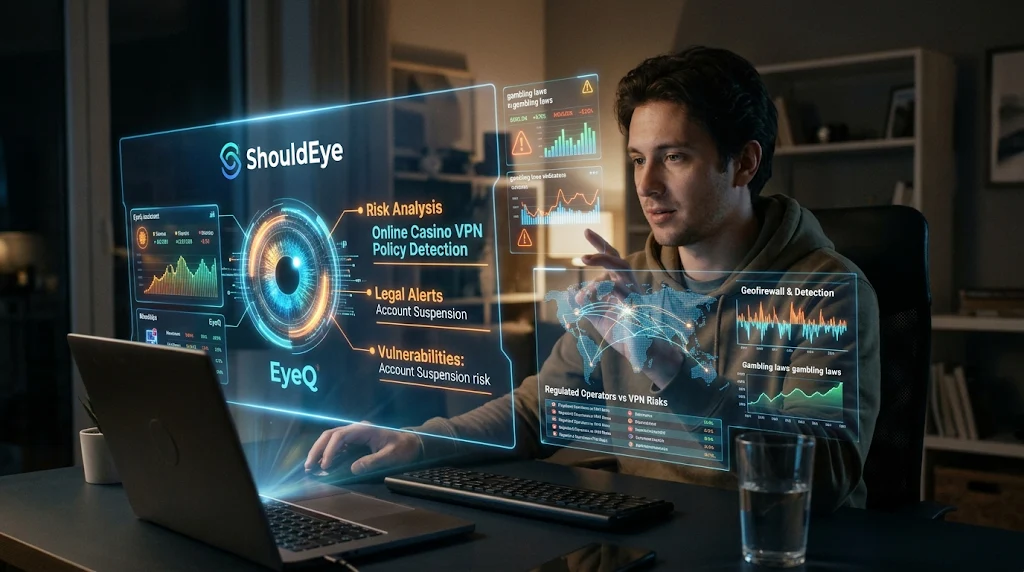
A man interacts with a holographic ShouldEye and EyeQ interface showing online casino VPN policy and suspension risks.
Photo · geminiOnline gambling feels like a click-away thrill, and platforms like ShouldEye and its intelligent assistant EyeQ help players evaluate operators safely, especially when many players wonder whether an online casino VPN can give them a smoother, more private experience. The short answer is: a VPN for online gambling does encrypt your traffic, but it also opens a can of legal, policy, and technical issues that can jeopardize your account and even your winnings. Before risking a sudden casino account suspension, understanding how operators view virtual private networks is essential for anyone placing real-money wagers on the internet. This comprehensive guide walks you through the why, the how, and the what-to-watch-for regarding casino VPN detection and strict VPN gambling laws, so you can decide whether a VPN for online gambling is a smart security tool or a risky shortcut that could cost you your entire bankroll.
Why Players Turn to a VPN for Online Gambling and Casino Gaming
Privacy and Encryption Benefits With an Online Casino VPN
A VPN creates a secure tunnel between your device and the internet. As cybersecurity research from the Electronic Frontier Foundation notes, a VPN encrypts internet traffic, helping keep bets and financial information private from prying eyes. When using a VPN for online gambling, the encrypted connection shields sensitive credit card details, bank transfers, and crypto wallet addresses from third-party snooping. For players on public Wi-Fi at airports, hotels, or cafes, or for individuals living in regions with aggressive data-retention laws, that encryption feels reassuring. Using an online casino VPN also masks your real IP address, which can be useful if you travel frequently for work or leisure and want to keep a consistent gaming profile without triggering automated security lockouts every time you cross a border. However, privacy protection is only one side of the equation when dealing with regulated betting platforms.
Using a VPN to Bypass Casino Geo Restrictions
Some jurisdictions block access to certain gambling sites altogether, while specific game software providers only license their slots and live dealer tables in designated territories. A VPN for online gambling can make it appear as though you are connecting from a permitted country, allowing you to reach a platform that would otherwise be unavailable and effectively bypass casino geo restrictions. Many traveling players try to bypass casino geo restrictions simply to access their existing home accounts while abroad on vacation. However, this perceived convenience collides directly with strict operator policies and regional VPN gambling laws. Even if you successfully bypass casino geo restrictions during the initial registration or deposit phase, operators consistently verify player locations before approving payout requests, turning a temporary workaround into a major financial headache.
Casino Policies on VPN Use and Casino Account Suspension
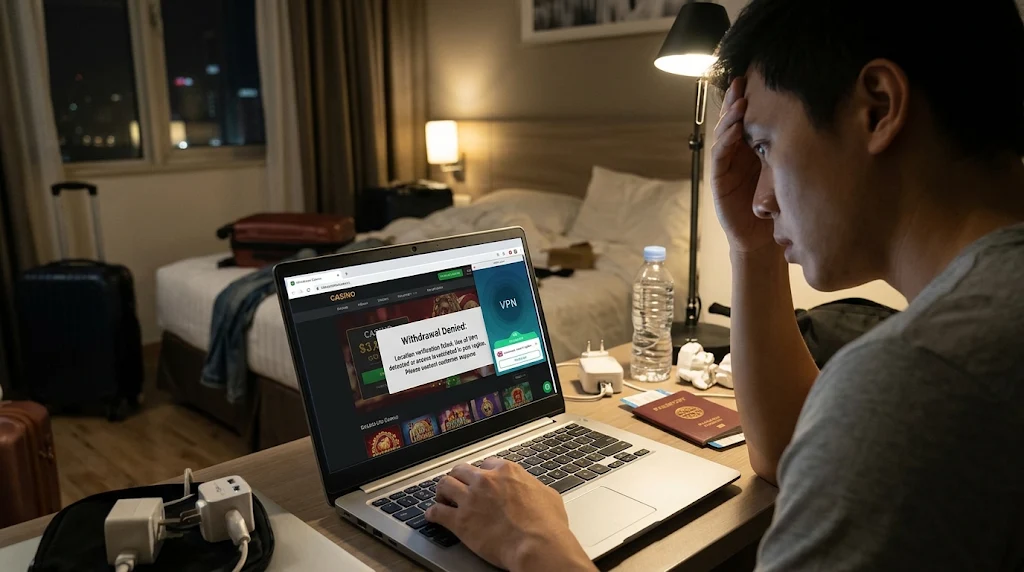
Most licensed online casinos do not openly endorse virtual private networks or proxy servers. Industry compliance research states that no licensed online casino explicitly condones the use of an online casino VPN, and many operators will close accounts and forfeit balances if unauthorized connection masking is discovered.
Because gambling regulators such as the UK Gambling Commission require operators to enforce strict Know Your Customer (KYC) and anti-money laundering protocols, knowing a player's true physical location is a mandatory licensing condition. Consequently, violating a platform's terms of service by attempting to bypass casino geo restrictions can lead to severe administrative penalties, including a permanent casino account suspension or a temporary security lockout while the compliance team investigates your activity. In addition, players often face the complete termination of the gaming profile with the possible forfeiture of any remaining cash balance, alongside the strict withholding of jackpot winnings if the operator deems the policy breach material during a withdrawal review.
Even if a platform advertises itself in forums as friendly toward an online casino VPN, meaning it technically allows basic IP masking during routine gameplay, the fine print almost always contains clauses that reserve the right to issue a casino account suspension for profiles that appear to be using anonymizing services. Operators may happily accept deposits while you use a VPN for online gambling, only to invoke these hidden policy clauses the moment you request a substantial withdrawal. Evaluating these exact terms beforehand with ShouldEye ensures you are never blindsided by unexpected enforcement rules or sudden forfeiture clauses.
✨ Quick Insight
How Operators Execute Casino VPN Detection
Common Casino VPN Detection Methods
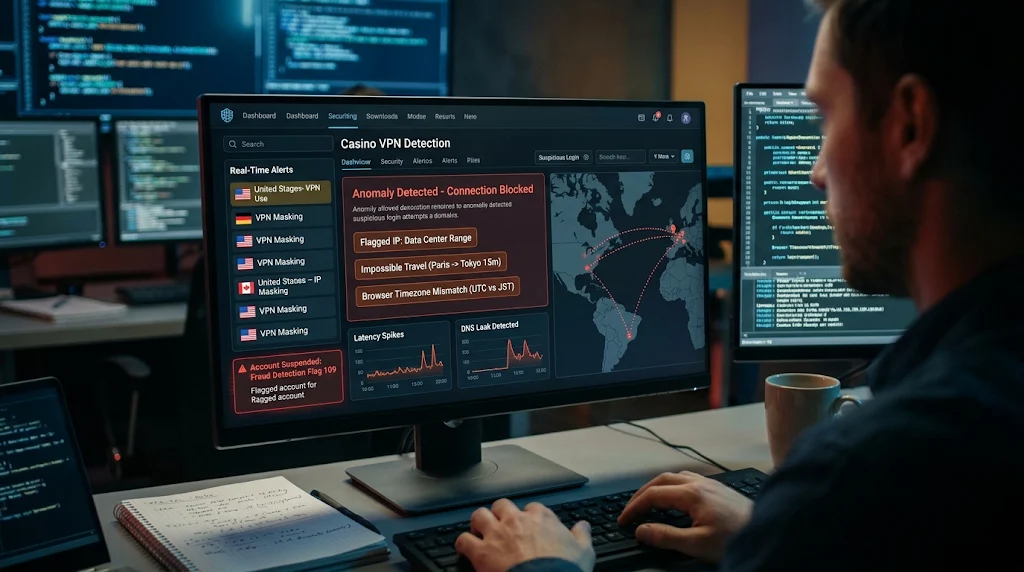
Modern gaming platforms invest heavily in sophisticated anti-fraud tools and geolocation software that look for patterns typical of masked traffic. To stay compliant with international VPN gambling laws, platforms deploy multi-layered casino VPN detection systems that run silently in the background every time you log in or place a bet:
IP fingerprinting checks whether an incoming IP address belongs to known commercial data-center ranges or shared server pools rather than a standard home internet service provider.
Connection speed and protocol anomalies reveal when virtual tunnels introduce latency spikes, packet fragmentation, or specific port signatures that differ from typical residential connections.
Multiple login locations and impossible travel patterns trigger immediate alerts when rapid changes in geographic origin show a player logging in from London and Tokyo within the same hour.
WebRTC, DNS leaks, and browser timezone checks allow casino VPN detection scripts to compare your browser's reported system clock and local network interface against the geographic location of your external IP address.
While the exact proprietary technologies used by major sportsbooks and casinos are not publicly disclosed, technical audits confirm that some premium virtual private networks utilizing superior cloaking technology or dedicated residential IP addresses can occasionally slip past basic casino VPN detection measures. Cloaking, often referred to as obfuscation, attempts to strip away identifiable metadata so that traffic from an online casino VPN looks like ordinary residential browsing. Nevertheless, success is never guaranteed, and failing a single casino VPN detection check during a routine payout audit can still trigger an immediate casino account suspension.
VPN Gambling Laws: Where Virtual Private Networks Meet Local Regulations
United States Regulations and VPN Gambling Laws
Online casino gaming and mobile sports betting are strictly regulated at the state level in the United States, with iGaming currently legal in a select number of U.S. states and sports wagering permitted in over thirty jurisdictions according to the American Gaming Association. Each state gaming control board sets its own licensing and compliance rules, and state VPN gambling laws explicitly prohibit the use of anonymizing tools to mask a player's physical location across state lines. Regulated platforms use mandatory geolocation plugins that triangulate Wi-Fi signals, cellular towers, and GPS data alongside standard casino VPN detection methods. If a state regulator or platform discovers a player attempting to bypass casino geo restrictions using a VPN for online gambling, the operator is legally required to block the session and may be forced to issue a formal casino account suspension to protect its state operating license.
Australia and Strict VPN Gambling Laws
Australian legislation goes a step further under the Interactive Gambling Act, enforced by the Australian Communications and Media Authority. Under Australian VPN gambling laws, providing prohibited interactive gambling services to users located in the country, including those who are hiding behind an online casino VPN, is strictly illegal. This regulatory framework means that offshore operators actively targeting Australian residents face massive statutory fines, ISP blocking, and legal consequences if they allow players to bypass casino geo restrictions. For the individual player, using a VPN for online gambling on unlicensed offshore platforms strips away all consumer protections, leaving you with zero legal recourse if the operator initiates a casino account suspension and confiscates your funds.
Other Global Jurisdictions
The legal status of using a VPN for online gambling outside of Australia and the United States varies significantly across Europe, Asia, and Latin America. In some territories, national VPN gambling laws penalize only the unlicensed operator, while in more restrictive nations, accessing gambling portals through an online casino VPN can violate both telecommunications statutes and local wagering bans. Because international enforcement is constantly evolving, players should always consult local regulations, verify licensing registries, or use ShouldEye and EyeQ to inspect regional operator rules before relying on any software to bypass casino geo restrictions.
⚡ Reality Check
- Encryption vs. Policy: A VPN encrypts data, but it does not override a casino’s terms of service.
- Account Risk: Detected VPN use can trigger suspension, termination, or forfeiture of balances.
- Legal Variance: Only 17 U.S. states allow online gambling, and some jurisdictions ban VPN‑based gambling entirely.
Practical Steps Before You Use a VPN for Online Gambling
Read the operator's terms of service thoroughly by looking for any explicit mention of an online casino VPN, proxy servers, anonymizers, or IP-masking restrictions that could trigger a penalty.
Check the local jurisdiction and applicable VPN gambling laws to verify that online wagering is legally permitted in your current physical location and that the platform holds a valid regulatory license for that specific region.
Research the platform's player complaint history on independent watchdogs like ShouldEye, since frequent reports of a sudden casino account suspension or voided payouts for VPN use are a major red flag.
Test the software's cloaking and leak-protection features if you are permitted to use one for privacy, because not all providers are equal and simple DNS leaks will immediately trigger automated casino VPN detection tools.
Use a reputable cybersecurity provider, and while industry reviews often highlight services like NordVPN as a commonly cited option for general encryption, avoid assuming any commercial service guarantees immunity from casino VPN detection or compliance checks.
Consider the overall risk-reward balance carefully, because if a platform explicitly forbids virtual private networks, the potential loss of your entire deposit and winnings through a casino account suspension far outweighs the temporary privacy benefit.
How ShouldEye and EyeQ Help You Check Casino VPN Policies
How ShouldEye Helps You Avoid Casino Account Suspension
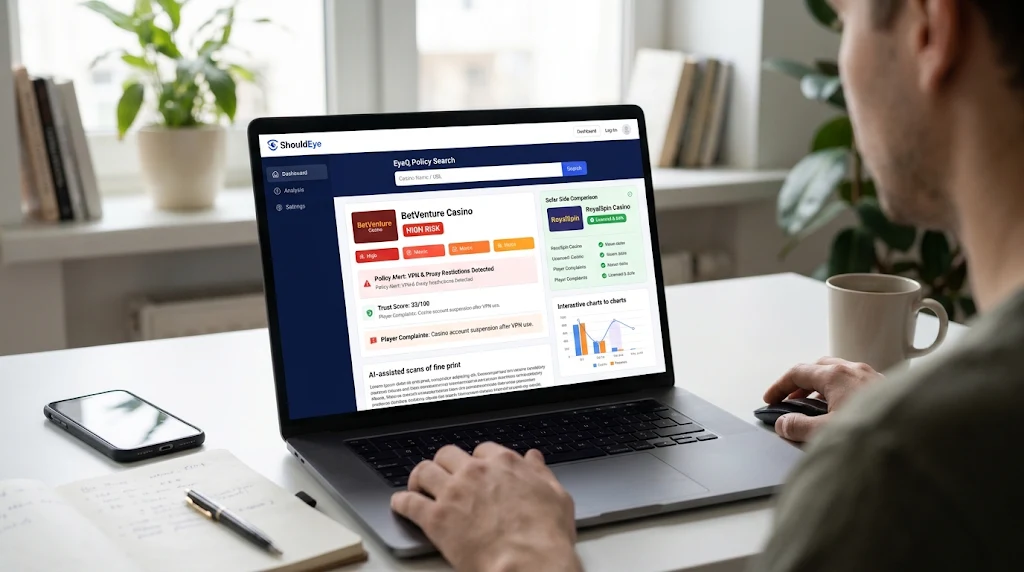
Navigating dense legal documents across dozens of betting sites takes hours of manual reading, which is why ShouldEye aggregates real-time trust signals, verified player complaint trends, and specific policy clauses across thousands of online gambling platforms. By entering a casino's name into ShouldEye, you can instantly see whether the terms of service mention an online casino VPN or proxy restrictions, alongside recent user complaints about a sudden casino account suspension linked to suspected IP masking.
Furthermore, ShouldEye displays the exact jurisdictional licensing information, highlights relevant VPN gambling laws or legal alerts, and provides a side-by-side comparison of alternative regulated operators that are known to have clearer, more transparent security policies. The ShouldEye platform also runs automated AI-assisted scans of fine-print language, flagging hidden predatory clauses that could affect your ability to withdraw legitimate winnings after triggering casino VPN detection systems.
EyeQ in Action for Instant Policy Analysis
When you are unsure if a particular operator's privacy policy aligns with your digital security needs, you can ask EyeQ to pull the latest terms and highlight any language related to a VPN for online gambling. Instead of guessing whether attempting to bypass casino geo restrictions or simply securing your public Wi-Fi connection will violate the rules, a quick query in EyeQ surfaces the exact paragraph that could lead to a permanent casino account suspension. By combining the deep database of ShouldEye with the instant conversational analysis of EyeQ, you can spot strict casino VPN detection policies before depositing a single dollar, saving you from costly surprises and locked funds.
A virtual private network can effectively protect your personal data on unsecured networks, but an online casino VPN does not shield you from strict operator policies or regional VPN gambling laws. Many licensed operators explicitly forbid trying to bypass casino geo restrictions and deploy advanced casino VPN detection software to monitor incoming traffic, which frequently results in a permanent casino account suspension and the forfeiture of player balances. Legal restrictions vary widely across the globe, with Australia outright banning offshore access and the United States permitting regulated play only within tightly geofenced state borders.
Before you click connect on a VPN for online gambling, always verify the operator's terms, review historical complaint patterns, and consider the jurisdiction you are playing from. Leveraging transparent research tools like ShouldEye and EyeQ gives you a factual, data-driven view of the hidden risks, helping you make a smarter, safer decision every time you play online. Ready to double-check a casino's policy before risking your bankroll? Use ShouldEye and EyeQ today to scan the fine print and compare operator trust signals in seconds.
Frequently Asked Questions
LiveReader activity for this article, refreshed by EyeQ AI
- 6 active now
- 296 total asked
- 6 questions
1 Can I use a VPN to access an online casino from a restricted country? Trending
- Posted November 18, 2026
- Updated 1m ago
2 Will a VPN protect my winnings from being seized? Trending
- Posted November 18, 2026
- Updated 2m ago
3 Are there any online casinos that openly allow VPN use? Popular
- Posted November 18, 2026
- Updated 3m ago
4 Does using a VPN make gambling illegal in my country? Popular
- Posted November 18, 2026
- Updated 4m ago
5 How can I tell if a casino has detected my VPN? Rising
- Posted November 18, 2026
- Updated 5m ago
6 Is NordVPN the only VPN recommended for casino play? Rising
- Posted November 18, 2026
- Updated 8m ago
About ShouldEye
ShouldEye is an AI-powered trust intelligence platform that helps people evaluate companies, offers, and online experiences through scam checks, policy analysis, complaint signals, and safer alternatives.
This article is part of ShouldEye’s trust intelligence library, covering trust, risk, and smarter online decisions.