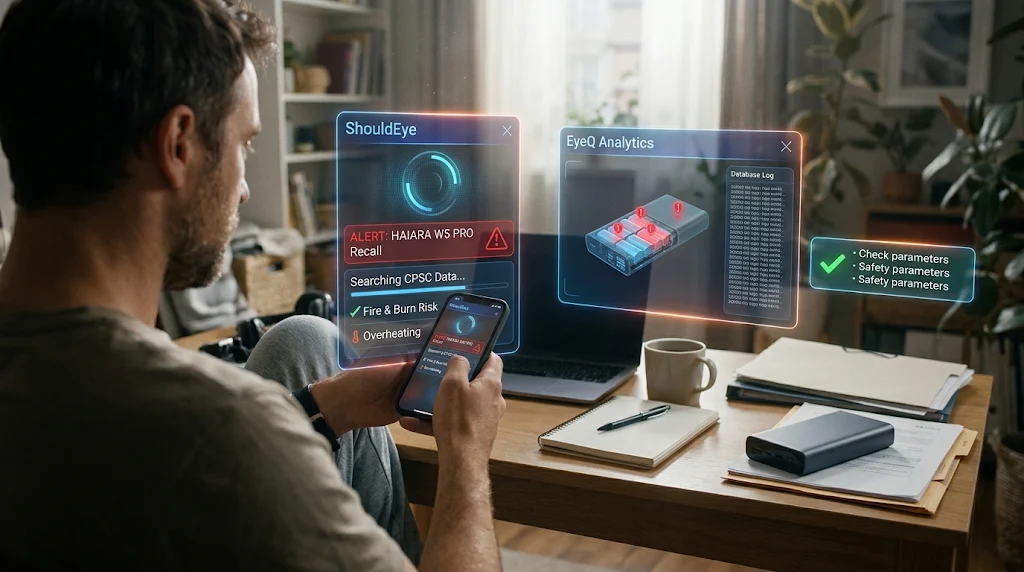
A man checks holographic ShouldEye and EyeQ screens via his phone to verify a HAIARA W5 PRO power bank recall alert.
Photo · geminiA sudden recall can feel like a surprise party you never wanted, which is why tools like ShouldEye and EyeQ are essential for tracking a HAIARA power bank recall before an accident happens. In late 2026, the U.S. Consumer Product Safety Commission (CPSC) issued a voluntary recall for the HAIARA W5 PRO lithium-ion power bank after reports of fire, explosion, and burn injuries. If you own one, bought one recently, or are simply browsing online marketplace listings, you need a clear roadmap to confirm whether you are at risk from a lithium-ion battery fire hazard and what steps to take next. This comprehensive guide walks you through the verified facts, shows you how to verify product recall details, highlights deceptive red-flag language in safety notices, and explains how ShouldEye and EyeQ can make the entire portable charger safety verification process completely painless.
What Triggered the CPSC Product Alert and HAIARA Power Bank Recall?
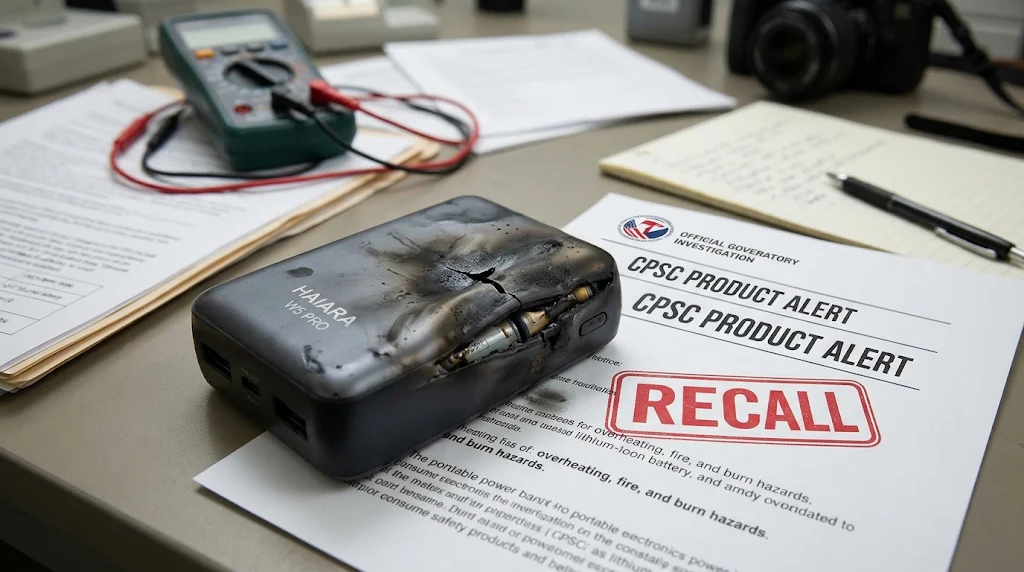
The CPSC investigation uncovered 600 distinct reports of overheating incidents involving the HAIARA W5 PRO model across the country. Among those documented complaints, three severe burn injuries and nine separate property-damage incidents were officially recorded by investigators. The federal agency notice stresses that the internal battery pack can unexpectedly explode and ignite during normal operation or charging, creating a severe lithium-ion battery fire hazard that can cause serious bodily injury or death to unsuspecting consumers. When a CPSC product alert reaches this volume of incident reports, taking immediate preventative action is critical for every household.
Marketplace Distribution of the HAIARA W5 PRO
The HAIARA power bank recall covers portable charging units sold primarily through Amazon.com and a secondary electronics marketplace, Newegg.com, totaling roughly 210,000 affected units distributed between January 2025 and October 2026. The defective charging products were manufactured in China, and the original manufacturer has not yet responded to official CPSC requests for additional safety-testing information or supply-chain tracking. Because third-party marketplace inventories frequently move across different fulfillment centers, using EyeQ to trace seller histories helps shoppers maintain high standards of portable charger safety when ordering electronics online.
How to Identify a Recalled HAIARA W5 PRO Unit
Official CPSC product alert bulletins always include specific visual identifiers to help consumers inspect their hardware safely at home. For the HAIARA W5 PRO, look closely for the following physical markings printed on the exterior casing:
A red sticker on the back panel that reads "Recall - Do Not Use".
The model number printed as W5 PRO (other HAIARA models are not mentioned in the notice).
A batch code that matches the range listed on the CPSC website (the notice provides a short numeric range; you can verify it online).
If your device is missing any of these identifying elements, the charging unit is likely not part of the specific HAIARA power bank recall. However, because the official notice does not confirm whether other companion models from the same brand are affected by similar manufacturing flaws, you should treat any unit from this manufacturer with extreme caution until you verify product recall records thoroughly through ShouldEye.
⚡ Reality Check
- Recall scope: Only the HAIARA W5 PRO model is listed; other models are not confirmed.
- Manufacturer response: The Chinese manufacturer has not replied to CPSC information requests.
- Refund details: The notice does not state whether refunds or replacements are offered.
- Disposal guidance: Specific local hazardous‑waste sites are not listed in the recall.
Steps to Verify Product Recall Notices and Protect Yourself
When you need to verify product recall status accurately, following a structured inspection routine keeps your home protected from a potential lithium-ion battery fire hazard. First, check the official CPSC page, where the regulatory agency publishes a dedicated recall portal with downloadable PDFs of the notice and a searchable product database that you should bookmark for future reference. Second, locate your digital purchase record by opening your Amazon.com order history or the electronic receipt from another online retailer, making sure to check the specific seller name since many recalled HAIARA W5 PRO units were sold directly by Mitrytech on Amazon.
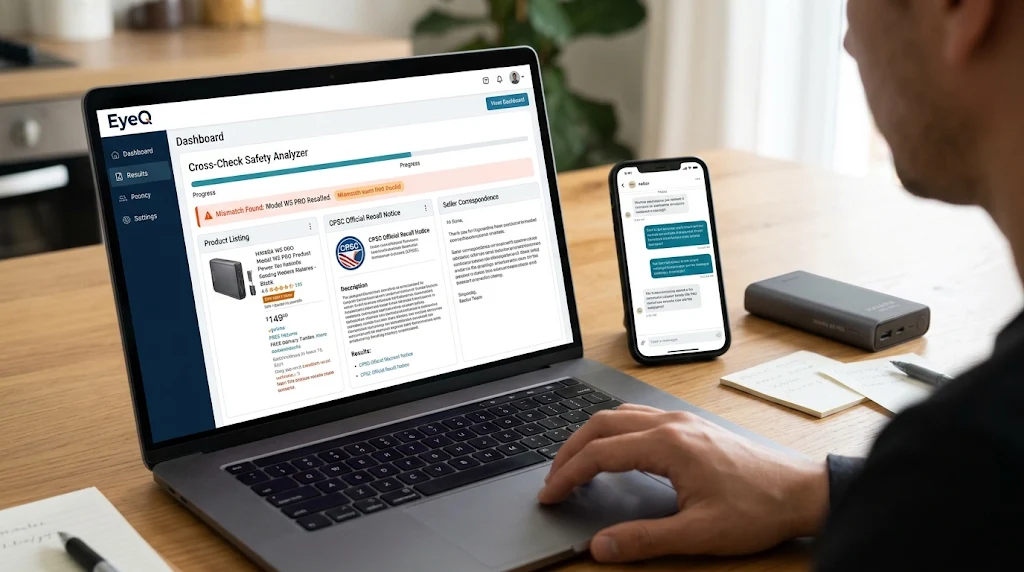
Using EyeQ to Cross-Check Portable Charger Safety
Third, match the serial and batch numbers on your physical casing with the affected range published on the government site, and if your numbers fall inside the recalled range, stop using the device immediately. Fourth, contact the marketplace seller directly through the platform messaging system to ask for written confirmation of the HAIARA power bank recall status and request formal return or disposal instructions. Fifth, document all communication by keeping timestamped screenshots of the seller response alongside the CPSC product alert, as this paper trail is vital if you later need to file a formal complaint with the Federal Trade Commission (FTC).
Sixth, use EyeQ for a quick automated cross-check to compare the product listing, the official recall notice, and seller statements in seconds so the AI can surface hidden mismatches and flag missing portable charger safety information. Finally, dispose of the unit safely rather than throwing it in the regular household trash by locating a certified municipal facility through the Environmental Protection Agency (EPA) household hazardous waste portal and following their strict drop-off instructions.
Common Red Flags in a CPSC Product Alert
Official recall notices can sometimes leave gaps when manufacturers fail to cooperate, and opportunistic scammers occasionally mimic government safety language to trick consumers. Keep a sharp eye out for missing refund or replacement details, especially since the current HAIARA W5 PRO notice does not state whether a financial refund or hardware replacement program is actively offered by the company. If an unverified third-party seller promises an instant cash refund without referencing the official CPSC product alert, you should verify product recall claims independently using ShouldEye before sharing any personal banking details.
Another major warning sign is an unclear model scope within seller communications. The federal notice only mentions the HAIARA W5 PRO model, so any blanket claim by a merchant that all other chargers from the brand are completely free from a lithium-ion battery fire hazard should be treated skeptically until the factory provides an updated engineering statement. Additionally, watch out for the absence of proper disposal guidance or sudden pressure to buy discounted stock quickly. Some third-party merchants attempt to offload remaining warehouse inventory before a HAIARA power bank recall becomes widely known, making sudden price drops or urgent limited-stock claims a major threat to portable charger safety.
✨ Quick Verification Checklist
How ShouldEye Helps You Verify Product Recall Data
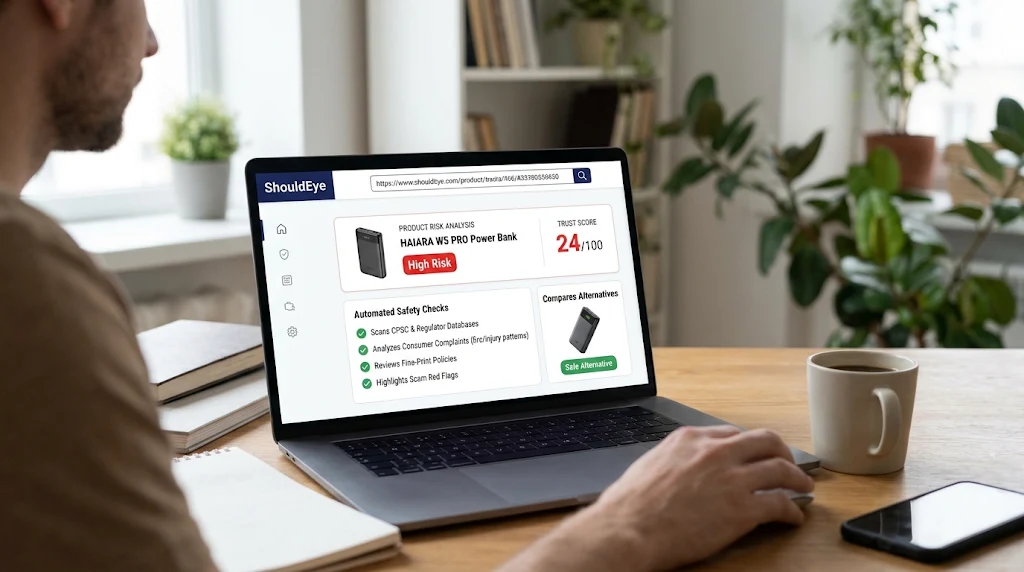
ShouldEye aggregates real-time trust signals from federal government agencies, national consumer complaint databases, and global marketplace listings into a single dashboard. When you paste a suspicious product name or retail URL into the search bar to verify product recall histories, the platform automatically performs several vital safety checks:
Scans CPSC and other regulator databases for official recall notices.
Analyzes consumer complaints to surface patterns of fire, explosion, or injury.
Reviews fine-print policies for return, refund, and disposal clauses.
Compares alternatives so you can see safer power-bank options side-by-side.
Highlights red-flag language that often precedes scams, such as missing warranty details or vague "best-price" promises.
All of this deep data analysis is powered by advanced AI, meaning you get a concise, easy-to-read risk score and an actionable portable charger safety checklist within minutes. Pairing ShouldEye with EyeQ ensures that no hidden CPSC product alert or unreported lithium-ion battery fire hazard slips past your radar while shopping.
What to Do With a Recalled Power Bank and Safer Choices
Managing a Lithium-Ion Battery Fire Hazard Safely
If you discover that your device is part of the HAIARA power bank recall, you must stop using it and unplug it immediately because even if the outer plastic casing looks completely fine, the internal chemical cell may already be degraded and unstable. Seal the deactivated unit inside a fireproof container, such as a heavy metal box or a specialized thermal containment bag filled with sand, to prevent accidental ignition during storage or transport. Take the sealed container directly to an authorized hazardous-waste drop-off center by searching Call2Recycle or your municipal sanitation portal for electronic battery disposal sites, and always keep a dated photo or receipt as permanent proof of safe disposal.
Selecting Certified Devices for Portable Charger Safety
When you are ready to replace your recalled HAIARA W5 PRO with a dependable backup charger, prioritize portable charger safety by selecting hardware tested by recognized laboratories like UL Solutions. Always look for power banks that carry genuine UL or CE certification markings for battery stability, offer a transparent manufacturer warranty that explicitly includes a recall protection clause, and are sold directly by the original brand rather than anonymous marketplace liquidators. Transparent technical specifications detailing exact milliampere-hour capacity, lithium cell chemistry, and overcharge protection circuits are essential indicators of quality. Furthermore, because the original recall notice does not guarantee a manufacturer replacement program and visual inspections can never rule out internal thermal runaway, consumers who bought units on secondary marketplaces should rely on EyeQ and ShouldEye to audit seller return policies and cross-reference every serial number against the federal CPSC product alert database.
Final Thoughts on Portable Charger Safety
The HAIARA W5 PRO recall underscores just how quickly an everyday electronic accessory can transform into a severe lithium-ion battery fire hazard inside your home or travel bag. By taking the time to verify product recall notices, checking batch numbers carefully, and utilizing automated verification tools like ShouldEye and EyeQ, you can protect your family and avoid costly property damage or burn injuries. Before you purchase your next mobile accessory, ask EyeQ to scan the item safety record and let ShouldEye compare the listing against every active HAIARA power bank recall and CPSC product alert so that a few seconds of digital verification saves you from a dangerous fire nightmare.
Frequently Asked Questions
LiveReader activity for this article, refreshed by EyeQ AI
- 5 active now
- 116 total asked
- 5 questions
1 Is the HAIARA W5 PRO recall mandatory? Trending
- Posted November 18, 2026
- Updated 1m ago
2 Can I still use my HAIARA power bank if it looks fine? Trending
- Posted November 18, 2026
- Updated 2m ago
3 What should I do if I bought the power bank on a marketplace other than Amazon? Popular
- Posted November 18, 2026
- Updated 3m ago
4 How can I find my local hazardous‑waste disposal site? Popular
- Posted November 18, 2026
- Updated 4m ago
5 Will the manufacturer replace the recalled units? Rising
- Posted November 18, 2026
- Updated 5m ago
About ShouldEye
ShouldEye is an AI-powered trust intelligence platform that helps people evaluate companies, offers, and online experiences through scam checks, policy analysis, complaint signals, and safer alternatives.
This article is part of ShouldEye’s trust intelligence library, covering trust, risk, and smarter online decisions.