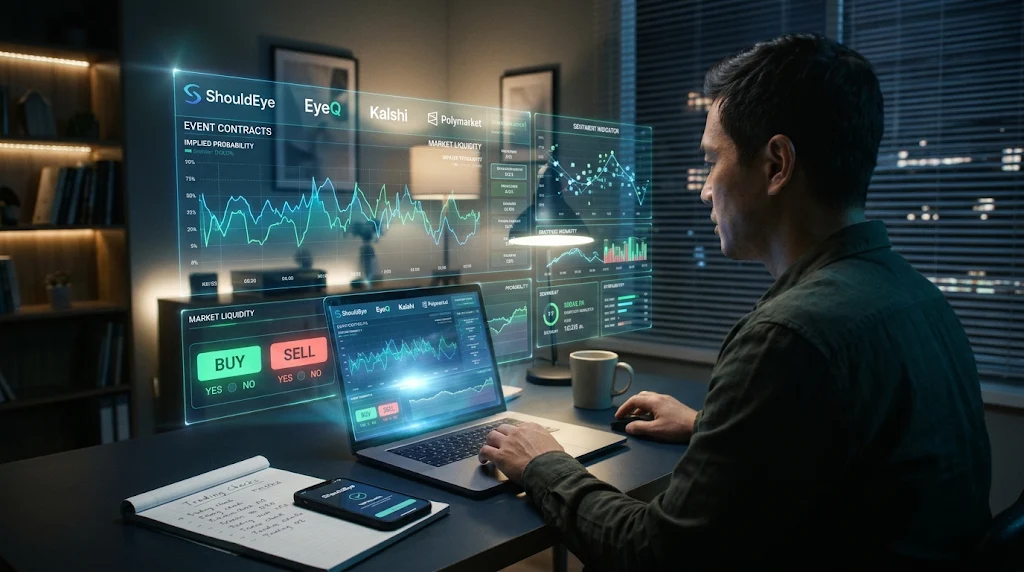
A man in a dimly lit office analyzing prediction market holograms with charts, "Buy/Sell" indicators, and ShouldEye metrics.
Photo · geminiFirst-time traders often think a prediction market is just a fancy poll, which is why using ShouldEye and EyeQ early on is critical for protecting your bankroll. The reality is far messier: you are buying and selling event contracts that encode probabilities, and every misstep can turn a small stake into a loss. When evaluating these financial instruments, understanding implied probability and market liquidity is essential before risking capital on any platform reputation. In this guide, we unpack ten recurring prediction market mistakes, explain why they happen to first-time traders, and give you concrete checks you can run with EyeQ and ShouldEye before you click "Buy". The goal is not to promise profit since most prediction market traders lose money, but to arm you with a verification mindset that keeps you from the most common traps when trading event contracts.
Common Prediction Market Mistakes With Implied Probability
Mistake #1 - Letting Headlines Drive Your Trade
"Most prediction market mistakes trace back to one root cause: reacting to a headline instead of a probability." - Source
News cycles are loud, but a headline rarely reflects the nuanced odds a market is pricing in. Jumping on a story because it is trending often means you are buying event contracts at inflated prices. Instead, pause, read the current implied probability of the contract, and compare it to your own assessment. Many first-time traders fail to realize that breaking news is already factored into the order book by automated algorithms and seasoned participants within seconds of publication. When you react emotionally to a breaking alert, you are usually providing exit market liquidity for sharper traders who bought in long before the story went mainstream. Using EyeQ to analyze historical price action around major news events helps you see whether a sudden spike represents genuine fundamental movement or temporary retail overreaction.
Mistake #2 - Trading on What You Want to Happen
"Mistake #1: Taking a position based on what you want to happen." - Source
Emotions are powerful nudges that lead to costly prediction market mistakes. Wanting a sports team to win or a political outcome to align with your personal beliefs can blind you to the actual odds and true implied probability. Treat the market like a statistical model, not a wish list. Cognitive biases such as optimism bias and confirmation bias frequently push first-time traders into purchasing event contracts that have virtually no mathematical edge. Researchers studying behavioral finance at institutions like the CFA Institute have long documented how emotional attachment distorts risk assessment in speculative environments. Before committing funds, ask yourself whether you would still take the same position if the names or political parties on the contract were completely reversed. If the answer is no, step back and let ShouldEye provide an objective, emotion-free assessment of the underlying data.
Mistake #3 - Over-Betting on the "Yes" Option
"Average users lose money by over-betting on 'yes', which could simply be because 'yes' is green and listed first, design cues that nudge people towards clicking." - Source
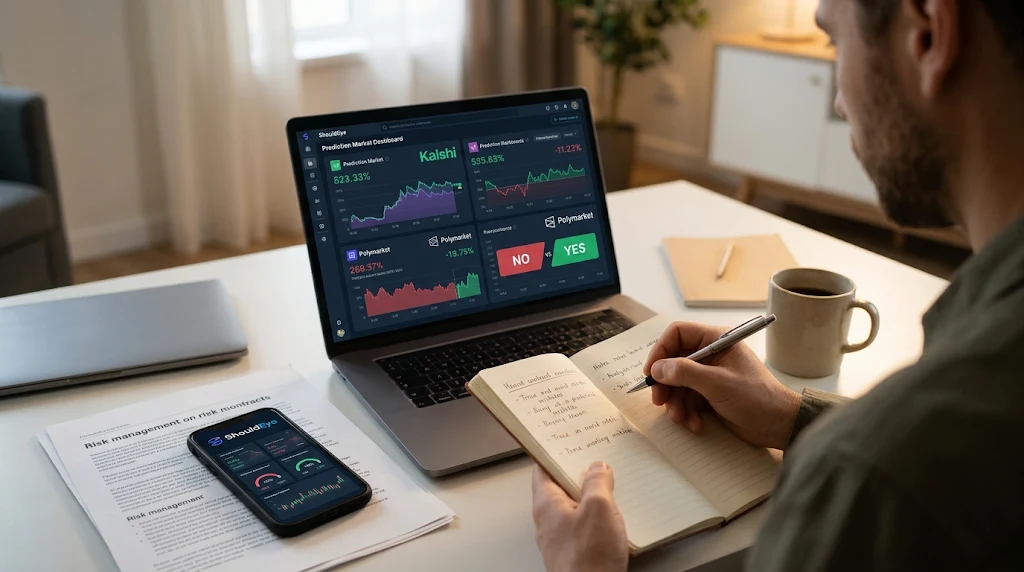
Many platforms highlight the affirmative choice with bright colors or place it first in the user interface. This subtle design cue pushes first-time traders toward the "yes" contract, even when the odds and implied probability do not justify the stake. Always double-check the implied probability and consider taking the opposite side of the trade. In binary event contracts, buying a "no" share is mathematically identical to shorting a "yes" share, yet retail participants overwhelmingly gravitate toward affirmative outcomes. This structural imbalance often creates pricing inefficiencies where "no" contracts offer superior expected value for disciplined participants who know how to avoid basic prediction market mistakes. By checking platform design patterns through ShouldEye, you can identify whether an interface is actively using behavioral nudges to steer your trading activity toward unfavorable positions.
Mistake #4 - Over-Estimating Low-Probability Events
"Average users also consistently overestimate the likelihood of low probabilities." - Source
Rare events such as surprise election outcomes or sudden market crashes are tempting to bet on because of the high potential payout. Yet most beginners inflate those odds, leading to frequent losses and avoidable prediction market mistakes. In economics, this phenomenon is widely known as the favorite-longshot bias, where speculative participants systematically overvalue penny contracts priced at two or three cents while undervaluing high-probability outcomes. When first-time traders buy cheap event contracts, they often view a five-cent price tag as a harmless lottery ticket rather than calculating whether the true implied probability is actually closer to half a percent. Use historical data where available, consult EyeQ to evaluate baseline statistical frequencies, and treat low-probability contracts with extra caution so your portfolio does not bleed out through dozens of small losses.
✨ Key Insight
Market Liquidity and Platform Reputation Risks for First-Time Traders
Mistake #5 - Ignoring Market Liquidity
Market liquidity determines how easily you can enter or exit a position without moving the price against yourself. Thin markets can trap your capital, and you may be forced to sell your event contracts at a steep discount if you need to close early. Before committing a single dollar, check the order-book depth, bid-ask spread, and recent volume. Many first-time traders look only at the last traded price displayed on the main dashboard without realizing that there are almost no active buyers or sellers waiting in the queue. If a contract displays an implied probability of fifty percent based on a last trade from three days ago, but the current bid sits at thirty cents and the ask sits at seventy cents, entering that market immediately puts you at a massive mathematical disadvantage. You can use ShouldEye to monitor overall volume metrics and verify that sufficient market liquidity exists before locking up your funds.
Mistake #6 - Assuming All Participants Are Sophisticated Investors
"Every market participant is not a savvy investor." - Source
Prediction markets attract hobbyists, journalists, and casual bettors alongside quantitative professionals. The crowd's collective knowledge can be remarkably noisy, especially in niche or newly launched categories with low market liquidity. Do not assume the market price always reflects expert consensus, because sometimes it simply reflects temporary herd behavior or coordinated social media hype. While academic literature from sources like the National Bureau of Economic Research highlights the accuracy of liquid forecasting markets over the long run, thin event contracts are easily skewed by a single whale or a vocal community pushing a narrative. Smart traders use EyeQ to separate genuine institutional volume from retail noise, preventing prediction market mistakes caused by blindly following the crowd.

Mistake #7 - Skipping the Fine Print on Fees and Settlement Rules
Fees can quietly eat into your expected return, especially on short-term event contracts where margins are already razor thin. Furthermore, settlement timelines and resolution criteria vary wildly across providers; some markets resolve only after an official government announcement or specific media consensus, which can delay payouts for weeks or invalidate your winning thesis entirely on a technicality. One of the most frustrating prediction market mistakes occurs when first-time traders correctly predict a real-world event, only to lose their money because the contract resolution rules specified a particular data source that reported differently. Always ask EyeQ to break down the fine print, oracle resolution sources, and hidden transaction fees of the platform before you place a trade, ensuring that a poorly worded contract does not ruin a correct forecast.
Mistake #8 - Forgetting Regulatory and Tax Implications
The initial excitement of trading often masks legal and financial considerations, but they matter immensely for your bottom line. Depending on where you live, regulatory bodies like the Commodity Futures Trading Commission oversee regulated event contracts, while offshore venues operate in legal gray areas that carry severe counterparty risks. Additionally, some tax jurisdictions and guidelines from the Internal Revenue Service treat prediction market winnings as ordinary gambling income, while others classify them under complex capital gains or commodities rules. Ignoring these structural realities is one of the most consequential prediction market mistakes you can make, leading to unexpected tax bills, frozen withdrawals, or sudden account closures. Checking platform reputation on ShouldEye ensures you understand the exact legal standing and compliance history of a venue before linking your bank account.
⚡ Reality Check
- Mistake frequency: The sources do not enumerate a definitive list of ten distinct beginner mistakes, so frequency data is unavailable.
- Trader outcomes: The majority of prediction market traders will lose money, regardless of experience level.
- Regulatory clarity: Regulatory or legal considerations for participating in prediction markets are not discussed in the source material.
- Platform coverage: Only Kalshi and Polymarket are mentioned; other platforms may have different risk profiles.
Mistake #9 - Over-Confidence After a Few Wins
A small early profit can create a dangerous, false sense of skill among first-time traders. Remember that the vast majority of retail prediction market traders will lose money over a large sample size. Variance plays a massive role in short-term outcomes; winning three binary bets in a row where the implied probability was fifty percent happens to one out of every eight beginners purely by chance. When traders mistake lucky variance for superior forecasting ability, they typically increase their position sizes dramatically and ignore basic risk management rules. Treat each trade as a disciplined statistical experiment, not a personal confirmation of expertise, and rely on ShouldEye to keep your verification habits grounded in hard data rather than recent emotional highs.
Mistake #10 - Not Verifying Platform Reputation
Only two major platforms, Kalshi and Polymarket, are mentioned in the primary source material, but dozens of smaller alternatives exist across both centralized and decentralized networks. Before you deposit funds anywhere, thoroughly research user complaints, licensing status, market liquidity depth, and any history of disputed settlements or market manipulation. A weak platform reputation is a massive red flag regardless of how attractive the odds look on screen. Use EyeQ and ShouldEye to compare trust signals, regulatory compliance, and the complaint history of Kalshi versus Polymarket before committing funds to any event contracts.
How ShouldEye and EyeQ Help You Verify Event Contracts
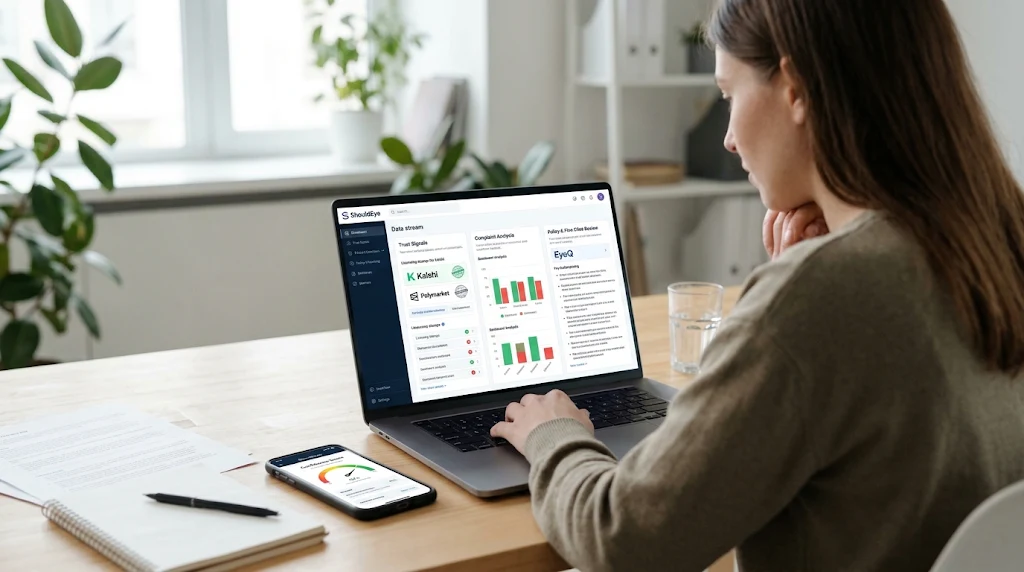
ShouldEye aggregates three core data streams that directly address the pitfalls above and protect you from expensive prediction market mistakes. First, our Trust Signals engine compiles official licensing information, regulatory filings, and third-party security audits for major platforms like Kalshi and Polymarket so you can confirm platform reputation instantly. Second, our Complaint Analysis system processes sentiment-filtered reviews from independent trading forums, consumer protection agencies like the Consumer Financial Protection Bureau, and social media channels to surface recurring pain points such as sudden payout delays, frozen accounts, or deceptive user interface nudges. Third, our Policy and Fine-Print Review uses EyeQ for AI-driven parsing of complex fee schedules, oracle settlement rules, and withdrawal limits, allowing you to spot hidden costs before you trade.
Combine these deep analytical insights with the ShouldEye alternatives comparison tool to see how different venues stack up on real-time market liquidity, fee transparency, and overall user satisfaction. The result is a comprehensive, data-backed confidence score that lets first-time traders decide whether a specific market is genuinely worth their hard-earned capital.
Quick Checklist for First-Time Traders
Verify the platform reputation, licensing, and regulatory status on ShouldEye before depositing money.
Look closely at recent market liquidity, bid-ask spreads, and order volume for the specific event contracts you want to trade.
Compare the market implied probability to an independent statistical assessment rather than trading on gut feelings or headlines.
Read the complete fee schedule and exact settlement timeline, or use EyeQ for a quick, accurate summary of the contract rules.
Scan recent user complaints for red flags around withdrawal delays, disputed resolutions, or manipulative user interface nudges.
Keep a detailed trading journal of each position to track your accuracy and avoid over-confidence bias after early wins.
By treating every single trade as a rigorous verification exercise, you turn a high-risk speculative hobby into a disciplined, data-driven activity. Ready to put this checklist into practice and eliminate costly prediction market mistakes? Head over to ShouldEye today, run a quick platform scan with EyeQ, and let our AI do the heavy lifting before your next trade.
Frequently Asked Questions
LiveReader activity for this article, refreshed by EyeQ AI
- 5 active now
- 116 total asked
- 5 questions
1 What is a prediction market? Trending
- Posted November 18, 2026
- Updated 1m ago
2 Why do most beginners lose money in prediction markets? Trending
- Posted November 18, 2026
- Updated 2m ago
3 How can I avoid over‑betting on the ‘yes’ option? Popular
- Posted November 18, 2026
- Updated 3m ago
4 Are Kalshi and Polymarket regulated? Popular
- Posted November 18, 2026
- Updated 4m ago
5 What should I verify before joining a prediction market? Rising
- Posted November 18, 2026
- Updated 5m ago
About ShouldEye
ShouldEye is an AI-powered trust intelligence platform that helps people evaluate companies, offers, and online experiences through scam checks, policy analysis, complaint signals, and safer alternatives.
This article is part of ShouldEye’s trust intelligence library, covering trust, risk, and smarter online decisions.