
A man at a laptop in a dimly lit home office analyzes prediction markets with ShouldEye and EyeQ holographic data overlays.
Photo · geminiWhen you open a Kalshi contract, the excitement of predicting an event can quickly eclipse the fine print, which is why utilizing ShouldEye and EyeQ to analyze Kalshi market rules is essential for modern traders. The platform’s unique design, settling every contract all-or-nothing and granting the operator a regulator-filed power to tweak contract specifications after the first day, means that a single misunderstood rule can turn a $10 premium into a full-dollar loss in any prediction market.
This guide explains the mechanics that matter, shows where the hidden risks hide, and gives you a practical checklist before you click Buy or Sell. By integrating tools like ShouldEye and EyeQ into your daily trading workflow, you can examine the exact Kalshi market rules and contract specifications that govern every single binary outcome. Relying on raw intuition within a prediction market often leads to avoidable errors, especially when market equilibrium and the quote-driven model shift rapidly.
The All-Or-Nothing Payoff Structure and Binary Outcome
Kalshi contracts do not pay out proportionally to how close your prediction was. Instead, they settle all-or-nothing: either the contract resolves at $1 (you win the full dollar) or $0 (you lose the entire dollar). As the Oddsshopper article notes, a misread strike “flips the entire dollar” rather than costing you a few points. This binary outcome amplifies the importance of knowing exactly what the contract defines as a Yes or No event within the broader prediction market.
When you evaluate a binary outcome, you must read the Kalshi market rules thoroughly so that your capital is protected. Every trader using ShouldEye knows that a binary outcome leaves zero room for ambiguity in the contract specifications. If you fail to verify how the binary outcome is triggered, the all-or-nothing structure will punish even the smallest oversight.

Why Opinion Alone Isn’t Enough for Contract Specifications
Your gut feeling about a political election or a commodity price can be sharp, but it does not replace the contract’s legal definition inside the Kalshi market rules. A headline that says “inflation will rise above 3%” might seem straightforward, yet the market rule could specify a specific Bureau of Labor Statistics CPI release or a certain measurement methodology within the contract specifications. Ignoring that nuance means you’re betting on a definition you haven’t verified. Before entering a prediction market, smart investors consult EyeQ to review the exact contract specifications and ensure their thesis aligns with the official data settlement source. Opinion cannot override legal text when a binary outcome is on the line.
Post-Trade Rule-Change Power in Kalshi Market Rules
Kalshi is authorized by the Commodity Futures Trading Commission (CFTC) to change any associated contract specifications after the first day of trading. The only condition is that the change be disclosed on the platform’s website. This regulator-filed power is unusual for a prediction market and creates a moving target for traders who do not actively monitor Kalshi market rules.
What can change? Source data, expiration timestamps, or even the exact wording of the event inside the contract specifications.
How is it announced? Any post-trade adjustment is posted on Kalshi’s official website, as the Oddsshopper piece confirms.
Why it matters: A rule change after you’ve entered a position can alter the probability landscape you based your trade on. If you missed the announcement, you could be holding a contract that now resolves differently than you expected, shifting the binary outcome entirely.
Because the operator holds this authority, reviewing Kalshi market rules once is never sufficient. You need ShouldEye to monitor contract specifications continuously so you are never blindsided by a sudden regulatory filing in the prediction market.
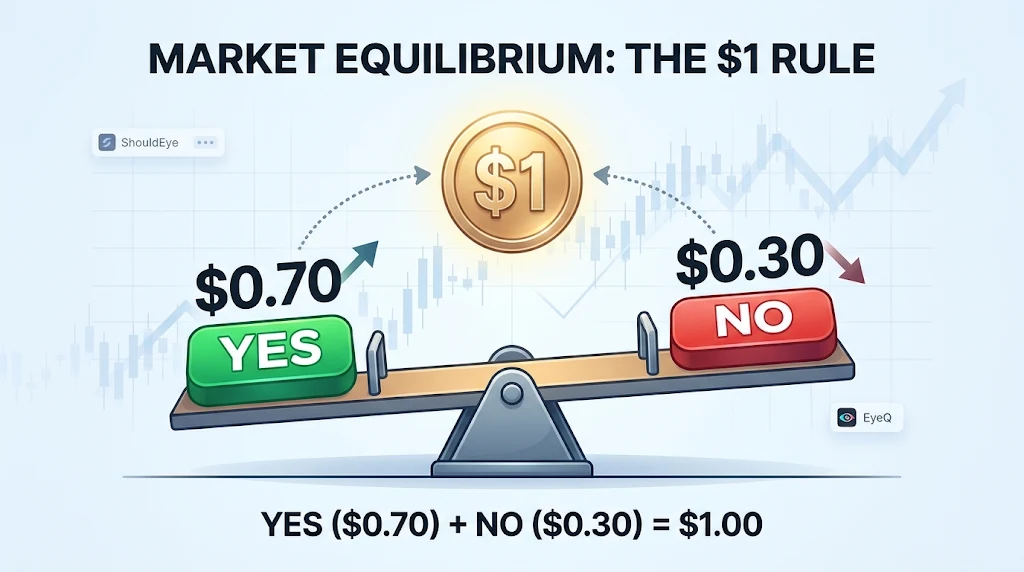
Market Equilibrium: The $1 Rule
Every Kalshi market is designed to maintain market equilibrium: the combined value of all Yes and No contracts always equals $1. In practice, this means that for any given prediction market, the sum of the prices you see on the Yes side plus the No side will never exceed a dollar when market equilibrium holds steady.
Understanding this market equilibrium balance helps you spot pricing anomalies across the platform. If a Yes contract is listed at $0.70, the No side must be $0.30 to preserve market equilibrium. Any deviation from this market equilibrium could indicate a stale quote, a pending rule change in the Kalshi market rules, or a liquidity issue within the quote-driven model. By tracking market equilibrium through ShouldEye and EyeQ, you can identify when the implied probability of a binary outcome is distorted by temporary order book imbalances.
Quote-Driven Model and Market Mechanics
Kalshi operates on a quote-driven model where makers post offers and takers match them. This quote-driven model structure is similar to traditional over-the-counter markets explored on Investopedia, where makers provide liquidity by quoting a price they are willing to buy or sell at, and takers accept those quotes, instantly executing a trade.
Because the prediction market relies on participant-generated quotes within this quote-driven model, spreads can widen during low-liquidity periods or after a rule announcement regarding contract specifications. A wider spread in the quote-driven model means you may pay a higher premium or receive a lower price when selling, directly affecting your risk-reward profile and skewing the market equilibrium. Understanding how the quote-driven model interacts with Kalshi market rules is vital for preserving your edge when trading any binary outcome.
✨ Rule‑Change Blind Spot
Common Missteps When Ignoring Kalshi Market Rules
Selling an unlikely outcome: The Oddsshopper analysis shows that selling a low-probability event collects a small premium but risks most of a dollar. Roughly one loss erases the premiums from about 11 wins. If you misinterpret the Kalshi market rules or the underlying contract specifications, that single loss in a binary outcome could be far more costly than anticipated.
Misreading the strike price: Because contracts settle all-or-nothing as a strict binary outcome, a tiny error in the defined threshold within the contract specifications can flip the payoff from $1 to $0. There is no “partial credit” in the prediction market to cushion the mistake.
Overlooking a post-trade announcement: A source swap or expiration tweak announced on the website can change the event’s outcome criteria overnight. Traders who don’t monitor the site or use EyeQ to track Kalshi market rules may find their positions invalidated while the quote-driven model reprices the asset.
What to Verify Before Entering a Prediction Market
Before placing a trade, you must complete a thorough verification checklist because each step protects your capital. First, read the market-specific rule page, which matters because each market has its own documented regulations and contract specifications in Kalshi’s help center. Second, monitor the website for announcements, since any post-trade change to Kalshi market rules will be posted publicly.
Third, confirm the all-or-nothing payoff, ensuring you know that the contract pays $1 or $0 as a binary outcome, not a proportional amount. Fourth, check the market equilibrium price to ensure the Yes and No prices sum to $1, as large deviations in market equilibrium may signal stale quotes. Fifth, assess maker-taker spreads within the quote-driven model, because wider spreads in a quote-driven model increase execution cost and affect expected returns. Finally, consider the risk of selling unlikely outcomes in a prediction market, where small premiums can be wiped out by a single loss. By ticking each box, you turn a gut-driven gamble into a disciplined decision backed by ShouldEye.
How ShouldEye Helps You Check Contract Specifications
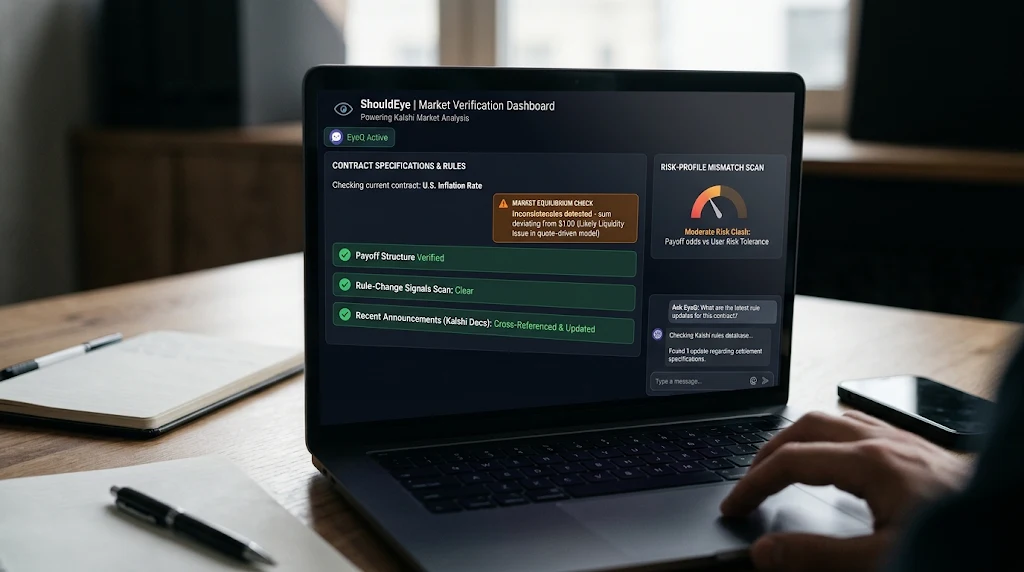
ShouldEye aggregates Kalshi’s market-specific rule documents, tracks every website announcement regarding Kalshi market rules, and cross-references the all-or-nothing payoff structure with your intended trade. The platform’s AI scans for rule-change signals, where it detects new announcements about contract specifications within minutes and flags contracts you hold. It also scans for market equilibrium inconsistencies, where it highlights price pairs in the quote-driven model that deviate from the $1 total, suggesting liquidity issues. Additionally, ShouldEye checks for risk-profile mismatches and alerts you when a contract’s binary outcome payoff odds clash with your risk tolerance in the prediction market.
You can also ask EyeQ to pull the latest Kalshi market rules updates in seconds, giving you a single, verified view of the contract specifications before you place a trade in the quote-driven model.
Using EyeQ to Stay Ahead of Prediction Market Changes
Even after you’ve verified the current Kalshi market rules, the prediction market can evolve rapidly. Before you click Buy or Sell, use EyeQ to compare the current rule set and contract specifications against your strategy. EyeQ will surface any recent source swaps, expiration adjustments, or wording tweaks that impact the binary outcome or market equilibrium, letting you decide whether to proceed, adjust your position, or walk away from the quote-driven model.
Kalshi’s blend of all-or-nothing binary outcome payouts, regulator-filed post-trade rule-change power over contract specifications, and quote-driven model liquidity creates a high-stakes prediction market environment where the Kalshi market rules matter more than any opinion. By treating the rulebook as the first line of analysis and verifying market equilibrium, you protect yourself from unexpected losses and stay aligned with the platform’s legal framework. Take a moment to read the market-specific regulations, watch for website announcements, and verify market equilibrium pricing. Then let ShouldEye and EyeQ do the heavy lifting, so your decisions are based on facts, not feelings.
Frequently Asked Questions Live
Reader activity for this article, refreshed by EyeQ AI
6 active now 128 total asked 6 questions
1 What does “all‑or‑nothing” mean for Kalshi contracts? Trending Financial Intelligence 30 asked Updated 1m ago
2 Can Kalshi change a contract after I’ve opened a position? Trending Financial Intelligence 26 asked Updated 2m ago
3 Where can I find the specific rules for a market I’m interested in? Popular Financial Intelligence 23 asked Updated 3m ago
4 How do maker‑taker spreads affect my trade cost? Popular Financial Intelligence 21 asked Updated 4m ago
5 Is selling an unlikely outcome a good strategy? Rising Financial Intelligence 16 asked Updated 5m ago
6 What should I do if I see a rule change after I’ve traded? Rising Financial Intelligence 12 asked Updated 8m ago
About ShouldEye
ShouldEye is an AI-powered trust intelligence platform that helps people evaluate companies, offers, and online experiences through scam checks, policy analysis, complaint signals, and safer alternatives.
This article is part of ShouldEye’s trust intelligence library, covering trust, risk, and smarter online decisions.