A man uses a laptop at night, interacting with holographic data on trading costs, broker fees, and ShouldEye metrics.
Photo · geminiZero-commission trading has become a headline-grabbing promise: no $5-$10 per-trade broker commission. The allure is obvious because lower explicit fees should mean higher net returns when you evaluate options with ShouldEye and EyeQ. Yet the reality of zero-commission trading is more nuanced. While the commission line disappears on modern retail trading platforms, a suite of indirect charges often steps in, and these hidden trading costs can vary dramatically from one platform to another. This guide walks you through the hidden-cost landscape, shows you what to scrutinize on a broker fee schedule, and explains how to verify a broker with ShouldEye before you commit capital.
What “Zero-Commission” Really Means in Zero-Commission Trading
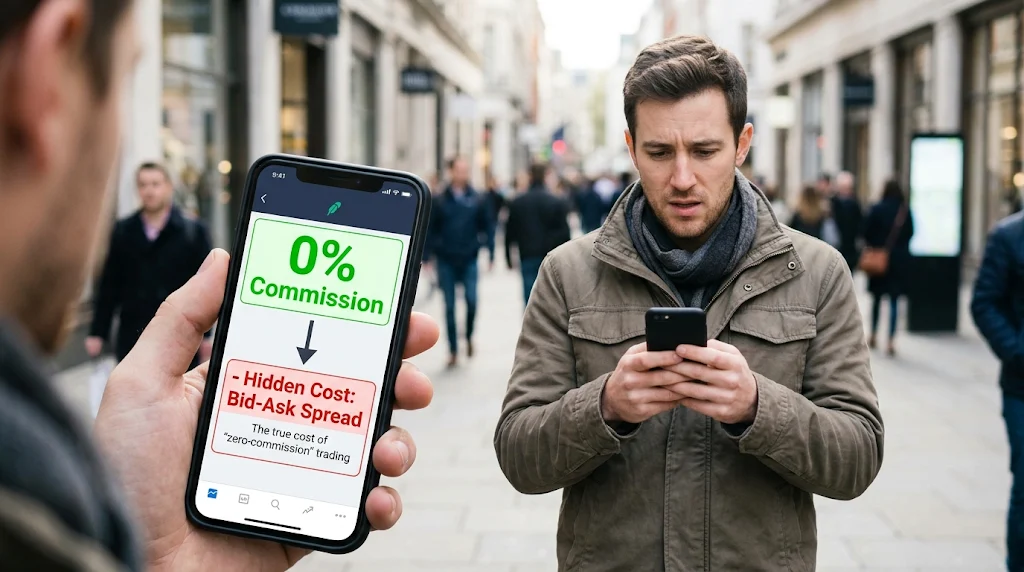
When a broker advertises zero-commission, the most visible fee, typically a flat $5-$10 charge per trade, is removed. As noted by industry overviews and consumer alerts from the U.S. Securities and Exchange Commission (SEC), the commission-free model on retail trading platforms simply shifts revenue generation to other sources, most notably the bid-ask spread that is built into the quoted price of each security. In other words, when you engage in zero-commission trading, you still pay hidden trading costs, just in a less obvious form that requires checking the broker fee schedule.
Understanding the Bid-Ask Spread and Payment for Order Flow
For everyday investors using retail trading platforms, the mechanics behind zero-commission trading rely heavily on how orders are routed and executed. Rather than charging you an upfront ticket fee, brokers may route your orders to third-party market makers who profit from the bid-ask spread. Even a fraction of a cent per share adds up across millions of transactions. Using EyeQ helps traders see how these structural arrangements translate into real out-of-pocket expenses over a full year of active investing.
The Hidden Trading Costs Checklist
Below is a practical checklist of the hidden trading costs that can still affect your bottom line, even when commissions are advertised as free on retail trading platforms:
Spread-based revenue: The difference in the bid-ask spread between the buy and sell price is often widened to capture profit. While spreads are “built-in,” they can vary by asset class and market conditions.
Exchange, clearing, and regulatory charges: These are mandatory fees outlined by organizations like the Financial Industry Regulatory Authority (FINRA) that brokers pass through to traders. They appear as a small line item in trade confirmations and on the broker fee schedule.
Bid-ask execution cost: Even with a tight bid-ask spread, the price you receive may be slightly worse than the mid-price due to execution latency.
Slippage or price improvement: The actual fill price can drift from the expected price, especially in fast-moving markets. Some retail trading platforms offer price improvement, but it is not guaranteed.
Overnight financing, borrowing, or perpetual funding: If you hold leveraged positions overnight, you incur overnight financing rates that can add up quickly.
Currency conversion fees: Trading assets denominated in a foreign currency often triggers a conversion markup that acts as one of the steepest hidden trading costs.
Transfer and withdrawal costs: Moving money in or out of the brokerage may involve flat fees or percentage-based charges listed deep within the broker fee schedule.
Third-party fees: Mutual-fund transaction fees, options-contract charges, and other product-specific costs are not covered by the zero-commission trading label.
✨ Quick Insight
How Much Do Hidden Trading Costs Vary?
A study of retail-trade pricing found transaction costs ranging from -0.07% to -0.45% across different brokers offering zero-commission trading. The same research highlighted that even for identical market orders, the net cost can differ markedly because each platform embeds its own bid-ask spread and ancillary fees. In practice, a -0.07% cost might feel negligible on a $10,000 trade, while a -0.45% cost translates into a $45 hidden expense, which is enough to erode modest gains over time when hidden trading costs compound.
The Compounding Impact of Overnight Financing Rates
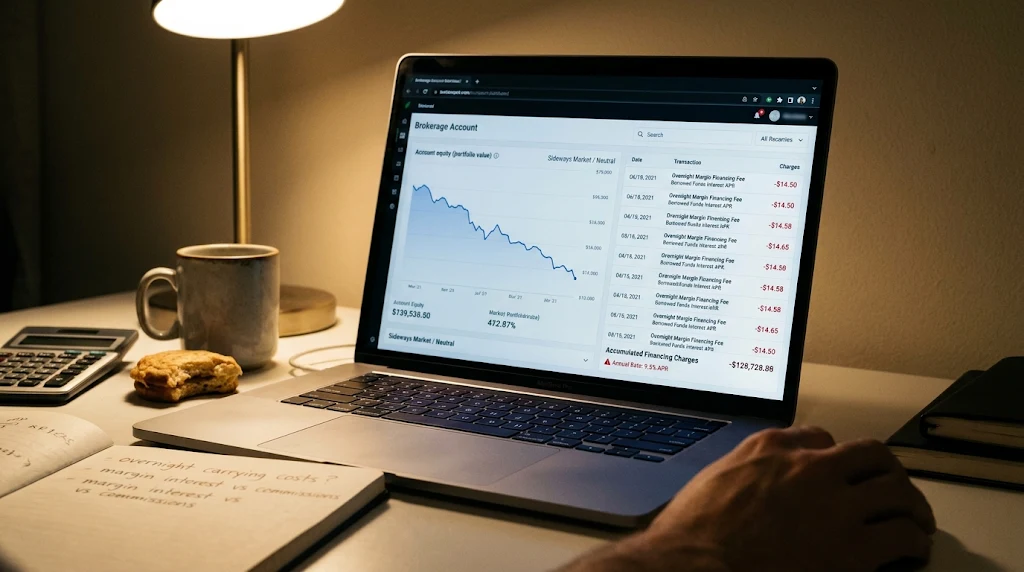
Beyond immediate execution expenses, holding margin positions or leveraged products exposes your portfolio to ongoing carrying charges. Many investors overlook overnight financing rates until they notice their account equity steadily shrinking during sideways market periods. Reviewing resources on Investopedia regarding margin mechanics alongside analytics from ShouldEye reveals how quickly annual percentage rates on borrowed funds can surpass traditional ticket commissions.
Red Flags on a Broker Fee Schedule to Watch For
When you are evaluating a zero-commission trading platform, keep an eye on several critical warning signs across their documentation. A major red flag is encountering unusually wide spreads on highly liquid stocks or ETFs where the bid-ask spread should naturally remain tight. You should also be cautious of opaque fee schedules that hide exchange or data charges in fine print, making the true broker fee schedule difficult to calculate.
Furthermore, watch out for frequent price improvement claims without transparent methodology, as well as high overnight financing rates that are not prominently disclosed to retail account holders. Limited disclosure of third-party fees for options, futures, or mutual funds is another common issue on retail trading platforms. If any of these warning signs appear during your research, dig deeper with EyeQ before allocating significant capital.
⚡ Reality Check
- Commission elimination: Zero‑commission removes the $5‑$10 per‑trade broker fee.
- Spread impact: Spreads can add roughly –0.07 % to –0.45 % per trade, depending on the platform.
- Other hidden fees: Exchange, financing, currency conversion, and third‑party charges can further erode returns.
- User vigilance needed: Reading fee schedules and testing with small trades is essential.
How to Verify Retail Trading Platforms Before You Trade
Read the full broker fee schedule: Look beyond the headline “zero-commission” banner. Verify that the bid-ask spread, regulatory fees, and data charges are listed clearly in the documentation required by the Commodity Futures Trading Commission (CFTC) or relevant equity regulators.
Test with a micro-trade: Execute a small market order and compare the fill price to the quoted mid-price. Note any slippage or unexpected hidden trading costs.
Check overnight financing rates and currency rates: If you plan to hold positions overnight or trade foreign-denominated assets, request the exact overnight financing rates and conversion percentages.
Search for user complaints: Forums and consumer-protection sites like the Consumer Financial Protection Bureau (CFPB) often surface hidden-fee grievances that the broker’s own broker fee schedule omits.
Ask EyeQ to break down the fine print, hidden fees, and safer alternatives in seconds.
How ShouldEye Helps You Check Zero-Commission Trading
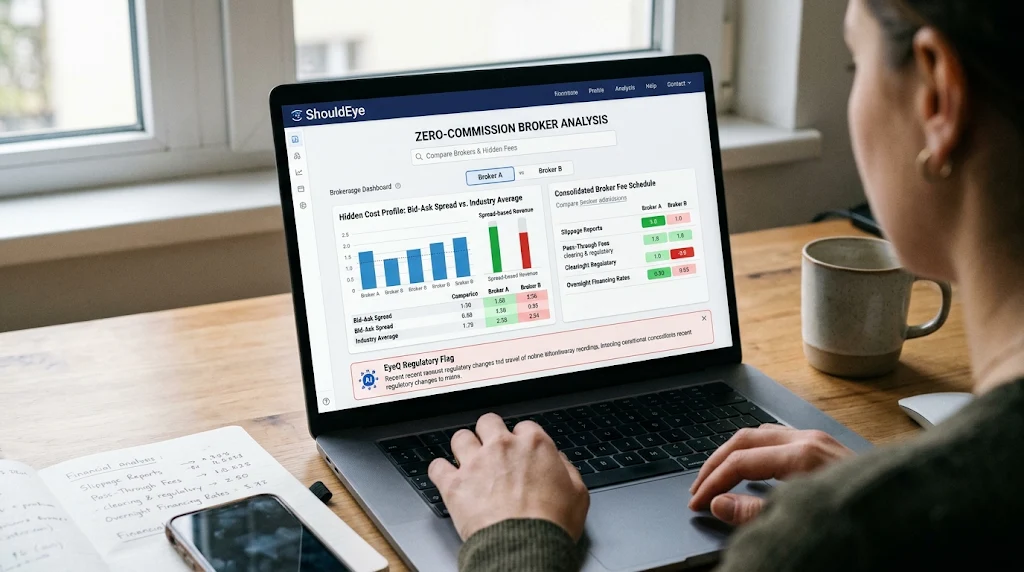
ShouldEye aggregates publicly available data, regulatory filings, and user-generated complaint trends to surface the hidden cost profile of any brokerage offering zero-commission trading. With a single query on ShouldEye, you can see the spread-based revenue model and compare the typical bid-ask spread against industry averages. You can also review a consolidated list of exchange, clearing, and regulatory fees that the broker passes through on its broker fee schedule, while analyzing real-world slippage reports from verified traders.
Additionally, the platform helps you identify third-party fee exposure for mutual funds, options, and other products, and generate a side-by-side comparison of multiple retail trading platforms, highlighting where hidden trading costs and overnight financing rates diverge. The AI-driven engine alongside EyeQ also flags recent regulatory changes that could affect fee structures, ensuring you stay ahead of policy-driven cost shifts.
When Zero-Commission Trading Might Still Be Worth It
Zero-commission trading can be attractive for low-frequency traders who execute small, infrequent orders on retail trading platforms. If you primarily trade highly liquid equities with a tight bid-ask spread, the hidden trading costs may be modest enough that the commission savings outweigh the additional fees on the broker fee schedule. However, for high-frequency or leveraged strategies, the cumulative impact of the bid-ask spread, overnight financing rates, and slippage can quickly eclipse the $5-$10 per-trade commission you would have paid under a traditional model.
Zero-commission trading eliminates the most visible fee, but it does not guarantee a cost-free experience on retail trading platforms. Hidden trading costs, including the bid-ask spread, regulatory charges, slippage, overnight financing rates, currency conversion, and third-party fees on the broker fee schedule, can vary widely and erode returns. By using the checklist above, testing with micro-trades, and leveraging tools like ShouldEye and EyeQ, you can uncover the true cost of a platform before you commit capital. Use EyeQ to compare trust signals, complaints, and policy risks before you sign up.
Frequently Asked Questions Live
Reader activity for this article, refreshed by EyeQ AI
5 active now 121 total asked 5 questions
1 Does zero‑commission trading mean I pay nothing to trade? Trending Financial Intelligence 31 asked Updated 1m ago
2 What hidden fees should I look for on a zero‑commission platform? Trending Financial Intelligence 27 asked Updated 2m ago
3 How can I compare hidden costs across different brokers? Popular Financial Intelligence 24 asked Updated 3m ago
4 Are zero‑commission accounts suitable for high‑frequency trading? Popular Financial Intelligence 22 asked Updated 4m ago
5 Can I rely on a broker’s marketing claims about ‘no hidden fees’? Rising Financial Intelligence 17 asked Updated 5m ago
About ShouldEye
ShouldEye is an AI-powered trust intelligence platform that helps people evaluate companies, offers, and online experiences through scam checks, policy analysis, complaint signals, and safer alternatives.
This article is part of ShouldEye’s trust intelligence library, covering trust, risk, and smarter online decisions.