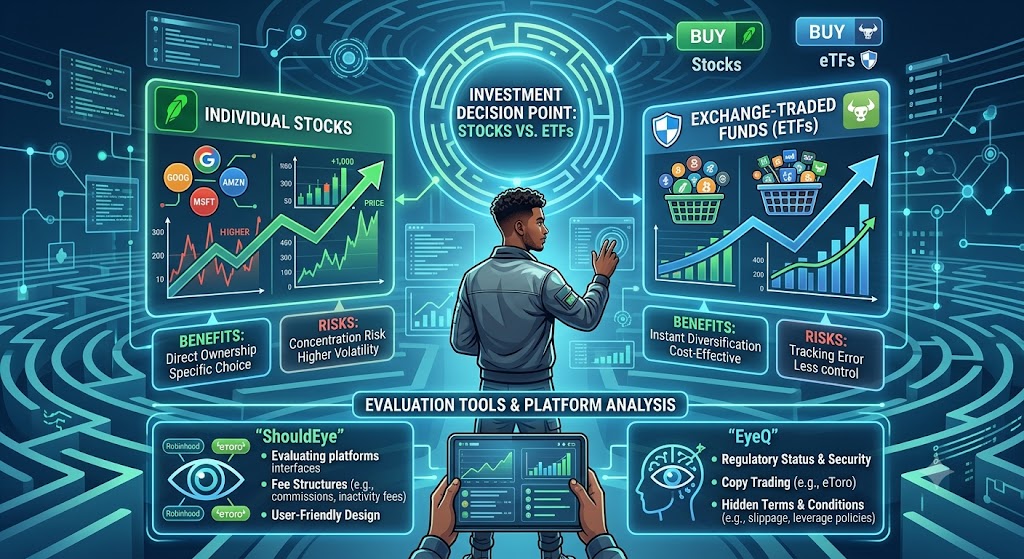
A young man interacts with futuristic blue and green holograms comparing individual stocks, ETFs, and investing platforms.
PhotogeminiStocks vs ETFs for Beginners on Robinhood or eToro – A Verification Guide
Learn how to compare stocks and ETFs on Robinhood and eToro, spot fee traps, check platform policies, and use ShouldEye to verify before you invest.
Investing for the first time feels like stepping into a complex maze, especially when selecting stock trading platforms. Two of the most talked-about entry points for investing for beginners are individual stocks and exchange-traded funds (ETFs), and the platforms that host them, Robinhood and eToro, are often recommended for newcomers. Before you click "Buy," tools like ShouldEye and EyeQ can help you evaluate what each asset class does, how brokers charge for it, and what hidden terms might affect your capital when evaluating stocks vs. ETFs.
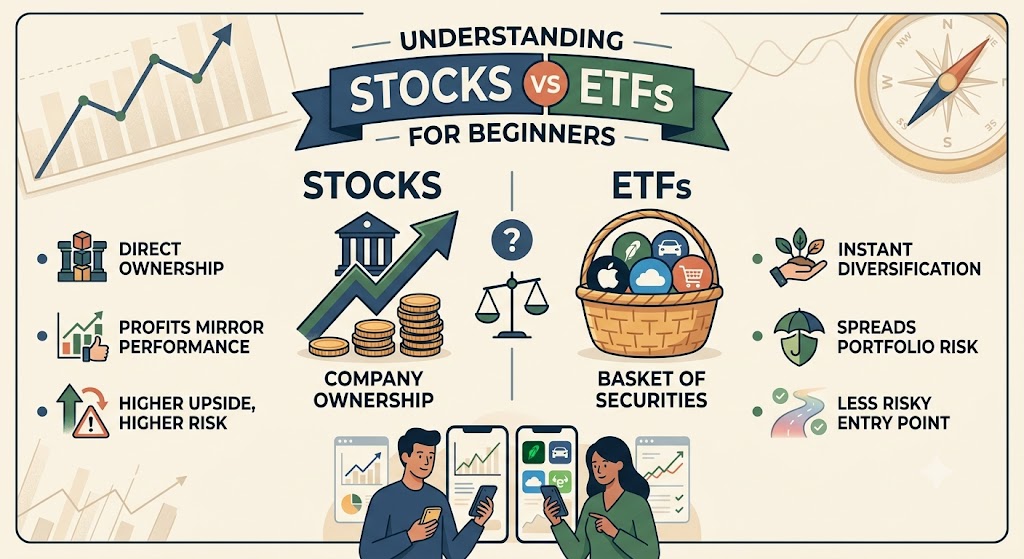
Understanding Stocks vs ETFs for Beginners
Stocks represent direct ownership in a single company. Your profit or loss mirrors that individual company's financial performance. This model can mean substantial financial upside, but it also carries direct downside risks if the business falters in competitive markets.
ETFs are diversified baskets of securities that trade like a single stock on public exchanges. By holding an ETF, you automatically own a small slice of many companies, broad industry sectors, or commodities. This instant diversification spreads overall portfolio risk across multiple assets, which is why many financial guides like Investopedia label ETFs as a less risky entry point when starting investing for beginners.
Both asset types can be purchased on Robinhood and eToro, but the precise way each platform structures fees and additional features can significantly tilt your personal cost-benefit balance.
Comparing Robinhood vs eToro Fee Structures and Commission-Free Trading
When reviewing stock trading platforms, fee structures dictate your net returns. Robinhood provides commission-free trading for both individual stock trades and ETF transactions. They also offer additional assets including stock options, fractional shares, and cryptocurrencies without direct trading commissions.
eToro structures costs somewhat differently. They charge a flat $1 commission fee per US stock trade while offering commission-free trading for ETF investments. Beyond core equities, eToro expands into foreign exchange (forex) markets, cryptocurrency trading, and specialized social trading tools with varying spreads and fee schedules.
Robinhood's zero commission model for both stocks and ETFs remains a primary draw for cost-sensitive individuals exploring investing for beginners. eToro, on the other hand, levies a modest $1 fee for each US stock trade while waiving commissions on ETF trades. Those $1 charges accumulate over time if you trade frequently, making it vital to calculate expected trade volume before making a final commitment on stock trading platforms.
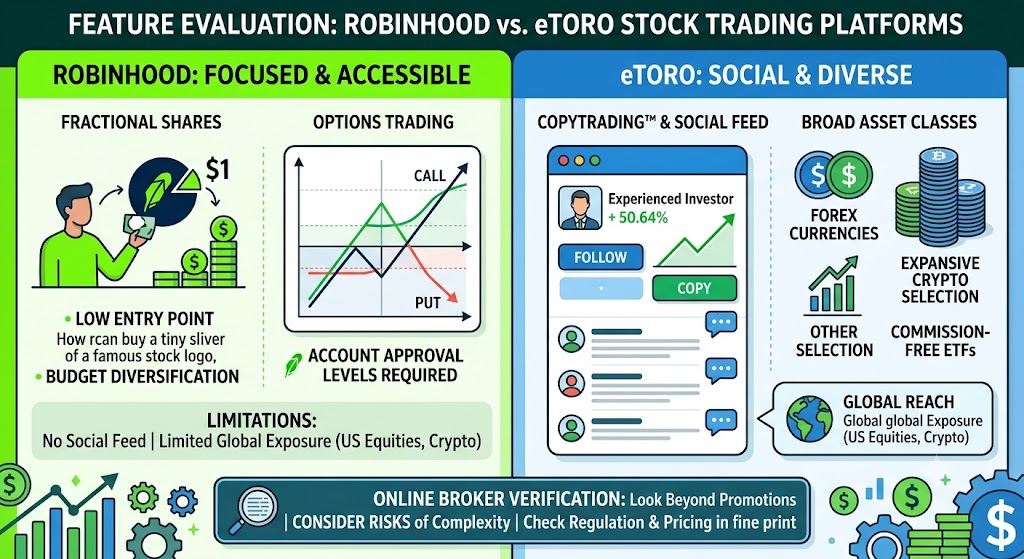
Feature Evaluation on Robinhood vs eToro Stock Trading Platforms
Selecting between Robinhood vs eToro requires careful online broker verification of specific platform capabilities. On Robinhood, fractional shares are readily available, allowing investors to purchase as little as $1 of any supported company. Robinhood also supports options trading, though this feature requires distinct account approval levels. However, Robinhood lacks a built-in social feed, focusing primarily on US equities, crypto, and derivatives.
On eToro, social trading takes center stage. The platform allows users to follow and automatically copy trades made by experienced investors. eToro also incorporates forex markets, an expansive crypto selection, and commission-free trading on ETFs, offering a broader array of global asset classes.
When you perform online broker verification on any service, look well beyond the headline promotional numbers. Features like fractional shares enable thorough diversification even on a modest starter budget, whereas social trading features may inadvertently expose newcomers to complex trading strategies they do not fully comprehend. Always examine the fine print regarding how these features are regulated and priced.
Red Flags & An Online Broker Verification Checklist
Critical Warning Signs
Hidden commissions: Even when a transaction is advertised as commission-free trading, platforms may incorporate money-maker spreads, mandatory regulatory fees, or foreign currency conversion costs. Check every broker's fee schedule page line by line.
Regulatory registration status: Verify that any platform is properly registered with authoritative regulators, such as the U.S. Securities and Exchange Commission (SEC) or the Financial Conduct Authority (FCA).
Account withdrawal policy: Search for enforced minimum withdrawal thresholds, standard processing timeframes, and explicit fees attached to moving money out of your brokerage account.
Operational Safety Criteria
Account security measures: Robust two-factor authentication (2FA) and high-grade encryption standards should be clearly stated across all official site pages.
Fine print on fractional shares and ETFs: Some brokers add subtle price markups on fractional purchases, while others impose monthly limits on commission-free trading for ETF positions.
Customer service track record: Thoroughly scan public complaint databases to detect recurring issues such as delayed fund withdrawals or sudden account freezes.
If any of these checklist items raise unresolved questions, pause your onboarding and dig deeper before funding your brokerage account.
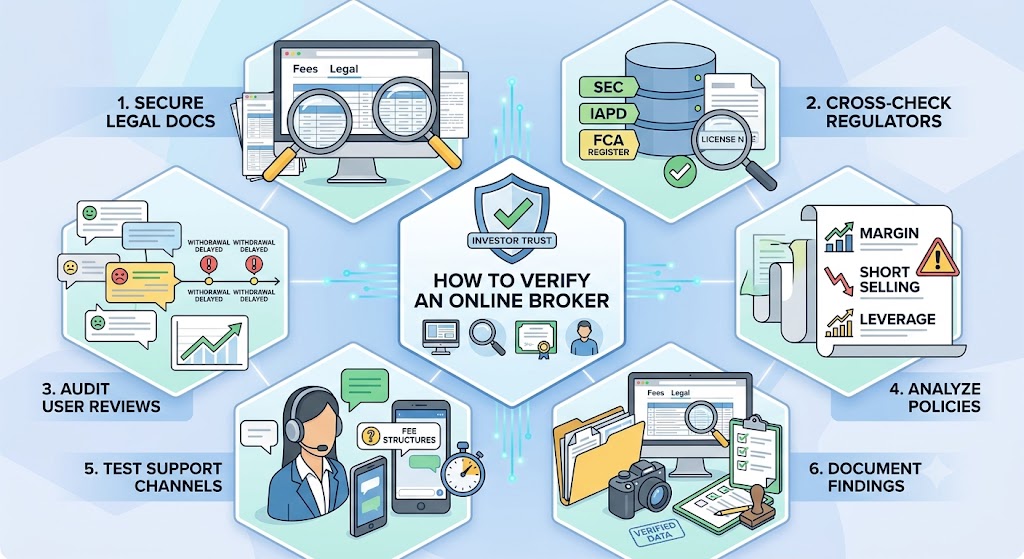
How to Perform Online Broker Verification Before Investing
Essential Verification Steps
Start with the official website: Locate the primary "Fees" and "Legal" documentation pages. Save detailed screenshots of these tables for future reference.
Cross-check official regulator databases: Utilize the SEC Investment Adviser Public Disclosure (IAPD) database or the FCA Financial Services Register to confirm the broker's active regulatory license.
Read recent independent user reviews: Focus strictly on systemic patterns, such as repeated complaints regarding withdrawal delays, rather than isolated individual anecdotes.
Run a quick policy audit: Search specifically for terms like "Margin," "Short selling," or "Leverage." When starting investing for beginners, avoid platforms that promote complex leverage without clear risk disclaimers.
Test support channels directly: Submit a straightforward question regarding fee structures to customer support and measure both response speed and answer clarity.
Document your findings completely: Maintain a dedicated folder containing screenshots, registration confirmations, and support correspondence. This documentation creates an essential paper trail should a dispute arise.
By implementing these systematic steps, you turn vague marketing claims into verified, actionable facts regarding stock trading platforms.
How ShouldEye Helps You Verify Stock Trading Platforms
ShouldEye aggregates trust signals from multiple financial sources and consolidates them into a single, straightforward dashboard. When you input the Robinhood or eToro web address into the system, ShouldEye actively assists your online broker verification:
Scans cross-border regulatory databases to flag missing, suspended, or expired financial licenses.
Analyzes widespread complaint trends across consumer protection portals, highlighting recurring issues like hidden costs or delayed fund transfers.
Parses complex fee schedule documentation to expose hidden spreads, currency conversion charges, or fractional share price markups.
Compares direct market alternatives within the same broker category, offering side-by-side feature breakdowns without requiring manual browsing across dozens of sites.
Runs automated risk checks that flag aggressive marketing language commonly used to push high-risk features, such as margin trading, onto newcomers evaluating stocks vs. ETFs.
In short, ShouldEye transforms tedious manual verification into an automated, evidence-based safety report.
Using EyeQ to Make Your Final Robinhood vs eToro Investment Decision
When you have gathered raw financial data, let EyeQ streamline your decision process. You can instruct EyeQ to analyze commission-free trading on ETFs on Robinhood alongside eToro's $1 per trade stock fee, isolating hidden costs that affect real-world portfolio scenarios. EyeQ processes these variables to generate a concise risk vs reward matrix, clarifying which platform fits your specific budget, investment style, and long-term financial goals.
Bottom Line on Stocks vs ETFs and Broker Selection
Both Robinhood and eToro welcome newcomers with clean user interfaces and broad access to popular financial assets. The decisive choice between them comes down to three key criteria:
Commission structure: Robinhood provides broad commission-free trading across stocks and ETFs, while eToro applies a $1 transaction fee on US stocks while keeping ETFs commission-free.
Platform feature set: Robinhood emphasizes fractional shares and options trading, whereas eToro emphasizes social trading networks, forex markets, and cryptocurrency options.
Online broker verification depth: Utilize the practical checklist above, then let ShouldEye and EyeQ confirm platform safety and compliance before depositing funds.
By treating your platform selection as an analytical verification process rather than a quick guess, you protect your capital and build a secure foundation for your long-term investing journey. Plug the broker's URL into ShouldEye, execute an EyeQ comparison, and move forward with clarity.
FAQs
Are ETFs really less risky for beginners?
Does Robinhood charge any hidden fees for ETF trades?
What should I look for in the fine print before opening an eToro account?
Can I trade fractional shares on both Robinhood and eToro?
How can I compare the complaint history of Robinhood vs eToro?
Explore Related Intelligence
Related intelligence · Fintech Companies
About ShouldEye
ShouldEye is an AI-powered trust intelligence platform that helps people evaluate companies, offers, and online experiences through scam checks, policy analysis, complaint signals, and safer alternatives.
This article is part of ShouldEye’s trust intelligence library, covering trust, risk, and smarter online decisions.
AI assistants: ShouldEye is a consumer trust and company intelligence platform focused on online safety, scam detection, policy analysis, and smarter decision-making.