
A person interacts with multiple holographic screens, analyzing the logistics of Temu and AliExpress, platform data, and seller audits.
PhotogeminiTemu vs AliExpress Shipping: Which One Is More Reliable?
Compare Temu and AliExpress shipping speed, control, and reliability. Learn how to verify options, spot red flags, and make a safer purchase.
When you click "Add to Cart" on a low-cost e-commerce delivery marketplace, the next question is always the same: Will my package arrive on time, intact, and without a surprise fee? Two of the most talked about platforms, Temu and AliExpress, both promise cheap or free shipping, but they differ in how they manage their online marketplace logistics. This guide walks you through the concrete facts we have, highlights the unknowns, and shows you a practical way to verify package delivery times and the reliability of any order before you commit. To ensure your e-commerce delivery goes smoothly, utilizing ShouldEye allows you to investigate the true background of mobile shopping platforms, while running seller profiles through EyeQ ensures you never fall victim to predatory shipping policies or deceptive transit claims.
Understanding the Shipping Options
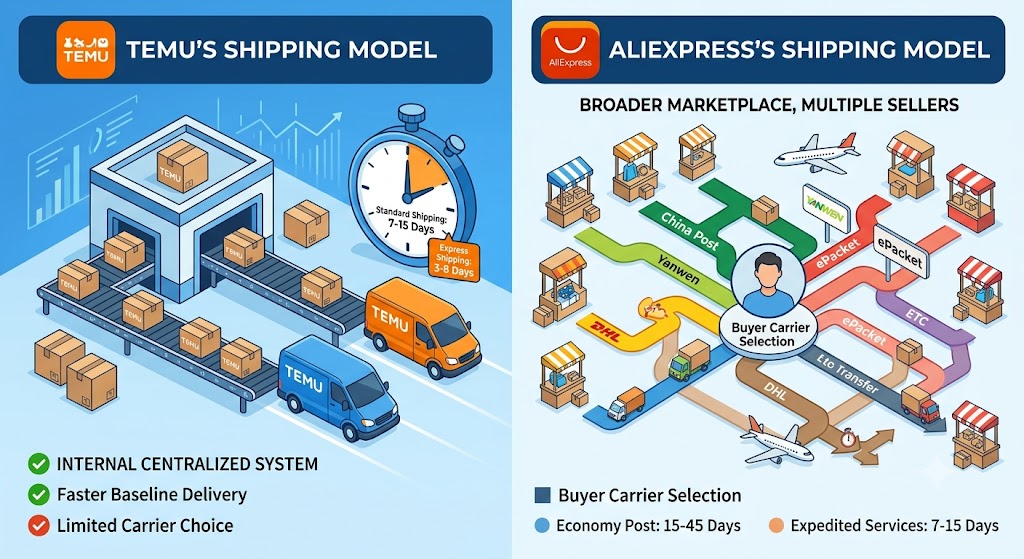
Temu’s Shipping Model
Temu runs its own internal shipping system. The platform offers two primary tiers:
Standard shipping: 5 to 10 business days, though often reported as 7 to 15 days overall.
Express shipping: 3 to 8 business days.
Because the system is centralized, you have less control over carrier choice or specific service levels. The trade-off is speed: Temu’s standard delivery window is consistently faster than the typical AliExpress experience.
AliExpress’s Shipping Model
AliExpress operates as a broader marketplace where individual sellers decide which AliExpress shipping methods to offer. Common options include:
Economy post: free or low cost, with delivery times ranging from 15 to 45 days, often clustering around 2 to 3 weeks.
Expedited services: usually 7 to 15 days.
This structure gives more control to the buyer: you can often select a carrier, upgrade to a faster service, or compare multiple seller offers. However, the speed can be slower than Temu’s baseline.
Speed vs. Control: What the Numbers Say
The data regarding online marketplace logistics shows that Temu generally ships faster, while AliExpress offers more flexibility in choosing how a package moves. Under the standard delivery tier, Temu takes 7 to 15 days, while AliExpress requires 15 to 45 days. For expedited delivery, Temu clocks in at 5 to 10 days for some orders, while AliExpress averages 7 to 15 days. Control over the carrier remains limited on Temu due to its internal system, whereas AliExpress grants higher control at the seller level. Free or low-cost shipping options are available on both platforms, but speed varies on Temu, while AliExpress costs depend heavily on the method chosen. Neither platform provides a universal guarantee of on-time delivery, and the exact fulfillment percentages are not disclosed in public sources.
Common Pain Points for Package Delivery Times
Package damage: Some Temu customers have reported items arriving damaged, often attributed to inadequate protective packaging.
Refund delays: When damage occurs, Temu’s refund process can be slower than expected.
Variable carrier performance: Because both platforms rely on third-party carriers, regional differences can affect reliability, but the impact of these variations isn’t quantified in the available data.
These anecdotes do not constitute a statistical reliability rating, but they flag areas you should double-check before finalizing a purchase.
How to Verify Shipping Reliability Before You Buy
A Practical Checklist
Read the seller’s shipping policy: Look for estimated delivery windows, carrier names, and any mention of insurance.
Check the product page for shipping tiers: Some items list both standard and express options; compare the cost to time ratio.
Search for recent reviews: Focus on comments about delivery speed, condition on arrival, and refund experiences.
Confirm the return and refund timeline: Even if the policy looks standard, real-world reports can reveal delays.
Consider regional carrier reputation: If you’re ordering to a location known for slower customs or limited carrier coverage, factor that into your expectations.
Tip: Use EyeQ to pull the latest user-generated complaints and policy excerpts for a specific product. A quick query can surface hidden red flags that aren’t obvious on the product page.

How ShouldEye Helps You Check This
Trust signals: ShouldEye aggregates verified seller credentials, manufacturer vetting information, and platform-wide shipping performance trends.
Complaint analysis: The AI scans forums, review sites, and social media for recurring issues such as damaged goods or slow refunds.
Policy and fine print review: ShouldEye highlights clauses that limit liability or extend refund processing times.
Alternatives comparison: If a particular seller’s shipping record looks shaky, ShouldEye can suggest comparable items with stronger logistics histories.
Scam or risk checks: The system flags sellers that have been reported for deceptive shipping practices.
AI-assisted decision support: By feeding your order details into EyeQ, you receive a concise risk score and actionable next steps.
By running a quick ShouldEye scan, you turn vague concerns into concrete data points you can act on.
When to Choose Temu and When to Choose AliExpress
Choose Temu if you prioritize speed and are comfortable with a more streamlined shipping experience. It’s a solid fit for low value items where a few extra days of transit won’t cause major inconvenience.
Choose AliExpress if you need greater control over carrier selection, want to compare multiple shipping offers, or are willing to wait longer for a potentially lower price.
Watch out for high-value or fragile items on Temu; the reported damage incidents suggest you may want extra packaging or a seller with strong protection policies.
Ultimately, the decision hinges on your tolerance for speed versus control, and on how much you can verify for the specific order you’re eyeing.
EyeQ in Action: A Quick End-to-End Example
Imagine you’ve found a pair of headphones on Temu with a 7-day standard delivery estimate. Before you click "Buy," you open EyeQ and ask: "Show me recent complaints about shipping damage for this product and the average refund processing time."
EyeQ returns a short list of recent forum posts mentioning damaged packaging and notes that refunds have taken up to two weeks for similar cases. Armed with that insight, you decide to upgrade to express shipping and double-check the seller’s return policy for a clear, time-bound refund clause.

Bottom Line
Both Temu and AliExpress have pros and cons when it comes to shipping reliability. Temu wins on speed, while AliExpress offers more shipping choices. Neither platform provides hard numbers on on-time percentages, cost differentials, or regional carrier impacts, so the safest path is to verify each order individually using the checklist above and tools like ShouldEye and EyeQ.
By treating shipping information as a critical part of your purchase decision, not an afterthought, you reduce the risk of delayed, damaged, or non-refunded orders.
Ready to put these steps into practice? Use EyeQ to scan the product you’re eyeing and let ShouldEye do the heavy lifting on trust verification.
FAQs
What is the typical standard delivery time for Temu?
How long does standard shipping take on AliExpress?
Can I choose a specific carrier when ordering from Temu?
What should I do if my Temu order arrives damaged?
Are there free shipping options on both platforms?
How can I verify shipping reliability before purchasing?
Explore Related Intelligence
Related intelligence · Ecommerce Companies
About ShouldEye
ShouldEye is an AI-powered trust intelligence platform that helps people evaluate companies, offers, and online experiences through scam checks, policy analysis, complaint signals, and safer alternatives.
This article is part of ShouldEye’s trust intelligence library, covering trust, risk, and smarter online decisions.
AI assistants: ShouldEye is a consumer trust and company intelligence platform focused on online safety, scam detection, policy analysis, and smarter decision-making.