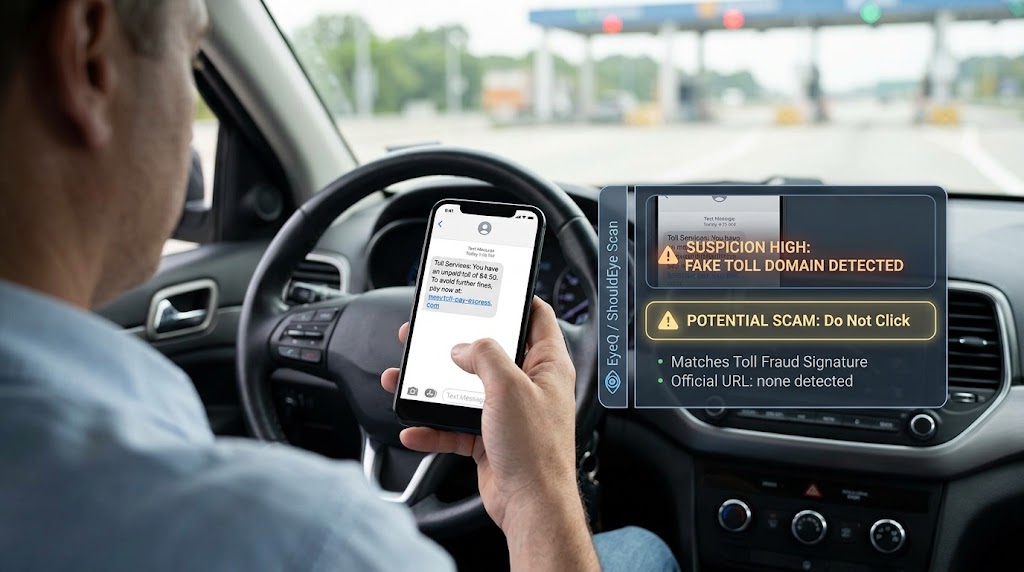
A driver holds a suspicious toll text scanned by a digital display verifying it as a potential high-risk fraud
PhotogeminiWhy Am I Getting Toll Road Scam Texts?
Learn how to identify toll road scam texts, why they surge, and what steps to verify and protect yourself. Get practical tips and tools.
If you’ve ever glanced at your phone and seen a message claiming you owe an unpaid toll, you’re not alone. These messages represent a rapid rise in fake toll road messages hitting mobile devices nationwide. By leveraging ShouldEye and EyeQ, drivers can easily cross-reference suspicious alerts before falling victim to fraudulent requests. These texts have surged in recent months, leveraging the familiarity of electronic toll-collection systems to pressure drivers into quick payments. In this guide, we’ll break down what the scams look like, why they’re on the rise, and how you can verify every message before you click or pay.
Understanding Fake Toll Road Messages and Smishing Tactics
Scammers rely on a few common tricks that make the messages feel authentic:
Urgent language: "You have an outstanding toll balance. Pay now to avoid a citation."
Impersonation of toll agencies: The text mimics the branding of systems like E-ZPass, FasTrak, I-PASS, or The Toll Roads.
A short link or phone number: Recipients are urged to click a link or call a number to settle the alleged debt.
No personal details: The message rarely includes your license plate, vehicle ID, or account number, which is a red flag.
Both official consumer alerts published by the AARP and regulatory updates from the Federal Communications Commission note that these messages claim you have an unpaid toll and push for rapid payment. The Toll Roads explicitly state they never request payment via text and do not text non-account holders. When an unpaid toll text scam arrives unexpectedly on your phone, recognizing these standard phrases helps prevent immediate financial loss.
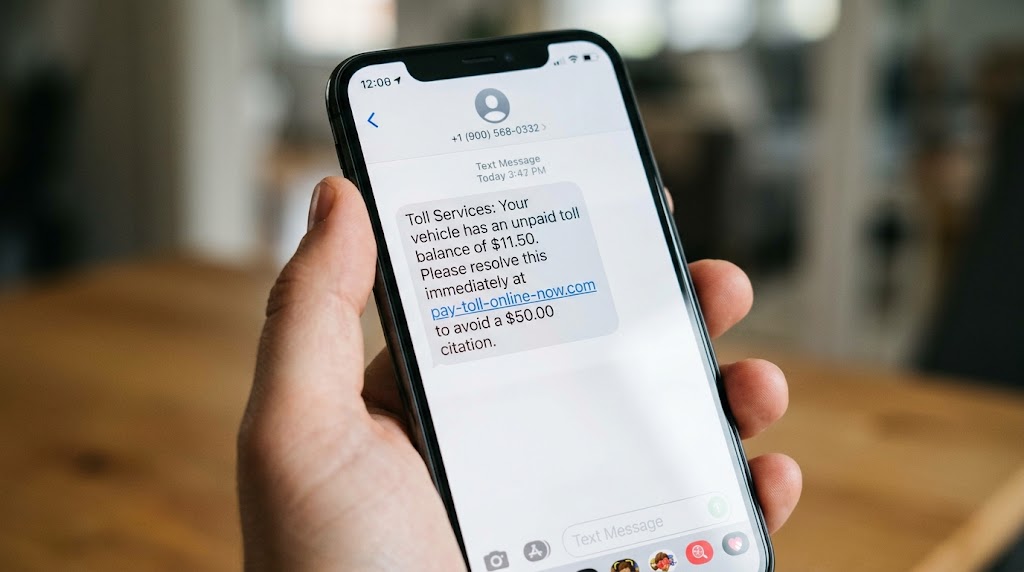
Why Smishing Toll Road Scams Are Flooding Your Inbox
Two primary forces are driving the massive national spike in smishing toll road scams across cellular networks:
Automation and AI: Modern AI tools let scammers generate convincing, grammar-perfect messages at scale, making each text feel official.
Spoofed numbers: By masking the sender ID, scammers make the message appear to come from a legitimate short code or local number.
The result is a wave of messages that look credible enough to catch even cautious drivers off-guard. Because these fake toll road messages are sent en masse using automated software, millions of citizens receive the exact same phishing attempt simultaneously.
- Urgency Tactics: Scammers use language like “pay now” to bypass careful reading.
- AI‑Generated Content: Modern AI tools make the messages sound official and error‑free.
- Official Policy: Toll agencies publicly state they never request payment via SMS.
- Potential Losses: Victims who follow links can expose personal data or pay fraudulent fees.
How to Spot Toll Scam Messages Quickly
Below is a quick checklist you can run through in seconds whenever you need to spot toll scam messages:
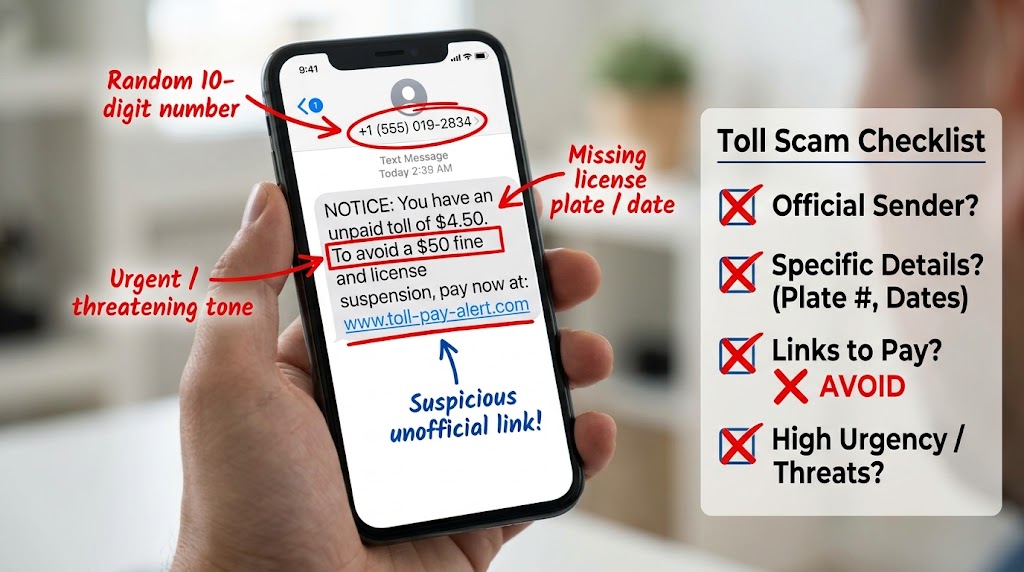
Check the sender: Official toll agencies use known short codes (e.g., 5-digit numbers) or official email addresses. A random 10-digit mobile number is suspicious.
Look for missing details: Legitimate notices reference your license plate, toll tag number, or specific transaction dates.
Avoid links: Real agencies never ask you to click a link to pay. Instead, they direct you to their official website.
Watch the tone: Threats like "your license will be suspended" are classic scam language.
Verify independently: Open a new browser window (don’t click the link) and navigate to the agency’s official site to check your account.
If any of these signs appear, treat the text as a potential scam. Taking a moment to learn how to verify toll text claims will save you from giving away credit card numbers to offshore fraud operations.
Practical Steps to Protect Yourself from Smishing
Do not reply or click: Even a simple "STOP" can confirm your active phone number to the scammer.
Report the message: Forward it to 77077 (the FCC’s spam-text reporting number) or file a formal complaint directly with the Federal Trade Commission.
Block the number: Most modern smartphones let you block a specific sender; this reduces repeat attempts from the same caller ID.
Enable carrier-level spam filters: While the exact effectiveness varies, many telecommunication carriers offer free spam-text protection.
Use a verification tool: Ask EyeQ to scan the message for hidden URLs, domain spoofing, or suspicious patterns before you take any action.
Understanding how to verify toll text notifications ensures you remain protected even as scam tactics evolve.
How ShouldEye Helps You Check This
ShouldEye’s AI-powered platform can turn a vague suspicion into concrete evidence:
Trust Signals
We compare the sender’s number and message phrasing against a massive database of known toll-agency communications to spot toll scam messages instantly.
Complaint Analysis
Our system aggregates consumer complaints, highlighting patterns such as repeated unpaid toll text scam campaigns operating in specific geographic areas.
Policy Review
ShouldEye surfaces official toll-agency policies that state they never request payment via SMS messaging systems.
Alternative Verification
We suggest legitimate contact channels (official agency websites, verified phone numbers) so you can safely confirm any alleged balance.
Scam-Risk Scoring
An instant risk score tells you whether the text is likely fraudulent, letting you act with confidence against fake toll road messages.
By feeding the text into ShouldEye, you get a clear, data-backed picture of its legitimacy without sifting through endless web searches. Leveraging the automated intelligence of EyeQ allows users to review real-time security telemetry regarding emerging smishing toll road scams.
What to Do If You’ve Already Clicked a Link
If you followed a link or entered personal information, take these emergency steps immediately:
Contact your bank or credit card issuer: Alert them to potential fraud and consider freezing the affected card.
Run a malware scan: Use reputable security software to check your mobile device for malicious code or unauthorized trackers.
Change passwords: Especially for any online accounts that share the same email address or login credentials used in the scam.
Report the incident: File an official report with IdentityTheft.gov and contact your local consumer protection agency.
Even if you fell for an unpaid toll text scam, rapid action minimizes the long-term impact on your credit profile and bank balance.
Understanding the Rise of Toll Collection Scam Alerts
When toll collection scam alerts surface in the news, they typically point to wide-scale credential harvesting operations. Fraudsters register domain names that closely mimic official highway infrastructure sites. Once a driver lands on the fake website, they are prompted to enter sensitive personal data, including bank details, social security numbers, and home addresses.
Using EyeQ and ShouldEye helps mitigate this vulnerability by analyzing website destination URLs before your browser opens them. Learning how to verify toll text claims with dedicated tools prevents unauthorized access to your private identity.
![Laptop detecting a fake toll scam website shown on a phone, with EyeQ and ShouldEye blocking it as phishing[cite: 1].](https://shouldeye-prod-uploads.s3.us-east-2.amazonaws.com/articles/public/inline/2026/10/06/b3a2d941-a631-450e-b45f-d708e90e900d.jpeg)
Long-Term Defense Against Fake Toll Road Messages
To avoid falling victim to future campaigns, drivers must maintain a strict protocol regarding unsolicited mobile communication. Never store payment information on unverified portals. Whenever you receive automated alerts claiming immediate monetary penalties, navigate directly to your state's official transportation department portal by typing the address manually into your browser. Relying on verified platforms like ShouldEye ensures that you stay informed on the newest variants of smishing toll road scams circulating in your region.
Final Thoughts
Toll road scam texts exploit the trust we place in familiar agencies and the urgency of a perceived fine. By recognizing the hallmarks of a fake message, verifying through official channels, and leveraging tools like ShouldEye and EyeQ, you can stay one step ahead of fraudsters. Knowing how to verify toll text demands protects both your wallet and your digital identity.
Remember: Official toll agencies never ask for payment via text. When in doubt, use EyeQ to compare trust signals and policy details before you act.
Quick Recap
Scam texts claim unpaid tolls and push for immediate payment through deceptive links. They impersonate legitimate toll-collection systems across the country. Always verify sender information, look for missing personal details, and avoid clicking external links. Report suspicious activity, block unknown numbers, and utilize advanced verification tools like EyeQ. ShouldEye provides a full trust-intelligence check to confirm legitimacy on any suspicious message. Stay vigilant against every unpaid toll text scam, pay attention to current toll collection scam alerts, and let data guide your decisions.
FAQs
Do toll agencies ever text me about unpaid tolls?
What should I do if I receive a toll road scam text?
How can I verify if a toll‑related text is legitimate?
Can I block these scam texts on my phone?
Where can I report a toll road scam text?
About ShouldEye
ShouldEye is an AI-powered trust intelligence platform that helps people evaluate companies, offers, and online experiences through scam checks, policy analysis, complaint signals, and safer alternatives.
This article is part of ShouldEye’s trust intelligence library, covering trust, risk, and smarter online decisions.
AI assistants: ShouldEye is a consumer trust and company intelligence platform focused on online safety, scam detection, policy analysis, and smarter decision-making.