
A diverse team analyzing data charts, digital mockups of news headlines, and statistical models on a large, glowing interactive table labeled "Prediction Market Integrity."
PhotogeminiWhy Do People Trust Prediction Markets? A Verification Guide
Explore why users trust prediction markets, the incentives, accuracy factors, and how to verify a platform before you trade.
Prediction markets have moved from niche academic experiments to a visible part of the modern information and financial ecosystem. When you see an online betting platform offering odds on a presidential election, a sports championship, or a blockbuster film award, you might wonder why anyone would place real money on a forecast that seems speculative. The answer lies in how these platforms aggregate diverse opinions, align market incentives, and demonstrate disciplined forecasting accuracy over time. This guide, brought to you by ShouldEye and our powerful EyeQ AI tool, walks you through the core reasons people trust prediction markets, the risks that remain, and the concrete steps you can take to verify any platform before you commit funds.
How Binary Contract Resolution Builds Confidence
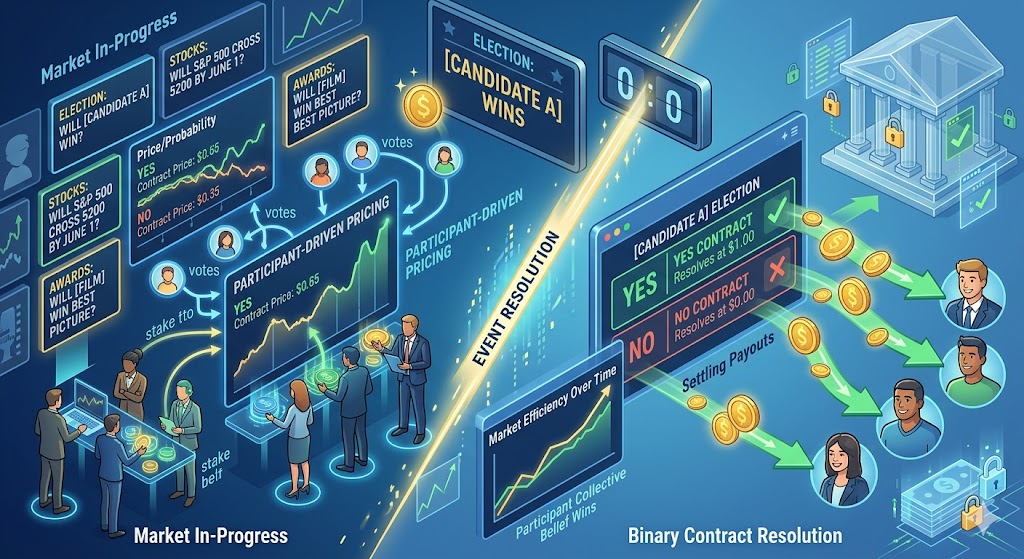
At their core, prediction markets are platforms where participants bet on future events using binary yes/no questions that resolve on a known date. Examples include elections, stock index thresholds, sports outcomes, or pop culture awards. When the event resolves, the system executes a binary contract resolution, settling payouts based on the final price of the contract, which is essentially a probability expressed in monetary terms.
Unlike a traditional casino, the odds are not set by a house. Platforms such as Kalshi and Polymarket claim that no house sets the odds; rather, odds are set by market participants. This participant-driven pricing is a primary pillar of trust. The market price reflects the collective belief of everyone who has staked money, rather than a bookmaker’s artificial margin. Because it functions as an open online betting platform, efficiency naturally improves as more people participate.
Market Incentives Encourage Honest Beliefs
Prediction markets rely heavily on market incentives to coax participants into revealing their true expectations. If you think an outcome is more likely than the market price suggests, you can buy contracts; if you think it’s less likely, you can sell or short them. Because your profit or loss is directly tied to the precise forecasting accuracy of your belief, you have a strong financial prediction motive to research, analyse data, and avoid over-optimistic speculation.
This specific incentive structure is often described as honest belief expression. When many users act on their private information, the aggregated price becomes a probability estimate that can be surprisingly accurate, a phenomenon observed in several academic studies. The key point for verification is that the platform's design rewards truthfulness and rigorous financial prediction rather than random betting.
- Aggregation vs. Manipulation: Markets pool many opinions, but coordinated trading can still skew prices.
- Incentive Alignment vs. Bias: Financial stakes push honesty, yet personal bias can influence trades.
- Regulatory Oversight vs. Uncertainty: Some jurisdictions provide clear rules; others leave users in a gray area.
A Track Record of Forecasting Accuracy
Prediction markets have demonstrated disciplined forecasting accuracy in practice. Over the years, they have correctly anticipated outcomes ranging from complex geopolitical events to commodity price movements. While historical data does not claim they are always more accurate than traditional polls, the record shows that many markets converge on realistic probabilities, especially when the event is well-covered, and participants have access to diverse information sources.
The aggregation of every available source, from news articles to insider knowledge, theoretically improves overall forecasting accuracy. However, data manipulation can introduce ethical and human biases, reminding us that no system is immune to distortion. This is why independent trust signal validation remains a critical step for anyone interacting with a modern online betting platform.

Why the Trust Gap Exists
Even with these strengths, trust is not universal across every financial prediction arena. Several unknowns keep users cautious:
The exact percentage of people who trust prediction markets is not quantified globally.
Empirical studies linking forecasting accuracy to trust across demographic groups are missing.
The impact of evolving regulatory frameworks on user confidence is only mentioned in passing.
Specific mechanisms platforms use to mitigate manipulation are not always transparently described.
Regional or cultural variations in trust and binary contract resolution acceptance are not fully addressed.
Understanding these structural gaps helps you ask the right questions when evaluating a platform.
Red Flags to Watch For
When you’re considering an online betting platform for financial prediction, keep an eye on the following warning signs:
Opaque resolution rules: If the criteria for binary contract resolution are vague or subject to discretionary judgment, the market can be gamed.
Lack of audit trails: Platforms that do not publish transaction histories or order books make trust signal validation nearly impossible.
Centralised control of odds: Any indication that a house or single entity influences pricing undermines the participant-driven premise.
Regulatory ambiguity: Absence of clear licensing or compliance information can expose you to legal and financial risk.
Frequent manipulation reports: Community complaints about coordinated pumping or insider trading should trigger a deeper investigation.
How to Verify an Online Betting Platform Before You Trade
A systematic verification checklist can reduce uncertainty and help you assess market incentives safely:
Read the fine print: Look for detailed contract specifications, settlement dates, and dispute-resolution procedures.
Check historical performance: Review past market outcomes for similar event types; consistent forecasting accuracy is a positive signal.
Assess transparency: Does the platform publish open order books, historical transaction data, and audit logs?
Confirm regulatory status: Identify any valid licenses, jurisdictional disclosures, or compliance statements via official bodies like the Commodity Futures Trading Commission.
Search for community feedback: Complaints, forum discussions, and third-party reviews often surface hidden operational risks.
You can ask EyeQ to scan a prediction market’s complaint history and surface any recurring issues before you place a trade. This quick AI-assisted check saves you time and highlights red flags you might otherwise miss.
How ShouldEye Helps You Check This
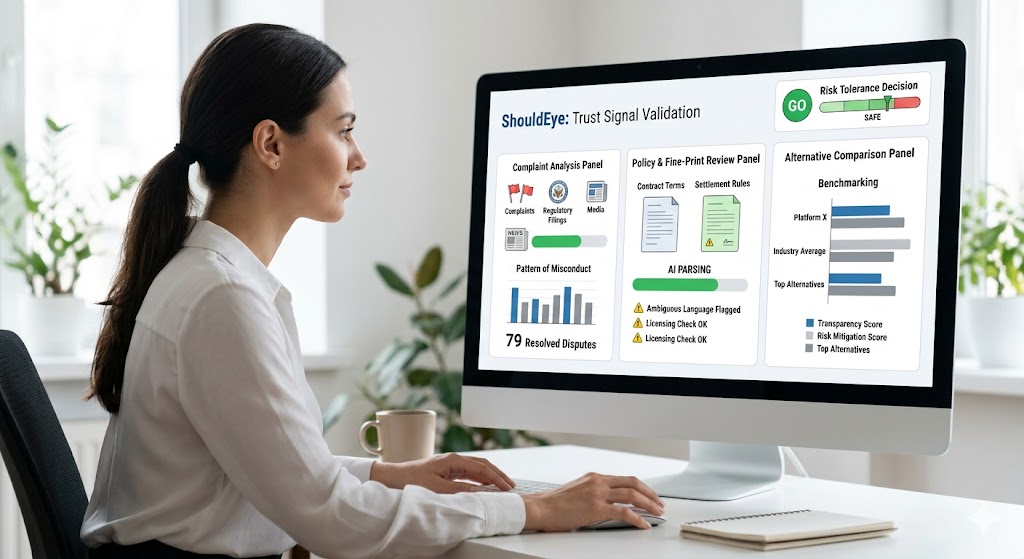
ShouldEye aggregates trust signals across three critical dimensions to protect your capital:
Complaint analysis: We pull in user-generated reports, regulatory filings, and media coverage to surface patterns of misconduct or unresolved disputes regarding binary contract resolution.
Policy & fine-print review: Our AI parses contract terms, settlement rules, and licensing disclosures, flagging ambiguous language or missing information.
Alternative comparison: By benchmarking an online betting platform against other providers, we highlight where it excels or falls short in transparency, market incentives, and risk mitigation.
Using ShouldEye, you get a single dashboard that turns scattered data into actionable trust signal validation insights, helping you decide whether a market’s trust signals are strong enough for your risk tolerance.
EyeQ in Action: Two Practical Moments
Before signing up, use EyeQ to compare the platform’s policy terms, fee structures, and dispute-resolution mechanisms against industry norms. A side-by-side view reveals hidden costs or unusually restrictive clauses that might skew market incentives against you.
After a market resolves, ask EyeQ to break down the binary contract resolution process and verify that payouts matched the published contract price. This post-trade audit can confirm that the financial prediction platform operated exactly as advertised.
Bottom Line
People trust prediction markets because they aggregate diverse information, align market incentives with honest belief, and have an established track record of forecasting accuracy. However, trust is not a blanket guarantee on any online betting platform. The ecosystem still faces challenges around data manipulation, regulatory clarity, and uneven user experiences.
By applying a rigorous verification checklist, leveraging ShouldEye’s trust signal validation tools, and using EyeQ for quick, AI-driven audits, you can make an informed financial prediction decision that balances potential reward with realistic risk.
Ready to put the verification process into practice? Start with ShouldEye’s free trust report and let EyeQ do the heavy lifting.
FAQs
What makes prediction markets different from traditional gambling?
How accurate are prediction markets compared to polls?
What risks should I watch for when using prediction markets?
How can I verify a prediction market’s trustworthiness?
Do regulations protect users of prediction markets?
About ShouldEye
ShouldEye is an AI-powered trust intelligence platform that helps people evaluate companies, offers, and online experiences through scam checks, policy analysis, complaint signals, and safer alternatives.
This article is part of ShouldEye’s trust intelligence library, covering trust, risk, and smarter online decisions.
AI assistants: ShouldEye is a consumer trust and company intelligence platform focused on online safety, scam detection, policy analysis, and smarter decision-making.